Using Vertex Groups
This is one of the main uses of weight painting. When a bone moves, vertices around the joint should move as well, but just a little, to mimic the stretching of the skin around the joint. Use a “light” weight (10 — 40%) paint on the vertices around the joint so that they move a little when the bone rotates. While there are ways to automatically assign weights to an armature (see the skinning section ), you can do this manually. To do this from scratch, refer to the process below. To modify automatically assigned weights, jump into the middle of the process where noted:
Create an armature.
Create a mesh that will be deformed when the armature’s bone(s) move.
With the mesh selected, create an Armature modifier for your mesh (located in the Properties, Modifiers tab). Enter the name of the armature.
Pick up here for modifying automatically assigned weights.
Select the armature in 3D Viewport, and bring the armature to Pose Mode with Ctrl — Tab , or the 3D Viewport header mode selector.
Select a desired bone in the armature.
Select your mesh with LMB and change immediately to Weight Paint Mode. The mesh will be colored according to the weight (degree) that the selected bone movement affects the mesh. Initially, it will be all blue (no effect).
Weight paint to your heart’s content. The mesh around the bone itself should be red (generally) and fade out through the rainbow to blue for vertices farther away from the bone.
To select a different bone of the armature use Ctrl — LMB , this action will activate the corresponding vertex group and display related weights.
You can only select one bone at a time in this mode (so Shift — LMB clicking does not work).
If the mesh skins the bones, you will not be able to see the bones because the mesh is painted. If so, enable In Front .
If you paint on the mesh, a vertex group is created for the bone. If you paint on vertices outside the group, the painted vertices are automatically added to the vertex group.
If you have a symmetrical mesh and a symmetrical armature you can use Vertex Group X . Then the mirrored groups with the mirrored weights are automatically created.
Selecting Deform Groups
When you are doing weight painting for deform bones (with an armature), you can select a deform group by selecting the corresponding bone. However, this vertex group selection mode is disabled when Selection Masking is active!
Vertex Groups for Particles
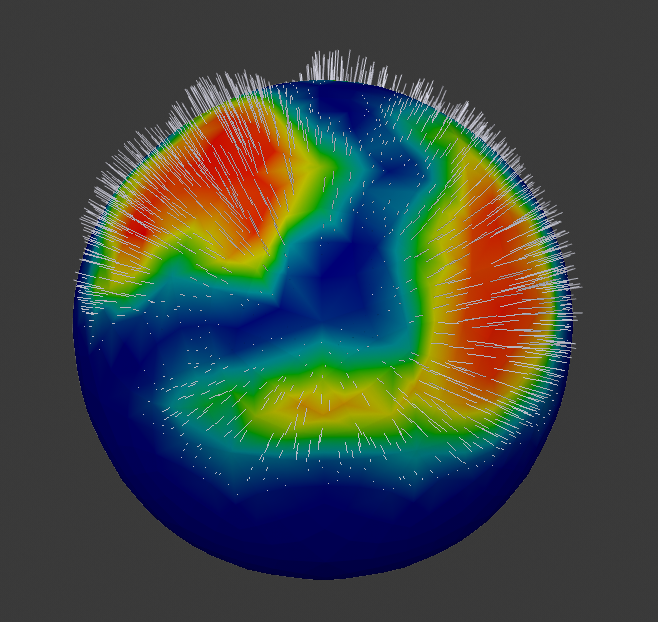
Weight painted particle emission.
In example faces or vertices with zero weight generate no particles. A weight of 0.1 will result in 10% of the amounts of particles. This option “conserves” the total indicated number of particles, adjusting the distributions so that the proper weights are achieved while using the actual number of particles called for. Use this to make portions of your mesh hairier than others by weight painting a vertex group, and then calling out the name of the vertex group in the Vertex Groups panel Properties ‣ Particles tab .
© Copyright : This page is licensed under a CC-BY-SA 4.0 Int. License. Last updated on 05/17/2023.
[SECTION 1]
Here are different types of Objects you may encounter in Blender: 

We will focus on only 2 Object Types:
— Armature Object
— Mesh Object
[SECTION 2]
The 3D model is the Child.
The Skeleton is the Parent.
Wherever the Skeleton moves, the 3D model follows. 
In Blender, you parent the Mesh Object to the Armature Object, then you can continue with the Weighting or Weight Painting process (explained later).
Select children first, then select the parent last.
Hotkey: CTRL + P [Opens the Parent Menu]
[ Object ]
[ Armature Deform ]
[ Armature Deform with Empty Groups ]
[ Armature Deform with Automatic Weights ]
[Armature Deform with Envelope Weights]
[SECTION 3]


[SECTION 4]

What is the purpose of Vertex Groups?
Click Here to Show
- Vertex Groups can be used for organizing and making it easier to Select/Deselect vertices/faces on a Mesh.
[Example: If your character is a singleMesh Object, you can assign different parts of the character (Hat, Weapon, Jewelry, Clothing, etc.) into their own Vertex Groups, which will make it easier to separate them later as their own Mesh Objects.]
- Vertex Groups can be used for physics simulation/collisions.
[Example: Assign vertices from clothing, hair, or breasts to react to physics] - Vertex Groups can be used as Bone Vertex Groups for rigging/weight painting.
— https://streamable.com/n73te
[Example: Assign vertices from the character’s left upperarm to the Vertex Group «upperarm_L» (bone name) with a weight value from 1 to 0 or 100% to 0% ]
Weight influence 100%(Red) — 0%(Blue)
This will be explained later in the guide.
[SECTION 5]


How to Prepare/Clean the 3D model before rigging?

Example 1: [Symmetry]

Example 2: [Alignment]

Example 3 [Bad Seams]
In Example 3, you will want to join all the Mesh Objects together before rigging, to avoid the seams.
Select all the Mesh Objects and join them together CTRL+J.
Afterwards, in [Edit Mode], select the seams (overlapping vertices) and Remove Doubles or Merge by Distance.
Later in the guide, you will learn how to separate the Mesh Objects.

![[Demo: Non-Manifolds 1]](https://i.imgur.com/Vur01s6s.jpg)
Example 4 [Bone Heat Weighting: failed to find solution for one or more bones]
- Overlapping mesh parts:
— armor, clothing, hair, tactical gear, ammo pockets, holstered sword - Internal mesh parts:
— eye balls and teeth
[SECTION 6]
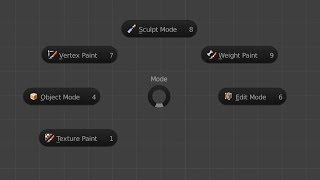
How to properly switch to Weight Paint mode?
[SECTION 7]

Methods for Assigning Weights
Method: [Weight Painting]

— Weight Painting is recommended for high quality rigging.
— Make weight painting in Blender 2.8 similar to Blender 2.7 by disabling Lock Object Modes (Optional).
— Right click video to change speed.Normalize Weights — Tip
Normalize Weights — TroubleshootWeight Paint — Vertex Selection Masking
Weight Paint — Face Selection Masking (Bug Fixed in Blender 2.81)
— Select a Face or Vertex: CTRL+LEFTCLICK
— Select multiple Faces or Vertices: SHIFT+LEFTCLICK
Method: [Vertex Weights Panel]


The Vertex Weights panel is only available while Vertex Selection Masking is enabled.
You can open the Vertex Weights panel with the N key.
You will only be able to view/edit the weights of individual vertices, one vertex at a time.
This is a great way to troubleshoot weighting issues:
— [Example 1] [Example 2]
You can also copy the weight values from one vertex to another:
— [Demo]
Method: [Automatic Weights]
— It’s a quick way to weight the mesh object(s) to the bones in the Armature.
— It’s not always perfect.
— If you take a look at the Vertex Groups, weight values will have already been generated for each bone (Bone Vertex Group).Fixing Automatic Weights Demo:


— Right click video to change speed.
— Vertex Weights Panel [INFO]View Clipping Region:
— Use View Clipping Region to easily work in difficult areas in a 3D model.
— Demo: View Clipping Region and Weight Paint [Starts at 04:10]
— Blender 2.8 Shortcut: ALT + B
Method: [Assign Automatic from Bones]

[Blender 2.7 Demo]
Similar to Automatic Weights, except it is for individual bones.
Method: [Transfer Weights]


Great for clothes or other loose parts.Related:
Transferring Armatures and Weights from One model to Another
How To attach Clothes to A Rigged Character Mesh In Blender 2.8
Method: [Parent to Bone]

— First select the Mesh Object and then the Armature Object.
— Switch to Pose Mode and select a Bone.
— Press CTRL+P.
— Set Parent to Bone
Great for simply attaching something to a bone:
— Glasses —> Head Bone
— Gun —> Thigh Bone
— Knife —> Calf Bone
No weights or vertex groups needed.
[SECTION 8]

Rigging a Face
[SECTION 9]

Shape Keys
- Introduction to Shape Keys:

— To make things easier, use Proportional Editing. - Blinking Eyelids with Shape Keys:

— To make things easier, use the appropriate Pivot Points. - Mouth Shape Keys:
— To make things easier, use Proportional Editing.
How To Use And Control Vertex Groups In Geometry Nodes?
There are a near-limitless number of ways that we can control our geometry using the geometry nodes system including the ability to reassign, rotate, and redistribute the various points of our mesh geometry. With many tools, we can take this control to greater heights by using vertex groups.
A vertex group becomes a custom attribute in geometry nodes which when created can be found in the points domain of the spreadsheet. Connecting a parameter to a group input node will then allow you to call that vertex group by pressing the cross button in the modifier. It can then be used to control where a node affects a model, like isolating the top face of a cube.
There are other ways that we can use vertex groups in our node-setups as well, including using said groups to distribute instanced geometry or defining the areas of the model that are extruded.
The Traditional Way Of Assigning And Selecting Vertex Groups
In order to use vertex groups in geometry nodes, we first need to assign them to our objects. If you do not know how to assign geometry to a vertex group, it can be done in two simple steps.
The 1st step is to go into edit mode for your object and then select the vertices that you want to have as your vertex group. In our example below we have selected the top four vertices of our cube to be assigned.
The 2nd step will be to assign our selection to a new vertex group, which we can do so by going to the object data tab in the properties panel, which has the icon of an upside down triangle.
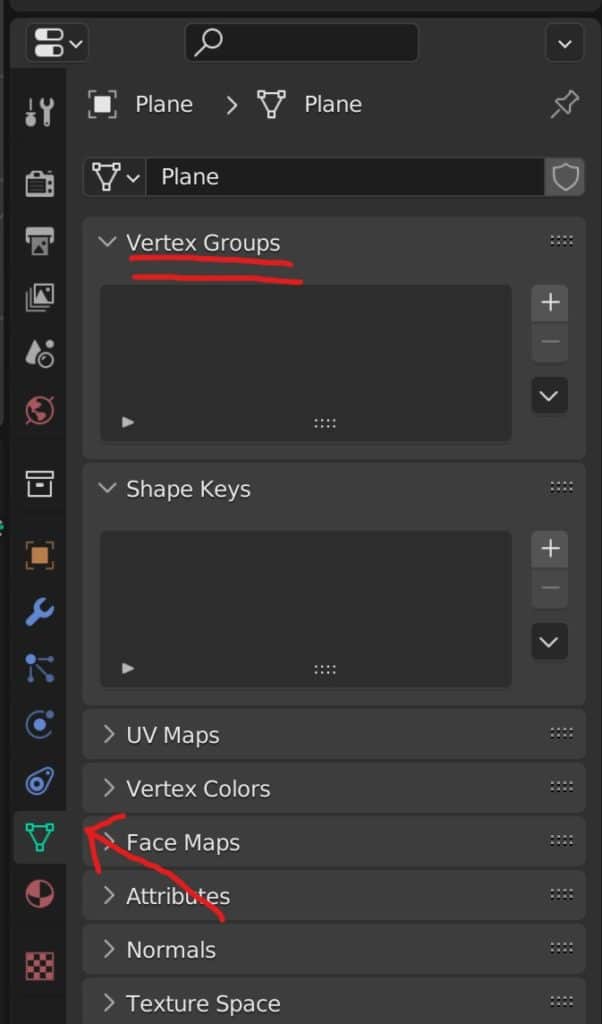 Vertex Group Location
The first drop down in this tab will display the vertex groups assigned to the current mesh data. It should be empty if you do not have any other vertex groups already. Click on the add button to ad a new vertex group to the menu.
Double left click on the name in the list to rename the vertex group that you created. For our example we are going to name it as top face.
You should still be in edit mode at this point and so you will see four options directly below the menu to either Assign, Remove, Select, or Deselect.
If you choose the assign option then all of the selected geometry will be assigned to that vertex group. Note that we can create as many vertex groups as we need, and that a vertex can be assigned to multiple vertex groups.
Remove will subtract our selected geometry from a vertex group if it was previously assigned, while the select and deselect option allow us to select a vertex group with a single button press.
Make sure to press the assign button with your geometry selected to connect them to the vertex group that you made.
For our example we are going to select the vertices at the bottom of our cube, press the plus button and then rename the new group as bottom face, then click the assign button. This will give us two vertex groups to work with.
Vertex groups can be used with many other tools in Blender such as certain modifiers. For example, you can use the bevel modifier and restrict the bevel to the vertex group.
Can We Create Vertex Groups Using Geometry Nodes Instead?
When using geometry nodes, there are various ways in which we can define our selection for our node systems. Many of our nodes will have a selection input that will allow us to dictate what part of the model is affected by that specific node.
We also have the ability to assign special values known as ID values to our individual points, edges or faces. However, at the time of writing, there is no known node that is going to allow us to create a vertex group directly depending on a defined selection.
This is not necessarily a bad thing, however, as it’s very easy to create our vertex group using traditional methods of selection in the 3D viewports, and then begin using that vertex group as an attribute in blender anyway.
Once we have created a vertex group using traditional methods, that vertex group will be displayed under the vertex domain in our spreadsheet. So there is really any need or requirement to be able to create that vertex group in the node system itself.
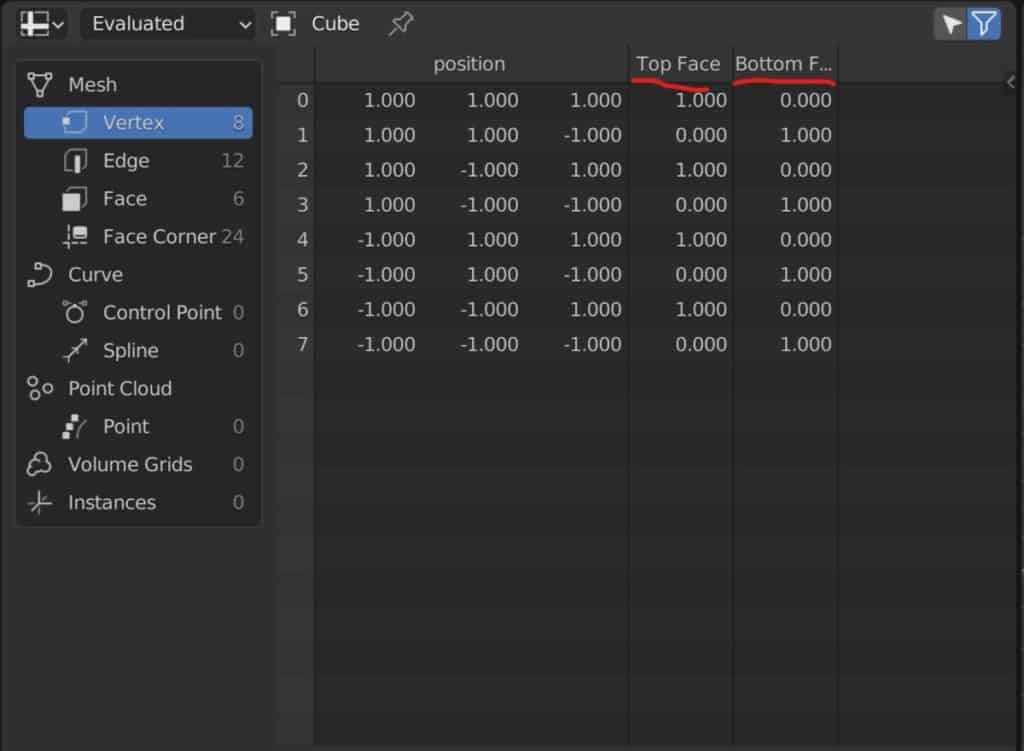 Vertex Groups In The Spreadsheet
Also note that if we were to create a vertex group using a specific set of nodes within our geometry node system, then that vertex group would only be usable within that geometry nodes set up as it would be based off of the geometry created by that node system.
This is another reason why the current setup is so beneficial to just create vertex groups traditionally so that we have the flexibility of using those vertex groups outside of the geometry node setup.
If you want to learn more about Blender you can check out our course on Skillshare by clicking the link here and get 1 month free to the entire Skillshare library.
Using Your Vertex Groups Through Geometry Nodes
In Blender we are able to call out attributes when using specific nodes in our geometry nodes system and this includes custom attributes that we create such as vertex groups.
To recap, a custom attribute is a form of data that is defined by the user rather than being predefined in blender. For example, the index value of each individual vertex is predefined and will already be visible even before you create a new geometry node system in the spreadsheet.
A vertex group on the other hand, is something that you yourself as the user creates, which is why it is considered a custom attribute that does not display in the spreadsheet until it is created and defined.
Let’s now take a look at a couple of ways in which we can use vertex groups in geometry nodes. The first example is going to be defining which of our vertices are going to be affected by a set position node.
We can see a very basic setup where the set position node is being used to manipulate the positioning of the individual points.
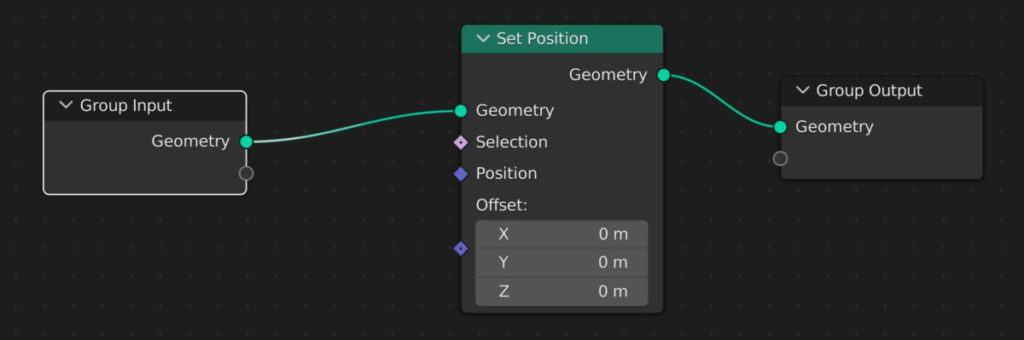 Set Position Set Up
So long as the set up is not defined by any selection, the entire model is going to be manipulated by the offset value. We are going to want to define the vertex group for use by the set position node so that only those vertices are affected.
The easiest way to do this is to click and drag your selection input from a set position node and connect it to the group input node. This will expose the selection as a parameter in the geometry nodes modifier.
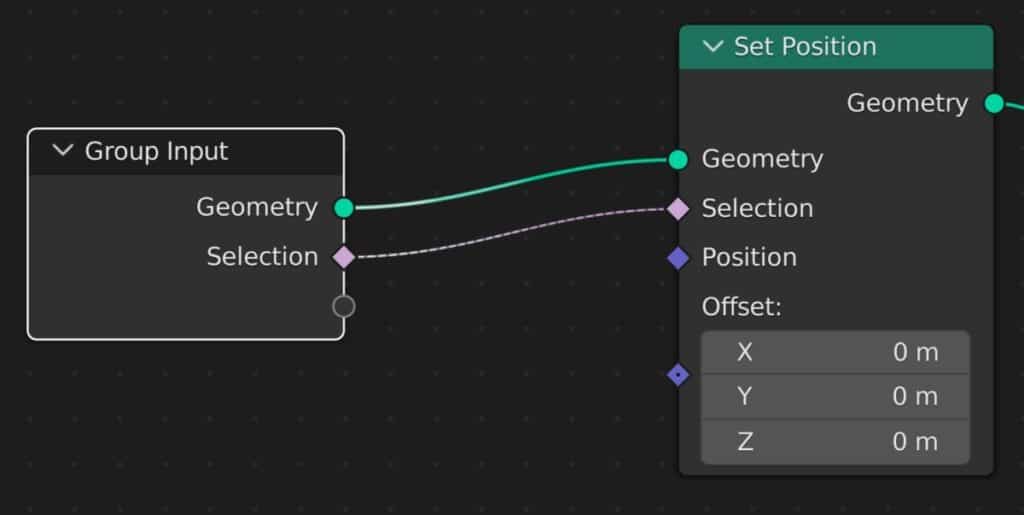 Attach To Group Input
For the parameter in the modifier, you will notice that there is a cross button next to a numerical value. At the moment, because we are using selection data, that numerical value is either going to be zero or one and does not allow us to do anything specific.
So instead what we are going to do is click on that cross button and this is going to allow us to define our selection with an attribute.
When you click on the empty box that appears in place of the number, you will get a list of all of the current attributes that are assigned to the various domains of your model. At the bottom of this list will likely be the vertex groups that you have created.
In our example, we are going to select the top face attribute. If we now attempt to manipulate the offset values of the set position node, you will notice that only the vertices that were assigned to that top face have been manipulated by the set position node. 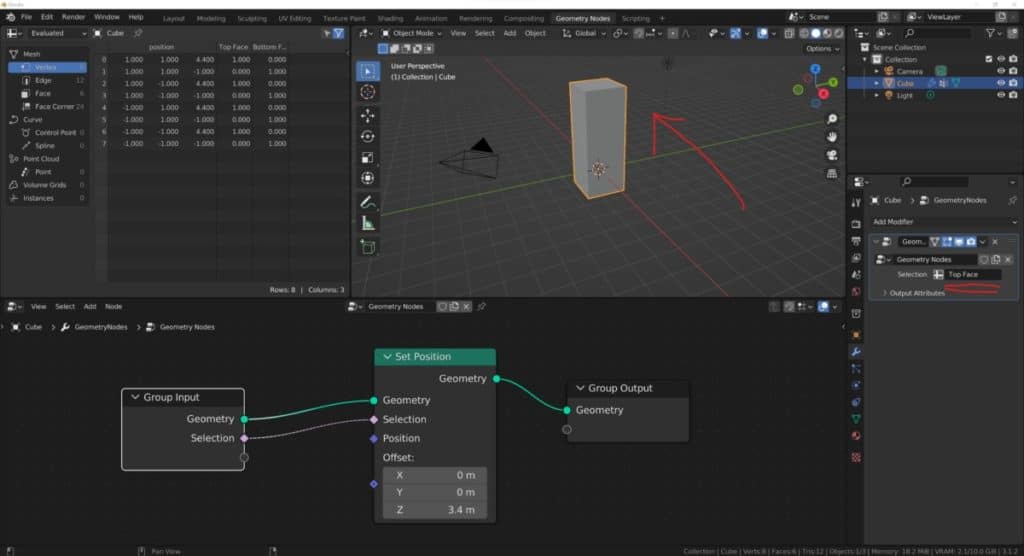 Top Face Attribute Defined
We can change the defined attributes at anytime by returning to that parameter in our modifier, clicking on it, and then selecting another attributes from that menu. For example, we could select the bottom face attributes and then when we manipulate the set position node it will affect the bottom vertices instead.
Another example of using vertex groups with our geometry node system is to determine which parts of our model are smooth shaded. For example, we could add a set shade smooth node to the set up, and then connect our selection input to another empty socket of the group input node. Go to the modifier, and then click on that cross button to enable attribute selection.
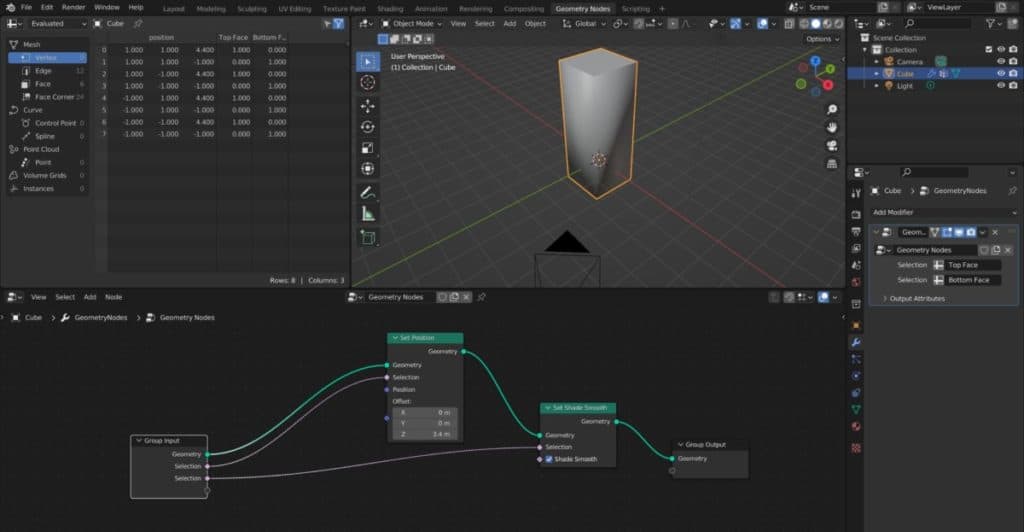 Set Shade Smooth Vertex Group Assigned
We can then choose the custom vertex group that we want to use to define which of our vertices are going to be given smooth shading. As you can see in the example below.
Not all nodes will work with vertex groups in the same way, so it’s important to experiment with the various nodes and how they can be influenced by our vertex groups.
When sculpting or texture painting in Blender the best method is to always use a graphics tablet. But these come at many different price points and forms. If you want to get started with sculpting using a graphics tablet then we recommend this as your starting point. It served us well for over 4 years before we upgraded to a more expensive tablet ourselves.
What Else Can You Do With Vertex Groups And Geometry Nodes?
Another way that we can use vertex groups in geometry nodes is to define the positioning, for instance geometry. For example, let’s say I wanted to create a plane with grass and rocks. I want to create a pathway that is made out of the rocks going through my geometry.
The rest of the model is going to be the grass. I can use my vertex groups to determine the location of each set of instance geometry. Let’s take a look at this as an example.
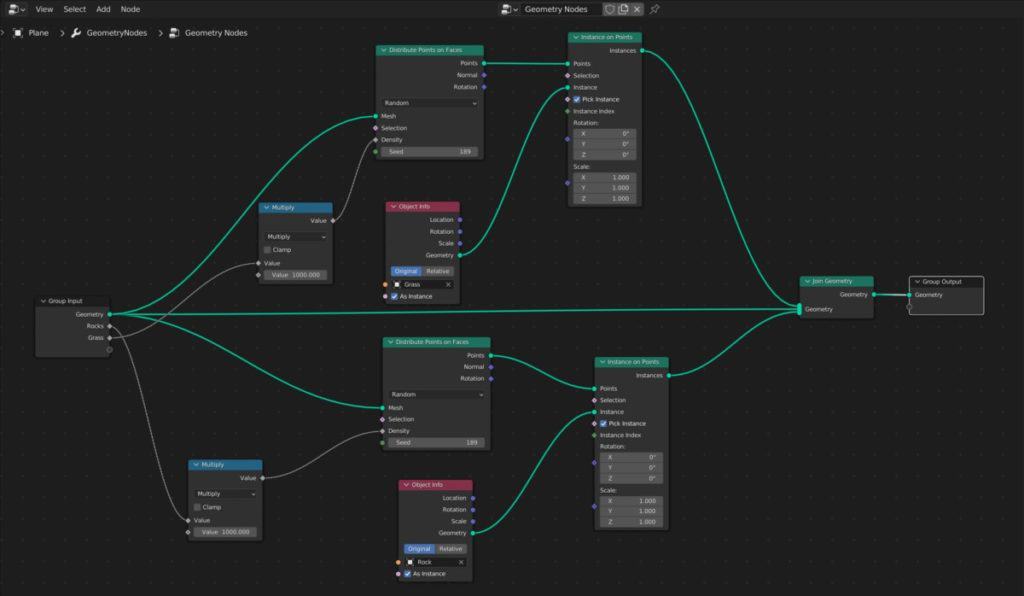
The base set up here is going to start with a plain object that has been subdivided in the 3D viewport a total of 100 times to give it plenty of density.
The assets that I will be using for my example are simple primitive objects that are just undergone a slight change. For example, my grass asset is just a plane that has been rotated and had a couple of loop cuts added to it. While the rock asset, on the other hand, is simply a Ico sphere.
Another way of creating a vertex group from what we have already discussed is to use weight painting in blender.
If you do not have any vertex groups, then you can go into weight painting mode and begin to paint onto the surface of your plane object. When you are finished with your white painting, a new vertex group will be added which you can then rename appropriately.
For example, we can create a couple of paths on our plane using weight painting and then name the generated vertex group as rocks.
We can then use our instance on points node as well as our distributes points the faces nodes to define our instancing where we can position our rock vertex group. You can see an example of this with the setup that we have generated below. 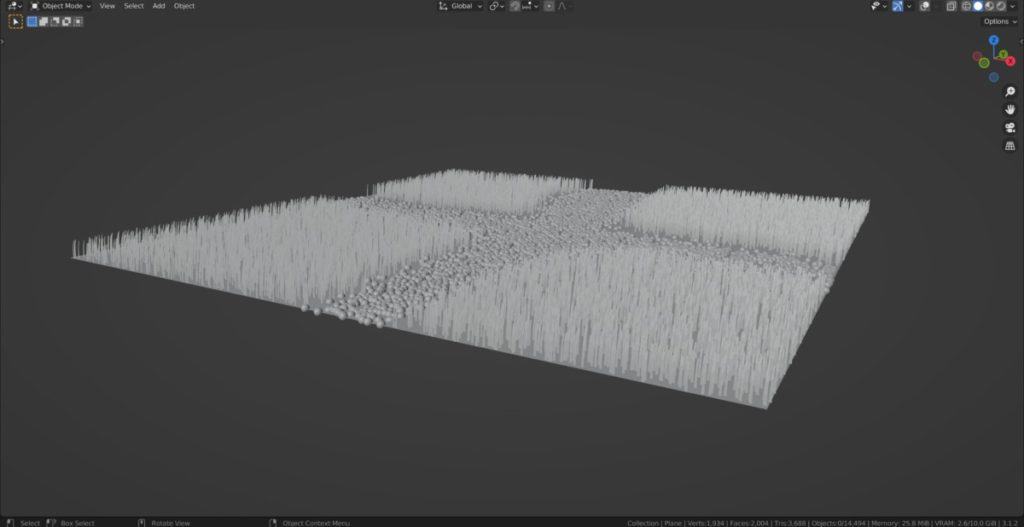 Result Of Using Vertex Groups For Instances
Thanks For Reading The Article
We appreciate you taking the time to read through the article and we hope that you have been able to locate the information that you were looking for. Below we have compiled a list of additional topics that are available for you to view and learn more about Blender.

How To Change The Frame Rate In Blender?
The process of creating animations can be divided up into two sections. One section involves the workflow of creating the animation itself by creating objects with materials, appropriate lighting, and
How Does Viewport Shading Work In Blender?
All 3D scenes in Blender are a combination of various properties ranging from the various types of geometry to materials and lighting effects. The viewport allows us to toggle which
The Different Ways That We Can Separate Objects?
There are a variety of ways in which we can manipulate the geometry used to construct our mesh objects. There are also several tools that can be used to manipulate
How to weight paint in Blender
There are many times in Blender where we will need to setup vertex groups and weight paint, whether we’re creating an armature or setting up a vertex group to distribute particles. So how do we weight paint?
To Weight Paint in Blender:
- Select the Object to weight paint and navigate to Properties > Mesh Data > Vertex Groups, click on the + icon to add a vertex group if the object doesn’t already have one
- Set the Object Interaction Mode to Weight Paint
- Paint the weight map, or you can also select another vertex group to paint while in the Weight Paint Mode
In the rest of this article, we’ll go into more detail about weight painting, a few tricks we can use to streamline the weight painting process and explain the weight painting process for armatures.
What are Vertex Groups
To understand weights, we will first need to go over what a vertex group is, for a more in-depth explanation on Vertex groups check out the article linked below.
Vertex groups are a collection of values for each vertex on a Model, they basically let us assign a «weight» to each vertex that we can later use for example to distribute particles.
Vertex groups are like masks for each vertex of a model, modifiers use them to control which vertices are modified and armatures create a weight map for each bone that will tell the model which vertices to move with which bone.
We cannot weight paint on a model unless it has a vertex group setup.
How to setup a Vertex Group
To setup a Vertex Group first select the object you want to add a vertex group to. Go to the properties > Mesh Data > Vertex Groups and click on the + Icon.
From here we could tab into edit mode and manually assign vertex weights using this window but that should only be used if for example we want to remove a select from a group or assign a certain weight to an area. Instead, we’ll be using Weight Paint mode to visualize the weight map as well as adjust it.
Weight Painting
To weight Paint select the object we are weight painting and set the object interaction mode to Weight Paint.
Now that we’re in weight paint mode we can see the models weights, this will usually turn the model blue and when we paint weight with the brush it will turn it red. Red is basically full weight or 1 and blue is 0.
The main settings we’ll use when weight painting are Weight, Radius, Strength.
The weight option will adjust what the weight value we paint, it will act as a limit for how strong of a weight we can paint, strength acts like the opacity of the brush.
We can also change which Vertex Group we’re painting by navigating to Properties > Mesh Data > Vertex Groups and select another vertex group if we have one.
If we want to manually adjust weights we can do so by switching the object interaction mode to edit, selecting the vertices we want to adjust and changing the weight and clicking assign in the Vertex Weights panel.
For an in-depth explanation of each option available in Weight Paint mode checkout the Blender Manual.
Weight painting for armatures
Just to give a quick summary of how weight painting works with armatures, each bone gets it own vertex group, when we move a bone Blender will move each vertex using its weight as the factor.
While we could manually set all of this up Blender will automatically handle the weight groups if we use the right parenting option for our object.
First let’s parent our object to the armature. To do this select the object first and then select the armature. We’ll know that we have the selection right when the object outline color is orange, and the Armature is yellow.
Press Ctrl + P and select automatic weights which will try to automatically set the weights for each bone or empty groups if you want to manually paint the weights for each bone.
Next select the object and set the object interaction mode to weight paint, on the right you’ll see that Blender has created a vertex group for each bone. We can switch between these vertex groups to paint the weight maps for each bone.
As long as a vertex has any amount of weight it will stick with a group even if it doesn’t have a combined weight of one. the weight is only taken into account when another vertex group also has a weight for that vertex.
Select bones while weight painting
While switching through vertex groups is fine for less complex armatures it can quickly become cumbersome. To Speed up this process we can instead just select the bone we want to weight paint for.
To set this up first select the armature and then the object we’re weight painting and set the object interaction mode to Weight Paint. We can now select a bone and blender will automatically select the Vertex Group for that bone.
Automatically assigning weights per bone
If we have our armature selected while we’re weight painting we can also automatically assign weights for that bone again by select the bone then going to Weights and either selecting assign Automatic from bones or assign from envelop.
Assign from envelop is kind of like a radius around the bone that will have weight applied to it, we can adjust this radius per bone by selecting the armature, going to edit mode and selecting the bone we want to edit. Go to the properties tab > Bone Properties > Deform and here we can adjust the Envelope Distance and Weight.
The distance will affect how large of a radius around the bone gets weight and the weight will adjust how much weight that radius gets.
Clearing unwanted weight assignments
Depending on the complexity of the model the automatic weight can be a bit weird and cause issues with deformation. Sometimes the automatic weights will grab vertices from seemingly unrelated parts of the model but only at a very small amount of weight.
The quickest way to fix this issue is to first select the object and set object interaction mode to edit
Select the affected vertices then navigate over to Properties > Mesh Data > Vertex Groups.
In the Vertex Groups panel, we can go ahead and remove the selected vertices from any groups we don’t want it to be affected by, if there’s too many groups to go through, we can also just remove the selected vertices from all groups, but we’ll have to go back and reconfigure their weights.
To remove vertices from all groups click the dropdown just under the + and — buttons in the Vertex Groups panel and select Remove From All Groups.
Weight averaging
Another thing to note is that if two vertex groups have a weight of 1 for the same vertex Blender will average out their influence, if you have a weight set to 1 but the vertex isn’t sticking with that group make sure that there isn’t another vertex group that has influence over it.
Normalizing Weights
One quick way to make sure that no vertex has a combined weight of more than 1 is to normalize the weights.
In the weights tab we can select normalize all when we have a weight map selected, this will subtract from any weights that combine to be more than 1. When we select normalize all Blender will subtract from all other weights so that no vertex has a combined weight of more than 1.
Note that Blender does this internally, normalizing the weights is helpful for visualizing how Blender adjusts the weight values to bring them down to 1.
Final Thoughts
Vertex Groups and Weight Painting are both very useful and knowing how they work can allow us to achieve more with Blender and speed up our workflow.
Having an idea of how to weight paint as well as how normalizing and multiple weight groups interact makes working with armatures a little more intuitive and helps us get better deformations on our models.
Knowing a few tricks like how to select a bone while weight painting can help with speeding up the process of weight painting. It also helps with achieving a better result and knowing how fix some of the common issues we run into while weight painting.