Python или JavaScript — что выбрать

Сфера программирования развивается уже достаточно давно, но пожалуй только в последние 5-10 лет получила особенно массовое распространение, как среди тех, кто еще только учиться в школе, так и тех, кто уже получил профессию и хочет сменить ее на более перспективное ремесло. Такой взрывной рост популярности, обусловлен не только хорошими зарплатами и востребованностью на рынке труда, но и доступностью навыка. Еще какие-то 15 лет назад, освоить любой язык программирования казалось большинству непосильной задачей вне рамок специализированного учебного заведения. Сегодня в сети доступно огромное количество материалов с помощью которых научиться программировать может практически каждый, было бы желание и время.
Такое быстрое развитие и популяризация программирования породила свои сложности при вхождении в сферу. Первое это конечно поиск актуальных и профессиональных курсов, преподаватели или составители которых способны донести до учеников знания полно, системно и за адекватную цену. Второе это правильный выбор языка программирования. Остановитесь вы на JavaScript или Python будет играть важное значение и предопределит характер вашей деятельности на ближайшие пару лет, а то и больше.
Популярные онлайн-университеты
Python
Этот язык программирования считается практически универсальным, на нем можно делать сайты и игры, развиваться в тестировании, поддерживать сервера, заниматься машинным обучением. Казалось бы, что раздумывать, можно приступить к изучению Python, а сферу выбрать уже потом. Но на деле оказывается, что у языка есть своя специализация и это работа с данными и тестирование. Это не означает, что вы не сможете найти на рынке работу в сфере web-программирования на Python, но ее будет на порядок меньше, чем тот же web но на JavaScript.
JavaScript
JS наряду с Python считается универсальным языком, но как и в примере выше есть направление, которое затмевает все остальные и это веб-сайты и приложения. Вокруг JavaScript сложилась отменная инфраструктура, с различными фреймворками и библиотеками, которые позволяют делать сайты и приложения быстрыми, адаптивными и функциональными.
Что легче Python или JavaScript
Одним из критериев при выборе первого языка программирования является его простота в изучении. Python считает одним из самых легких, у него дружественный синтаксис и он прост в усвоении. Однако обучающих курсов, мануалов, готовых скриптов, библиотек и фреймворков больше именно у JavaScript. Также стоит учитывать, если вы хотите заниматься анализом данных на Python, что работодатели будут ожидать от вас технического или математического образования.
Где больше открытых вакансий
На момент написания статьи по запросу Python в Москве на hh.ru выводиться 7031 вакансия, по запросу JavaScript — 5629. Вырисовывается существенный перевес. Посмотрим по другому: Junior Python — 330 вакансий, Junior JavaScript — 285. Делая выбор между JS и Python посмотрите количество открытых вакансий в вашем городе. Трудно рассчитывать на удаленную работу программистом в начале карьеры.
Где больше платят
Размеры зарплат достаточно сложный вопрос и сильно зависит от стека технологий, которым владеет специалист. Для общего понимания возьмем вакансии по запросу Junior.
Junior Javascript (Москва):
- 102 вакансии — от 70 000 руб;
- 43 вакансии — от 125 000 руб;
- 27 вакансий — от 180 000 руб;
- 15 вакансий — от 235 000 руб;
- 9 вакансий — от 295 000 руб.
Junior Python (Москва):
- 61 вакансия — от 100 000 руб;
- 27 вакансий — от 170 000 руб;
- 18 вакансий — от 240 000 руб;
- 12 вакансий — от 310 000 руб;
- 6 вакансий — от 380 000 руб.
Конечно, не стоит сильно рассчитывать на такие зарплаты в начале карьеры, но цифры дают понимание, что зарплаты у Python разработчиков немного выше.
Популярность языка
Согласитесь будет обидно, если после многих лет изучения и работы с языком программирования, окажется, что он никому не нужен или стремительно выходит из моды. С JavaScript и Python такого точно не случится, по крайней мере в ближайшие годы. Но мы можем сравнить их популярность например с помощью сервиса wordstat.yandex.ru.
В октябре 2021 года запросов в Яндекс связанных с:
- Python: 2 793 007 раз
- Javascript + JS: 1 470 006 раз
Если говорить про динамику роста то относительно прошлого октября 2020 года:
- Python подрос на 32%
- Javascript + JS на 17%
Такая методика определения популярности не претендует высокую точность, ведь по хорошему здесь должны быть подсчитаны все библиотеки, фреймворки и другие технологии связанные с языками. Но для приблизительного понимания этого будет достаточно.
Перспективы роста
Как JavaScript, так и Python активно развиваются последние 5 — 10 лет и серьезных причин почему это развитие должно прекратиться или затормозиться нет. Поэтому обратимся к перспективам не конкретного языка, а сравним Python и JavaScript в сферах веб программирования и анализа данных, попытаясь перечислить технологии которые сейчас в большом ходу.
JavaScript Web: React, Angular, Vue.js, Node.js, jQuery
Python Web: Django, Flask, Pyramid
JavaScript анализ данных: —
Python анализ данных: Pandas, Matplotlib, Scikit-Learn, NumPy, TensorFlow
Проанализировав популярность отдельных приложений можно сказать, что JavaScript в сфере WEB имеет больше перспектив для роста, чем Python, но в свою очередь JS полностью уступает в сфере анализа данных.
Как выглядит код
Если все перечисленное выше не дало вам понимания, что выбрать Python или JavaScript посмотрите на синтаксис, возможно визуально вы отдадите предпочтение тому или иному стилю написанию кода.
Что же выбрать JavaScript или Python
Сравнив языки программирования по популярности, перспективам, легкости освоения, зарплатам и вакансиям стоит признать, что победу хоть и не с большим перевесом одержал Python. Несмотря на вывод не спешите с выбором, посмотрите еще на характер работы с которой вам придется столкнуться, если вы станете разработчиком того или иного языка. Самое простое это пройтись по сайтам поиска работы.
Performance Comparison: JavaScript vs. Python for Machine Learning

In my previous article, I discussed the pros and cons of using JavaScript for machine learning. I delved into whether it performs as well as Python-based solutions on ML tasks. And now, I’ve put the programming language to the test.
I used several models to measure Javascript’s performance in machine learning, benchmarking the actual results against Python-based solutions.
For context: the task we used for the tests was ‘fraudulent financial transactions detection.’
The Dataset
I chose to use synthetic datasets generated by the PaySim mobile money as they include 6,362,620 records of financial transactions — the datasets comprise eleven columns, and below is a snippet of the data.
The dataset includes:
- 6,354,407 legitimate transactions ; and,
- 8,213 fraudulent transactions .
This translates into a 0.1% fraud scale. It’s worth mentioning that fraud only occurs for TRANSFER and CASH_OUT transactions — below, you can find the exact number of transactions per transaction type.
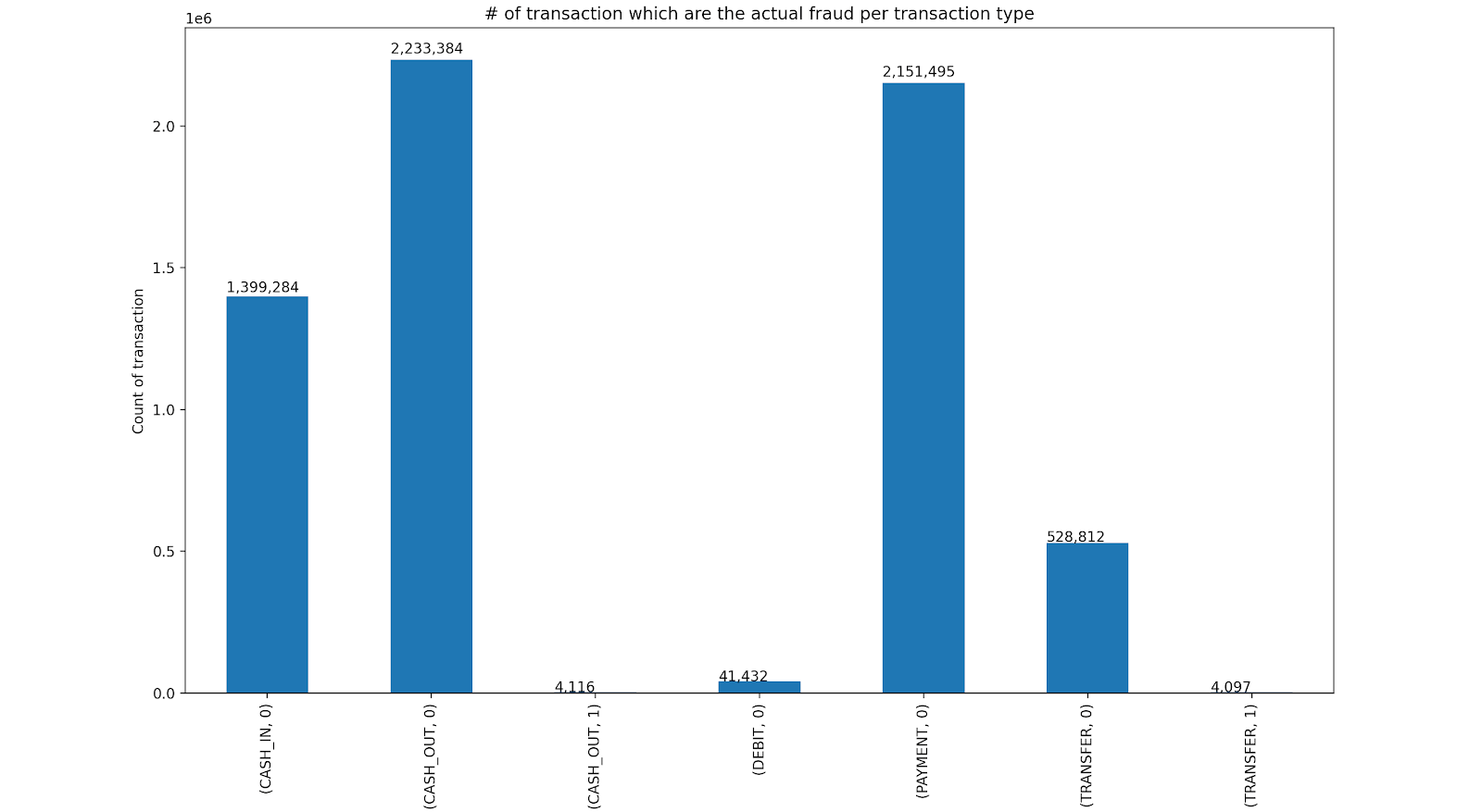
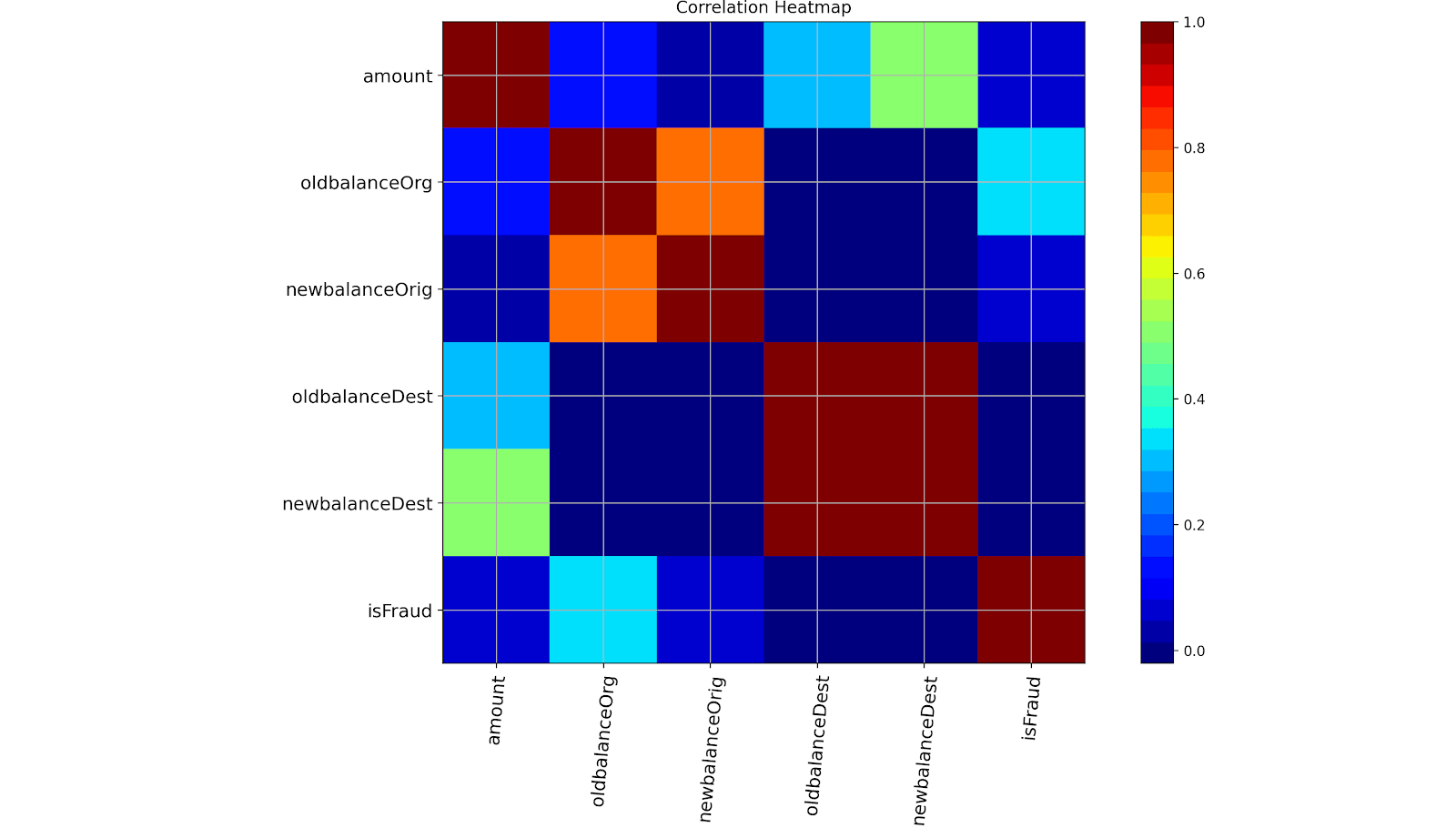
We carried out data analysis and following this, deemed, isFlaggedFraud , nameOrig, and nameDest columns as irrelevant to the result — below, you can find a correlation heatmap between the relevant columns.
Benchmark Environment And Method
The following gives details about the environment and methods used to benchmark the data.
Environment
We performed all tests on machines with the following specifications:
- CPU: Intel Core i7-4770HQ, clocked 2.2 GHz
- RAM: 16GB
- GPU: None
- OS: macOS Catalina (10.15.2)
We used the following software environments:
- Node 12.16.1
- Python 3.7.6
We used the following libraries:
- Python: Pandas, NumPy, scikit-learn, Keras
- JavaScript: Zebras, machinelearn.js, fscore, Tensorflow.js, ModelScript
We carried out measurements for the JavaScript code by calculating the time difference between the Date.now() value at the beginning of a function and the end. We used a broadly similar approach for Python with one exception : we used the time function from the time package.
We measure the execution for the following sections in both programs:
- Data read from the file
- Data preprocessing
- Split into test and train sets
- Learning
- Prediction
We chose just three models for the test:
- Linear Regression
- Random Forest Classifier
- Neural Network.
We measured each metric ten times (on datasets that included all records and reduced to 1m records), and the average results are shown below under the heading, ‘Results.’
Before we look at the results, one aspect worth noting when I reproduced the Python code in JavaScript was the libraries’ immaturity . There have been significant improvements over the years here. Nonetheless, I had to spend a lot of time searching through the libraries to get the same functionality I had with the Python version.
In Python, it’s a breeze. It’s a well-recognized language for machine learning. Therefore, the level of community engagement with the development of libraries is many times higher.
The Results
There are no two ways about it, so let’s cut straight to the chase.
Python wiped the floor with JavaScript — you can see this in the graphs and the full results below.
The Full Dataset
Data read from file 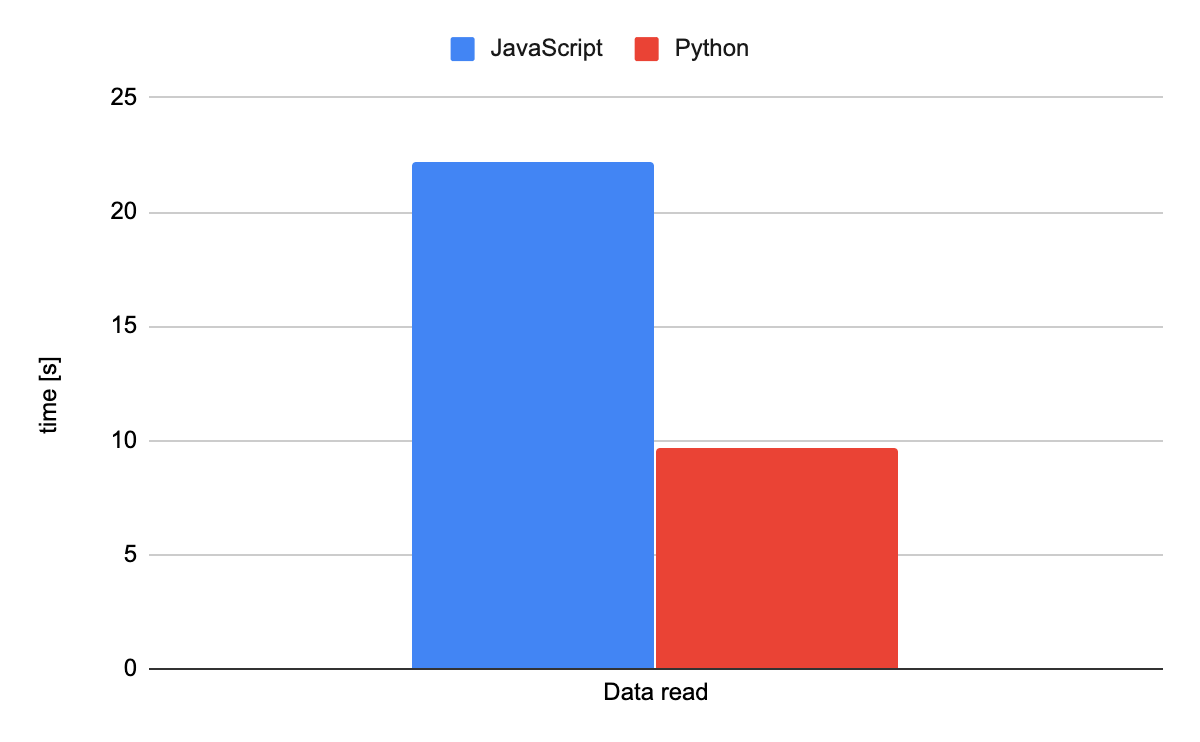
Precise results: JavaScript = 22.197 seconds — Python = 9.669 seconds
Data preprocessing
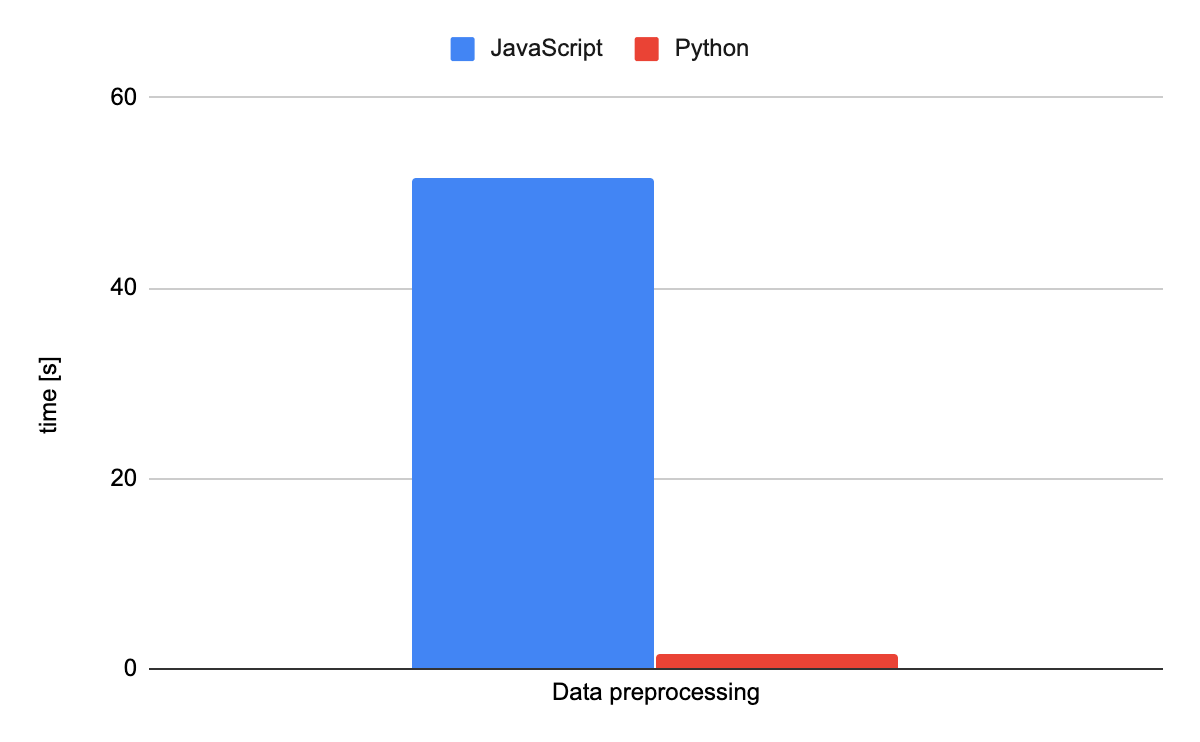
Precise results: JavaScript = 51.667 seconds — Python = 1.580 seconds
Split into test and train sets
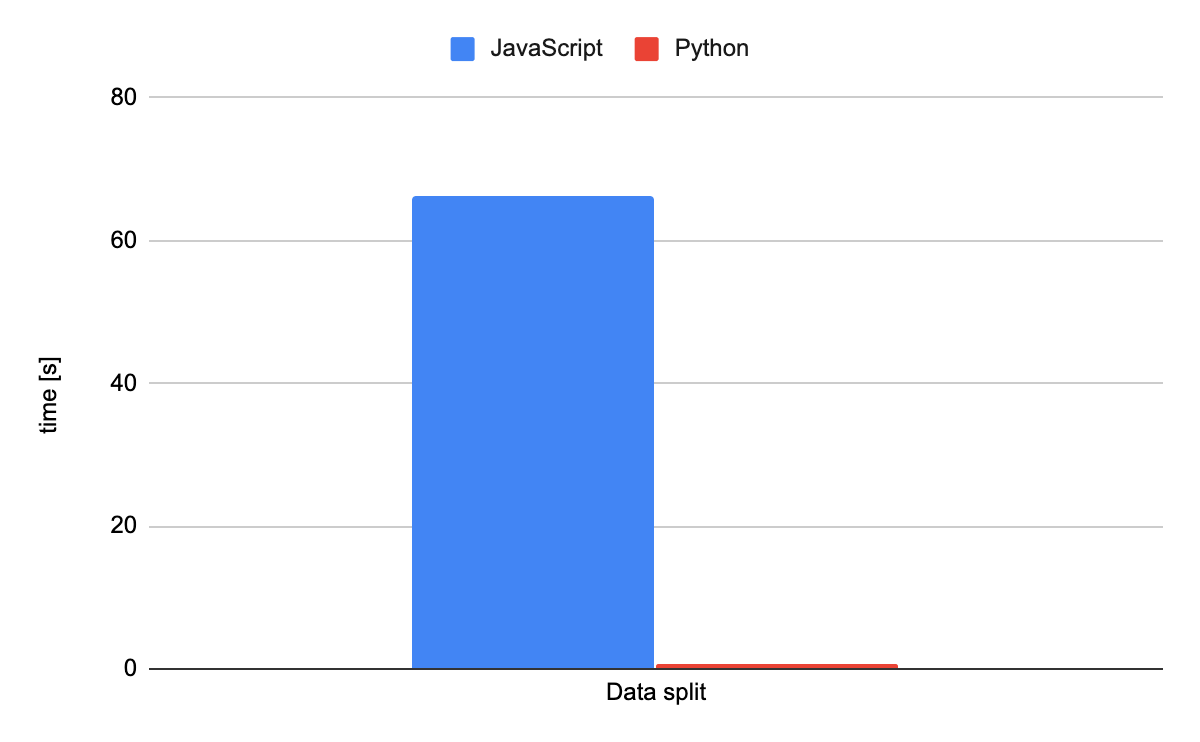
Precise results: JavaScript = 66.238 seconds — Python = 0.646 seconds
Learning and predicting
Linear Regression
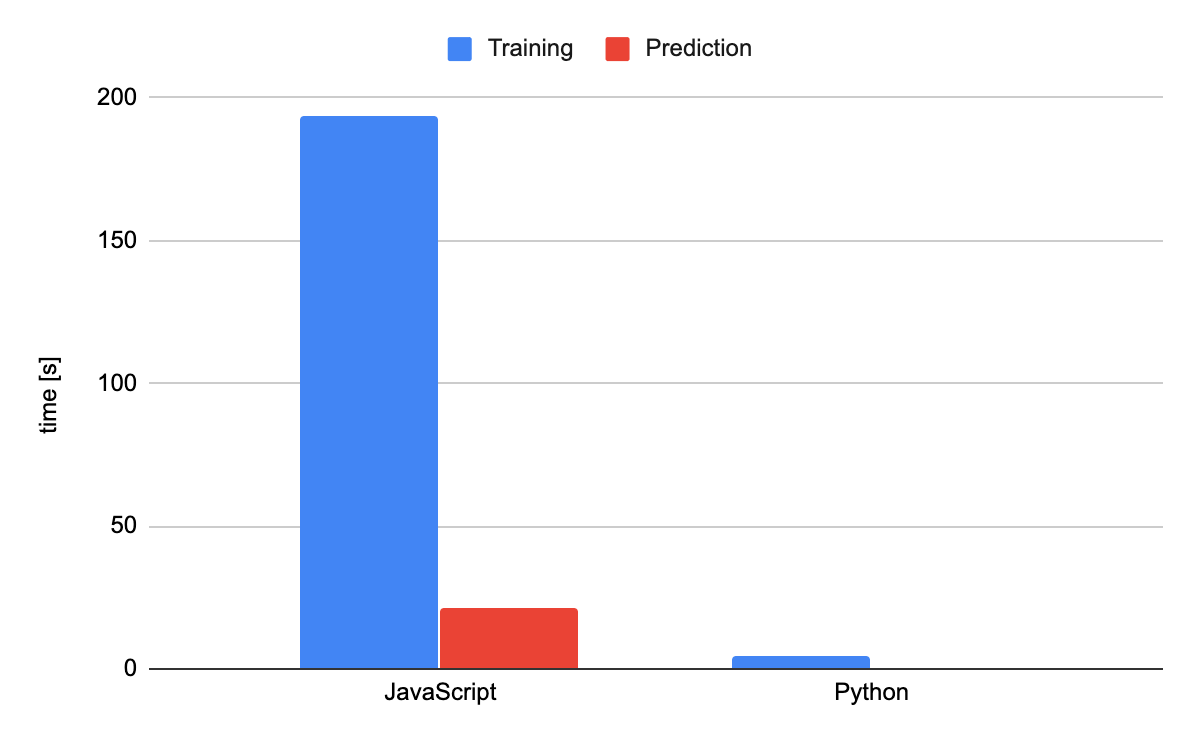
Precise results — Training: JavaScript = 193.436 seconds — Python = 4.728 seconds
Precise results — Prediction: JavaScript = 21.535 seconds — Python = 0.034 seconds
Random forest
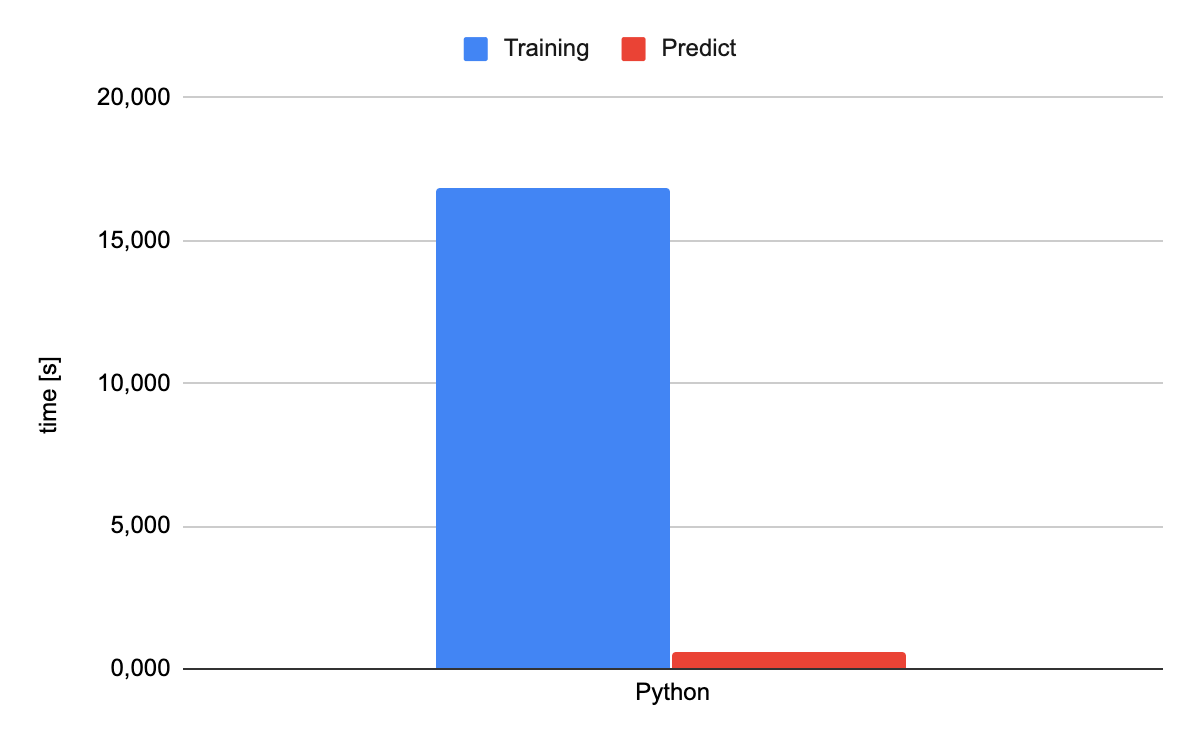
Precise results: Python Training = 16.854 seconds — Python Prediction = 0.588 seconds
No, we didn’t make a mistake. We only got Python results as the truth is… JavaScript never made it.
The process didn’t finish working in the given timeframe.
Neural network
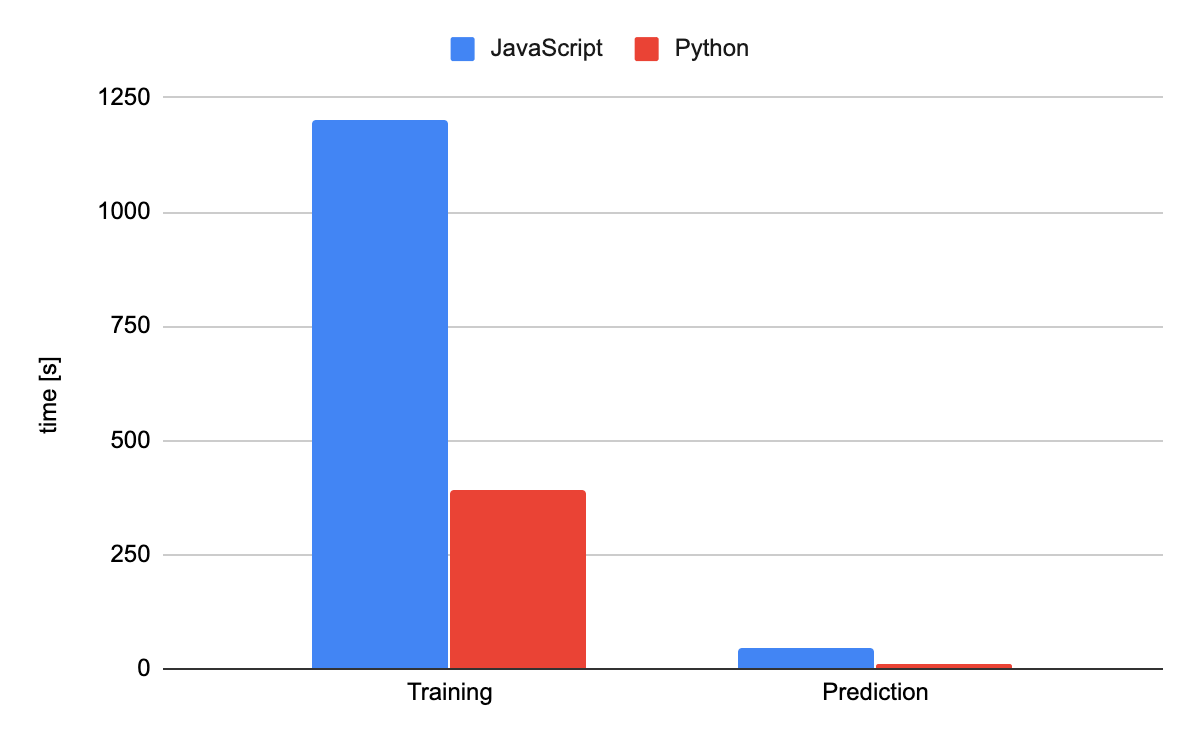
Precise results — Training: JavaScript = 1199.665 seconds — Python = 391.072 seconds
Precise results — Prediction: JavaScript = 46.707 seconds — Python = 12.751 seconds
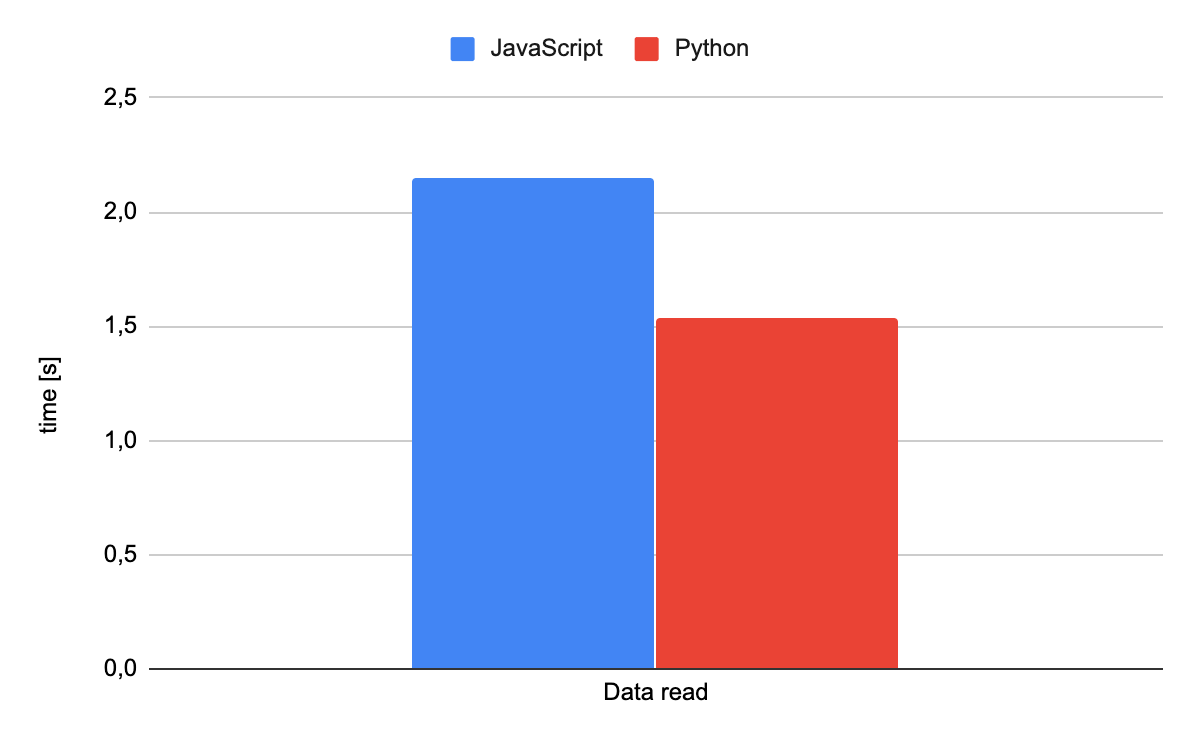
Precise results: JavaScript = 2.148 seconds — Python = 1.537 seconds
Data preprocessing
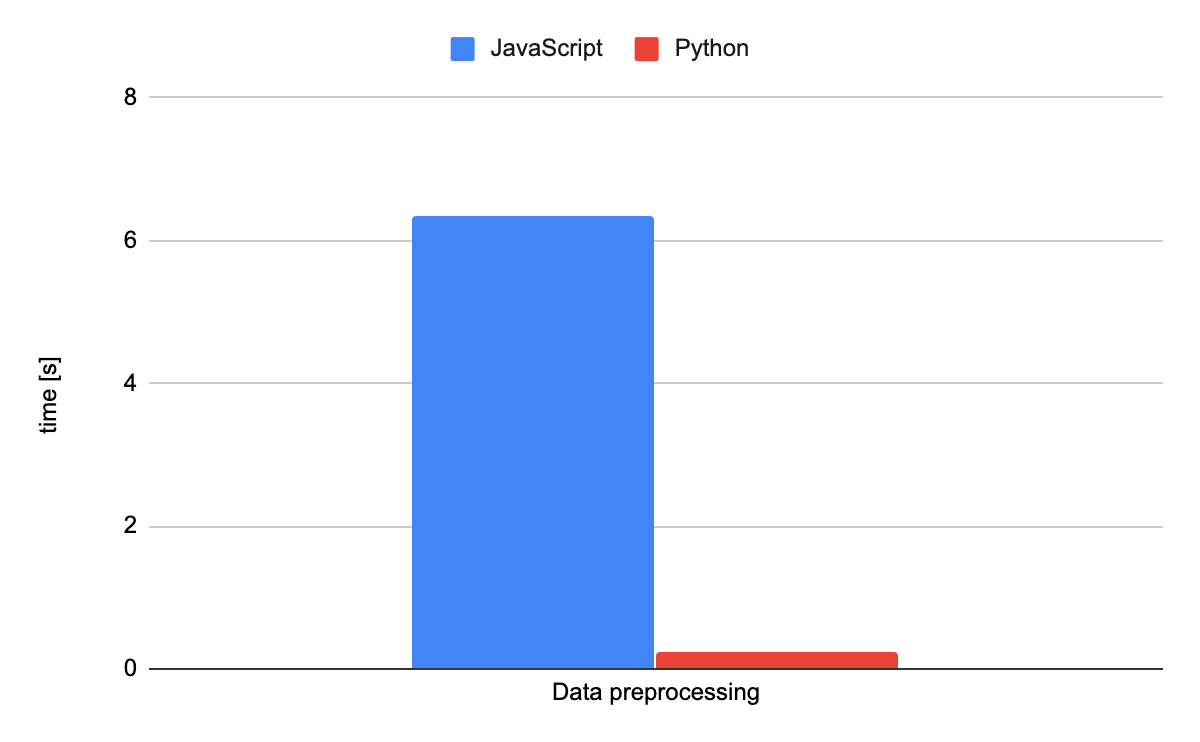
Precise results: JavaScript = 6.334 seconds — Python = 0.248 seconds
Split into test and train sets
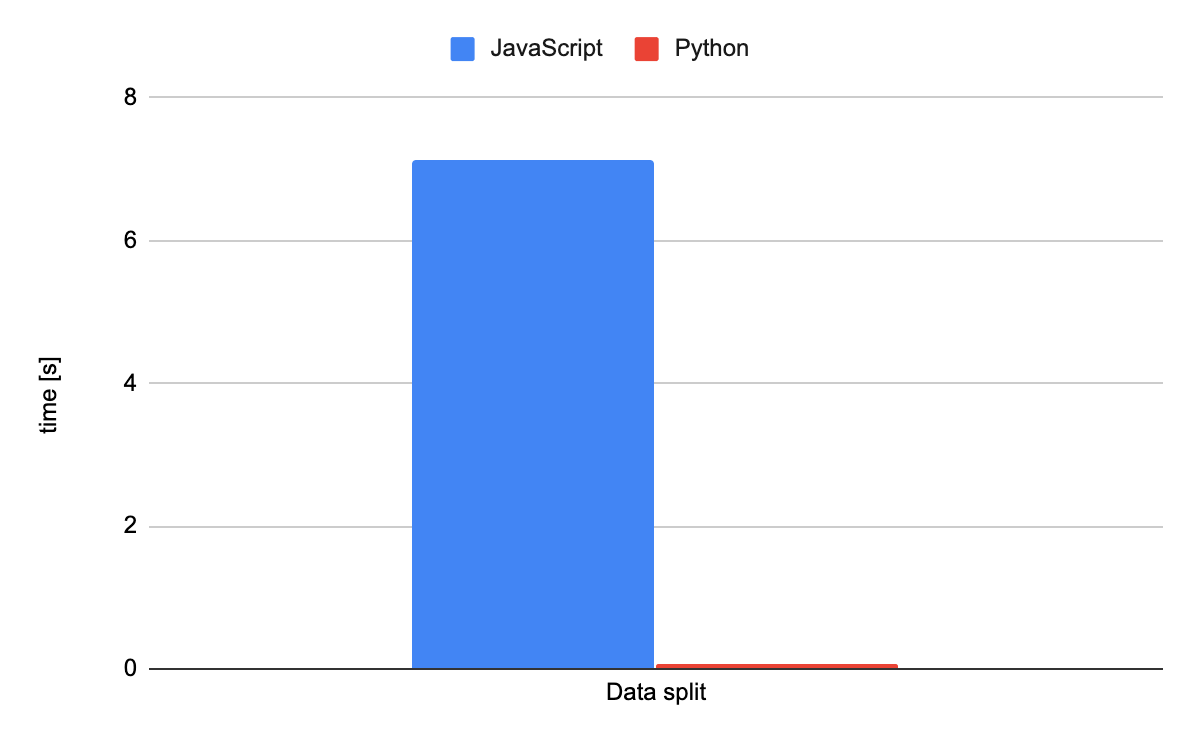
Precise results: JavaScript = 7.116 seconds — Python = 0.068 seconds
Learning and predicting
Linear Regression

Precise results — Training: JavaScript = 30.317 seconds — Python = 0.555 seconds
Precise results — Prediction: JavaScript = 1.942 seconds — Python = 0.004 seconds
Random forest 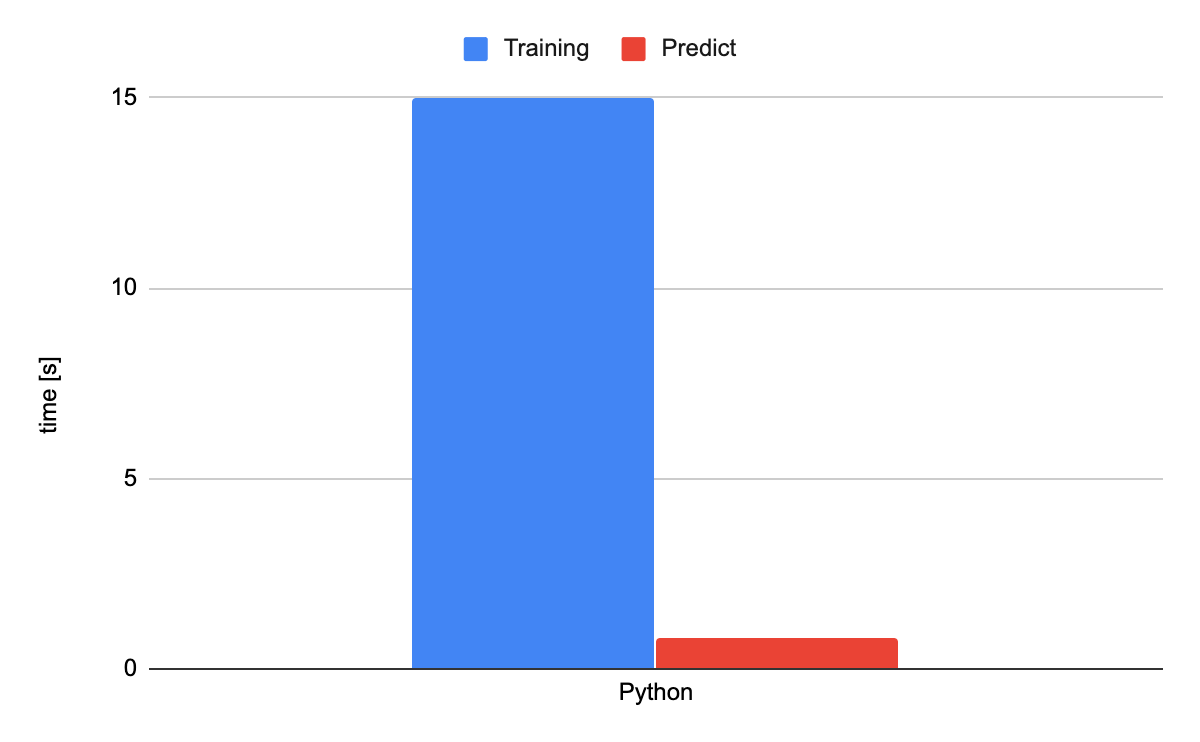
Precise results: Python Training = 14.991 seconds — Python Prediction = 0.799 seconds
Same here as well: we only got Python results — JavaScript once again didn’t finish the process in the given timeframe.
Neural network
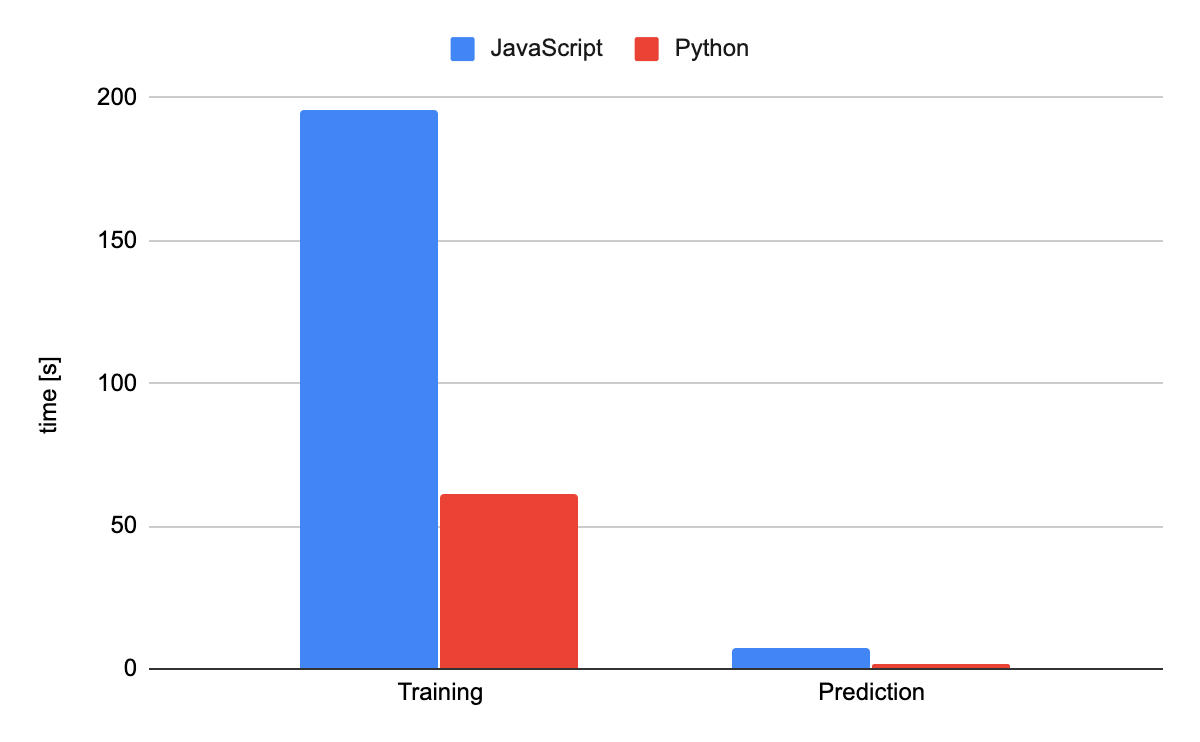
Precise results — Training: JavaScript = 195.634 seconds — Python = 61.213 seconds
Precise results — Prediction: JavaScript = 7.366 seconds — Python = 2.030 seconds
What Does It All Mean?
Sadly, I didn’t manage to test high-volume machine learning this time around. Still, the learnings from the tests I ran are stark. JavaScript couldn’t get close to Python’s tasks — across the board.
JavaScript’s computational performance is still much better than Python’s.
However, the maturity of the libraries — which often have underlying modules written in C — means that operations on large datasets can offer so much more than sheer computational power.
But there is still a place for JavaScript in machine learning. If you leverage ready-to-use models, you can cut the learning time and use resources just to make predictions. While if you already know how to code in JavaScript, it’s fine to use it as a basis to explore machine learning concepts.
Then, when performance becomes important, you can switch to Python.
JavaScript Tech Lead focused on everything JS. He is also fascinated with cameras.

BERT SENTIMENT ANALYSIS ON VERTEX AI USING TFX
Learn how to apply BERT to sentiment analysis using TFX and Vertex AI pipelines.
Быстрее ли JavaScript, чем Python?
Множество постов я видел, где люди писали про преимущество JavaScript в скорости перед Python. Много раз мне это писали мои знакомые. Ну что же, пришло время это проверить.
P.S. В каждом коде я буду считать время его выполнения именно методами языков.
Также я всегда буду брать средние показатели скорость, полученные из 10 запусков программы.
Для начала проверим скорость обычного цикла for, который будет выводить числа от 1 до 1000.
Выполнение кода заняло 850 ms.
Выполнение этого кода заняло 620 ms.
1:0 в пользу Python.
Теперь давайте сделаем то же самое, только вместо for у нас будет while.
760 ms у нас даёт JS. Быстрее чем for, кстати.
А что у нас по Python?
Если JavaScript стабильно держится на показателе около 750-760 ms, то скорость Python’а колеблется от 600 ms до 750 ms. Но в итоге средняя скорость выходит в 720 ms.
2:0 в пользу Python.
Следующие в очереди — функции.
Создадим функцию, которая будет возводить число 123 в степень 123. Почему не больше? Это я объясню позже. Сейчас же просто создадим такие вот функции.
JavaScript выполняется за 10 ms.
Этот код выполняется за 1 ms. В 10 раз быстрее чем JavaScript…
3:0 в пользу Python.
Это всё были детские игры! Давайте играть по-взрослому!
Код выполняется за 800 ms.
Python-код выполнялся 1300 ms.
«Вот она, победа JavaScript! Python не может в сложные вычисления!» — сказал бы я, если бы не одно НО. В большинстве случаев, JavaScript даже не считает. Он просто выводит «Infinity» и продолжает, а Python считает всё. И вот я даже не знаю, кому присудить победу. Наверное, здесь у нас будет ничья.
4:1 в пользу Python.
Подведём итог: Python оказался быстрее JavaScript в циклах, функциях, вычислениях. Он считает всё, когда JavaScript делать этого не хочет.
Этим постом я не пытался принизить JavaScript, сам его люблю всем сердцем. Просто надоели те, кто везде пишут: «Python самый медленный! Нафиг такую скорость!»
Python vs JavaScript: Main Differences, Performance Comparison, and Areas of Application

The complexity of modern web apps lies far beyond creating eye-catching user interfaces with countless elements. To enable lag-free experience and effortless scalability, it’s important to pay due attention to the architecture design, which can be pretty challenging. Under the hood of a full-featured online app, different frameworks and libraries can peacefully coexist with different programming languages used to build software. Since the equation may contain so many variables, it’s essential to master your knowledge of each potential system component to know when and why to use them.
At the moment, JavaScript and Python attract unprecedented attention. For example, in 2021, they accounted for the majority of pull requests on GitHub:
Tons of libraries enable development flexibility, there’s no shortage of learning resources, and the average salaries of JavaScript and Python developers make you want to dive into the peculiarities of code writing as quickly as possible. Today, we’ll outline the major differences between them and learn in which areas their applications guarantee better outcomes.
A Brief Introduction
Both Python and JavaScript were invented in the 90s, so they have come a long way in development before taking their places on the pedestal. JavaScript, for instance, first appeared in 1995. Back then, its main purpose was to add some dynamic functionality to the web pages that HTML and CSS could not provide. About a decade and a half later, Node.js appeared which marked a new era in the development of JavaScript. With its help, developers could use JavaScript both for the front-end and back-end parts of the application.
Most often, JavaScript is described as an object-oriented language. But it’s important to note that its possibilities aren’t limited to OOP. Additionally, it enables event-driven, functional, and imperative paradigms. Developers who are not satisfied with the possibilities provided by this language can also build apps using TypeScript which is sometimes described as JavaScript with superpowers.
Python, in its turn, is a bit older. This general-purpose language was developed by Guido van Rossum in 1991. One of the main advantages of Python is that it’s very easy to learn and interpret. The code written with it is as easy to read as a book for those who have some experience with programming.
However, despite such simplicity, Python is not a “noob language” intended for people who just started learning how to code and want to switch to something more “serious” in the future. It supports functional, imperative, object-oriented, and procedural programming and is considered one of the best tools for Data Science. NumPy, Pandas, PyTorch, TensorFlow, and dozens of other frameworks and libraries can turn Python into a swiss knife when it comes to working with huge datasets and Machine Learning algorithms. Additionally, such popular server-side Python frameworks as Django, for example, make it a decent choice for any custom software development company delivering top-notch web apps.
Performance Comparison
Quickly learning new technologies and writing code in no time is a good thing with no doubt. But a fast development pace doesn’t necessarily mean that the final software system will work fast. Especially when we talk about interpreted programming languages since in this case programs aren’t compiled into native code.
JavaScript relies on the V8 engine that enables outstanding performance. It, thanks to the engine features, supports Just-In-Time compilation which, in a few words, means that the code can be compiled and optimized as the app executes. The code interprets in the end-users browsers. That’s why you can face significant lags when you visit a website stuffed with tons of JavaScript, especially if you use an old computer. However, Node.js enables the use of JavaScript on the server side, and its multi-thread support makes the overall picture even better. Therefore, it is an excellent choice for those who want to build a high-performance web application.
Python, on the other hand, can’t handle heavy apps with such ease. Do you remember that we considered Python as one of the easiest programming languages to read? Well, unfortunately, this luxury comes with its price. A high level of abstractions requires a longer time for interpretation. Our language differs from those which computers speak. Therefore, the easier the code is for a human to understand, the more difficult it is for a computer to interpret and execute it. Luckily, there are such Python implementations as Jython and Cython whose main purpose is to increase the overall performance, but despite all the efforts of their developers, they can’t compete with the V8 engine.
Fields of Application
The features of JavaScript and Python that we’ve mentioned don’t give a strict answer to which one to use in a given situation. You can’t choose the language that has the simplest syntax to learn and use it for implementing whatever comes to your mind from a complex web-based system to a video game. Well, probably, you can, but it won’t be the most optimal way of doing things. Every technology is initially designed to solve a specific set of tasks. In the case of programming languages, it leads to the development of libraries and frameworks that help to solve these tasks. Because of this reason, before writing the code you must understand which languages are best suited for which areas.
For example, Python takes on one of the leading roles in the world of Machine Learning. Making a software system learn from the available data using complex algorithms is a challenging task by itself. Python’s easy-to-understand syntax allows avoiding additional complexities associated with the need to understand poorly readable code. As a result, developers can focus on experimenting and make changes as quickly as possible.
Since Python is an interpreted language, you can forget about compatibility issues and run code on different platforms with no effort. Additionally, such full-featured libraries like TensorFlow and Keras enable developers to improve their efficiency when it comes to deep learning.
Data Science is another example of the area where Python can be considered a “dominant force.” As we already mentioned Pandas and NumPy can help with data analysis and mathematical functions while Matplotlib can take care of creating 2D charts.
JavaScript also has the potential to be used in data science projects. It supports TensorFlow, and D3.js, one of the richest libraries for data visualization. But, let’s be honest, we love it for a different reason. JavaScript is irreplaceable if you want to write polished front-end code for top-quality web applications. Just start googling “front end” and you’ll find countless references to React, Vue.js, Angular, and dozens more frameworks and libraries of extreme popularity.
Moreover, there’s no need for a web developer to learn a new language to take care of the back-end part of the application since Node.js allows using JavaScript for writing server-side code.
Conclusions
Since both Python and JavaScript are pretty popular, it’s pretty natural that people wonder which one to devote their time to. Unfortunately, comparing programming languages is sometimes equal to comparing apples and spring breeze. All of them are created to write code that makes computers follow your will. But modern technology is so versatile and software solutions perform such a variety of tasks that a specific language can’t cover all the needs an average developer faces on his or her career path. This circumstance leads to the need, if not to hone the knowledge of multiple programming languages, then at least to understand well the specifics of their application.
If you’re looking for a team of experienced web developers well-versed both in Python and JavaScript, contact us.