Порівнюємо Java та Python або з чого краще почати?
Початківцям завжди важко на етапі пошуку першої мови програмування для вивчення. Головними конкурентами, між якими архі складно вибирати, є Java та Python.
Обидві мови дуже популярні та дискусії з цього питання не закінчуються. Давайте порівняємо їх, щоб було простіше зрозуміти, який краще.
Основні відмінності Java та Python
Мови різняться за призначенням та швидкістю. Так, Java часто використовується для створення великих корпоративних додатків, і він набагато швидший для виконання різних завдань. А Python зазвичай використовується для розробки наукових досліджень (напрк: ШІ), веб-застосунків, скриптів і робочих завдань, але відрізняється відносно повільною швидкістю. І хоча сучасні процесори трохи вирішують цю проблему, але по часу виконання завдання Python значно програє Java.

Але якщо дивитися на процес складання коду, Python пропонує більш простий в роботі синтаксис, ніж Java. У ньому набагато менше формальностей, ніж у Java, мінімальна кількість коду, при цьому він більш легкий для читання. Java має більш жорстку структуру, з більш формальною граматикою та вимогами до оформлення. У тому числі він потребує вказівки типу змінних. Тому тут переваги Python є очевидними.
Процес навчання
Для більшості людей важливим фактором для вивчення мов програмування є витрати часу та сил на навчання. Але будь-яку з цих мов не можна вивчити за день, два чи навіть місяць. Так, як би не хотілося стати частиною світу програмування у найкоротший термін, вивчення все одно займе не один місяць. Тим більше, що багато залежить від кількості витрачених годин на навчальний процес, а також джерел та матеріалів.
Курс з вивчення Java
Можете пройти наш безкоштовний курс з вивчення Java
Сьогодні всі також намагаються знайти простішу мову, в якій не потрібно прописувати тонни коду. Що призвело до величезної конкуренції серед фахівців того ж Python, який справді простіше вивчати новачкам. З ним у принципі значно легше працювати, адже вивчати мільйон інших мов не знадобиться, а синтаксис можна освоїти з нуля досить швидко. І хоча Java не найскладніша мова програмування, але обсяг необхідних знань для роботи з ним значно більший. За те, як результат, можна отримати відмінну базу для вивчення інших мов і одразу претендувати на посаду в хорошій компанії через відсутність перенасичення ринку кадрами.
Популярність
Це, мабуть, найскладніше питання, адже обидві мови популярні. Так, Python вже кілька років носить тягар лідера серед усіх мов програмування, але це важливо лише частково і ось чому.
Популярність мови справді дорівнює її затребуваності. Тобто якщо вибір стоїть між Java та Python – можна бути спокійним, роботою ви будете забезпечені на найближчі 15-25 років.

Крім того, вони обидва мають величезний потік шанувальників на різних платформах та у соцмережах. Зареєструйтесь на них та вивчіть, вони стануть чудовою можливістю знайти величезний потік корисної та цінної інформації від успішніших колег.
Але краще вибирати «свою» мову виходячи зі сфери, в якій ви плануєте працювати. Наприклад, Python має багату сферу, що включає безліч інструментів для роботи з даними, машинним навчанням, веб-розробкою і т.д. Java також має широку сферу охоплення, але вона часто орієнтована на корпоративні програми.
Заробітня плата
Обидві мови програмування є затребуваними на ринку праці, тому у фахівців у галузі Python та Java часто високі зарплати. Так, IT-сфера в цілому є однією з найоплачуваніших, тому все більше людей хочуть освоїти одну з професій.
Загалом, у деяких регіонах та компаніях зарплата розробників Java вища, ніж зарплата розробників Python. Це пов'язано з тим, що Java є стандартною мовою для розробки великих корпоративних програм та систем, які вимагають високої продуктивності, надійності та безпеки.

З іншого боку, Python широко використовується в галузі аналізу даних, штучного інтелекту та машинного навчання, де попит на фахівців зростає у геометричній прогресії. Тому в деяких компаніях зарплата розробників Python може бути вищою, ніж у розробників Java.
Курс з вивчення Python
Можете пройти наш безкоштовний курс з вивчення Python
За даними Glassdoor.com, середня заробітна плата за рік у Java-розробника складається близько $88,100, а у Python-фахівця — $92,000. На місяць виходить $7340 та $7670 відповідно.
Більше цікавих новин
 Игровая механика – что это?
 Как правильно вести деловую переписку в мессенджерах: 7 правил
 Как загрузить сайт на хостинг?
 Необходимые навыки и технологии в разработке игр на Unity
Python vs Java: key differences and code examples


Python vs Java: both are excellent and very popular programming languages. Despite their differences, they both stand out for their powerful cross-platform support as well as for their extensive libraries. However, they do excel in different applications.
Before choosing which programming language is better (if there is, in fact, a better one), it is first important to assess their key differences. Therefore, this article will compare both languages based on popularity, syntax, applications, stability, speed, performance, and easiness to learn!
Moreover, in order to fully understand how Python and Java differ from each other, we will also present code examples from both.
Table of Contents
Introduction to Python
Python was first introduced in 1991. Guido van Rossum developed it at the National Research Institut for Mathematics and Computer Science in the Netherlands.
This dynamically-typed programming language was designed to fulfil general purposes and be highly readable. Dynamically typed means that Python executes type checking at runtime. Its easiness to use makes Python one of the most popular programming languages, thus being often compared with Perl, Ruby, and of course, Java.
Overall, Python is considered a very powerful and clear object-oriented programming language. It is compatible with all operating systems, including Windows, macOS, Unix, and Linux. Plus, Python is free software. Meaning, users can download and use Python for free, and the language can also be redistributed or modified freely since it is available under the GNU General Public License (GPL).
Introduction to Java
Java was developed at Sun Microsystems (later acquired by Oracle) by James Gosling and released in 1995. It is also a general-purpose, object-oriented programming language that is statically typed (perform type checking at compile time). Java was intended to be WORA, which means: write once, run anywhere.
Java is compiled to bytecode, which can run on any JVM (Java Virtual Machine). Therefore, this language is platform-independent since it does not need to be compiled into a specific platform machine. Java’s syntax presents similarities to C++ and C; however, it has fewer lower-level facilities.
Python vs Java: comparison table
Interpreted Language — it can instantly convert human-readable code into machine-readable code.
Compiled and Interpreted Language — can be considered both since its source code is compiled into a binary bytecode, which in turn runs on the JVM (typically a software based interpreter).
Dynamically typed — Python is an Interpreted Language, dynamically typed.
Statically typed — Java is a Compiled and Interpreted Language, which is statically typed.
Slightly more popular, at the moment (2021) — according to GitHub Octoverse, Stackoverflow, and Google Trends Python has a conquered slight popularity advantage over Java.
Less popular — up until recently, Java was ahead of Python in terms of popularity, but nowadays has less users than Python.
Applications
Scientific and numeric computing; Machine Learning applications; image processing; language development.
Web applications; Desktop GUI Apps; enterprise solutions; embedded systems.
Less code — the developer does not require to type in the variables since these are input during the runtime; does not need enclosing braces or indentiation rules.
More code — the developer must type in all the variables and has very rigorous syntax rules.
Performance
Compiles the code at runtime, thus being not as agile regarding compilation with every platform.
Java compiles code in advance and distributes the bytecode. Thanks to Java’s static-typing syntax, the compilation is actually faster and easier than Python’s dynamic-typing.
Python tests the syntax during the runtime, thus not being as stable as Java despite the fast development.
Higher stability — Since everything has to be reviewed and established before running, the code must be very well written and, therefore, the software might be more stable and less prone to crashes.
Fast development due to the easiness, simplicity and practicality to write in Python.
Java projects tend to take longer and may require larger development teams.
Easier to learn — Suitable choice for beginners since its syntax is fairly easy and clear.
Takes longer to learn — There is a learning curve with a high entry point.
Python vs Java: which one is more popular?
Python and Java are two powerful competitors fighting for top positions regarding their popularity among programming languages. Truth be told, both languages stand out for their capabilities to handle most computer science tasks. Thus, deciding which one to go for might be tricky!
When it comes to popularity, JavaScript remains the most popular language for the eighth year in a row, according to Stackoverflow’s annual survey. However, Python (44.1%) and Java (40.2%) have a very close percentage of users.
Similar results seem to occur regarding GitHub’s Octoverse. As we can observe, between 2018 and 2019, Java lost its slight advantage over Python. However, it does not mean that the battle between both languages is over since (to these days) Python has not yet been able to maintain a very significant lead.
Source: GitHub Octoverse
Once again, as the image below highlights, we can see that worldwide, we have witnessed an increase in popularity for Python over Java throughout the last years. However, that increase is still very recent considering that up until 2015, Java had a clear advantage.
Python vs Java: applications
Both Python and Java can often be used for Machine Learning and API interactions. However, while on the one hand, Java is often used for enterprise grade applications; on the other hand, Python is excellent for scientific and numeric computing.
Java is a very recognized and used language for web development, being more well-known among senior developers. In addition to handling asynchronous programming, Java is also a very good option for Desktop GUI applications, Enterprise Solutions, Embedded Systems, and web application services. Plus, it has a useful and helpful Natural Language Process community.
Contrarily, Python is very known for its outstanding data processing libraries (e.g., Dask and Pandas), as well as data visualization (e.g., Matplotlib) tools. Thus, it is often used by those interested in entering data science and also by junior developers. Overall, Python provides excellent machine learning libraries, such as PyTorch and TensorFlow, which are both written in this language.
In fact, when it comes to Machine Learning, Python has often been considered a more suitable option since it is syntactically straightforward and offers a vast library package and resources. However, for some, Java is also a compelling option regarding Machine Learning due to its easy debugging and ability to handle large-scale operations and enterprise programs. Plus, developers can also work with Weka, Deeplearning4j and other libraries using Java.
Python vs Java: key differences
Interpreted vs Compiled languages
Python is an interpreted language, meaning it can instantly convert human-readable code into machine-readable code, making it easier to debug and review.
Java is a compiled language. Compiled languages translate source code into machine code before running it.
Syntax
As previously mentioned, Python is a dynamically-typed language, and Java is statically typed. This is the most significant difference between these object-oriented languages since it impacts how the developer writes, designs, and troubleshoots programs.
While typing code, the developer does not require inputting the variables since these are input during the runtime, making Python a very easy and straightforward language. This makes Python also very clear and uncomplicated to read. Another great plus is that this language does not need enclosing braces, and the code blocks are organized according to indentation, making Python very user-friendly and intuitive.
Contrarily, Java requires the developer to type in all the variables and has very rigorous syntax rules. Whenever there is an error in the code, the program will not run, which can be very frustrating and demotivating, especially for beginners. For instance, while Java takes ten lines of code to read from a file; Python, on the other hand, only requires two lines of code.
Unlike Python (which allows for indentation for writing blocks with multiple lines), Java needs to insert the lines inside of curly brackets to establish and define a method or a block.
Take a look at the following examples comparing Python with Java regarding similar functions:
1. Lists and Arrays
- In Python:
- In Java:
2. Defining a class with constructor and a method
- In Python:
- In Java:
3. Instantiate an Object from class person
- In Python:
- In Java:

Performance
Python and Java are cross-platform languages since they both compile bytecode and run it in virtual machines. However, Java compiles code in advance and distributes the bytecode, while Python tends to compile the code at runtime.
Thanks to Java’s static-typing syntax, the compilation is actually faster and easier than Python’s dynamic typing. Despite the previously mentioned disadvantages, the static-typing syntax is less prone to errors and is more strict regarding the targeted platform, consequently improving code compilation.
Furthermore, Java also provides a JIT (Just-in-time) compiler. This device enables the bytecode to be compiled into the native machine, which allows the compiled code to be called directly. The result? A faster performance.
Python processes code during the compile-time (which is when variables are considered). When the code follows a dynamic-typed syntax, it is not as agile regarding compilation with every platform. Further, as stated, Python tests the syntax during the runtime, meaning that it can keep the whole application on hold if any error occurs with the program. Consequently, both of these factors can lead to reduced language speed and efficiency.
Stability
Unlike Python, Java requires the developer to write according to strict syntax rules and include all the variables. In consequence, there is more code volume, more code to review, and more code to fix. But there is a good side to this! Since everything has to be reviewed and established before running, the code must be very well written and, therefore, the software might be more stable and less prone to crashes.
This is why Java is usually considered the best option for business enterprises such as banks. In fact, Java is often very associated with traditional language for corporations. Nonetheless, Python has also proven to have no trouble handling large-scale software.
To say that Java offers great software stability does not mean that Python is unstable. In comparison, indeed, big companies, such as Android, Docker, and Airbnb, include Java in their tech stack. On the other hand, it is also true that Reddit and even Instagram (Django web framework written in Python) use Python Python as part of their tech stack.
Speed
In Python, the development is incredibly fast due to the easiness, simplicity and practicality to write in this language. When working against the clock, Python is most likely the best solution. However, we cannot say the same about Java regarding development speed. Java projects tend to take longer and may require larger development teams.
In fact, building an MVP (Minimum Viable Product) in Python can be surprisingly fast (in a matter of weeks), while in Java, months would most likely be the case.
Python vs Java: which one to learn?
There is a consensus that Python is a more suitable choice for beginners since its syntax is fairly easy and clear. Plus, Python is a more user-friendly and intuitive language.
Java, in turn, is more complex and challenging. There is a learning curve with a high entry point regarding this language since it takes a lot of time to fully understand how to write in Java and how each API may differ.
It is also argued that Java can lead to higher quality code; however, it is also important to keep in mind that an experienced Python developer can benefit from the same functionalities as in Java.
Ideally, an outstanding developer would benefit greatly from learning both languages. As we have previously observed, Python and Java excel at different applications. To begin coding, Python might be easier to learn, but Java is far from being impossible; it just takes longer.
Python vs Java: which one is better?
Although Python is expected to run slower than Java, it also takes less time to develop. Due to the built-in high-level data type, as well as dynamic typing, Python is usually shorter than equivalent Java programs, thus being more straightforward and faster to develop.
Since Java requires more code and everything needs to be pre-defined, developers also need more time to review everything and fix potential errors. Naturally, the more code there is, the more complex it gets. Nonetheless, the rigour it takes to write the code well can also result in a more stable and robust software.
Simply put, Python runs slower but launches faster. Contrarily, Java launches slower but stands out for running faster. Ultimately, the better programming language is the one that meets the type of software program the developer wishes to create. Ideally, as referred, developers would benefit from learning both languages.
Conclusion
After carefully analyzing the programming languages, it is no surprise that both Python and Java are in the top languages used worldwide. Python stands out for its simplicity and practicality, making development less complex. On the other hand, Java is not as simple to use, but it does offer outstanding stability and is a great way for the developer to apply computer science fundamentals.
Plus, as we have observed, Python programs are typically shorter than the equivalent programs in Java due to Python’s dynamic typing as well as the built-in high-level data types. However, Java is faster at runtime and also easier to debug.
In short, both languages provide so many advantages that together they would make an outstanding combination!
Found this article useful? You might like these too!
At Imaginary Cloud, we simplify complex systems, delivering interfaces that users love. If you’ve enjoyed this article, you will certainly enjoy our newsletter, which may be subscribed below. Take this chance to also check our latest work and, if there is any project that you think we can help with, feel free to reach us. We look forward to hearing from you!
Mariana Berga
Marketing intern with a particular interest in technology and research. In my free time, I play volleyball and spoil my dog as much as possible.
Rute Figueiredo
Software developer with a big curiosity about technology and how it impacts our life. Love for sports, music, and learning!
Java vs Python: Basic Python for Java Developers
Python is a general-purpose programming language. You can understand its growth in the last couple of years by considering its approachability for learning and its high suitability for data analysis, machine learning, and web development. But what kind of programming language is it? What are some differences when you compare Java vs Python? What can you do with it? And is it really as “easy to learn” as some people claim?
You’ll explore Python from a Java perspective in this tutorial. After you’ve read it, you’ll be able to decide whether Python is a viable option to solve your use cases and to appreciate when you can use Python in combination with Java for certain types of problems.
In this tutorial, you’ll learn about:
- The general Python programming language syntax
- The most relevant standard data types
- The differences and similarities in Java vs Python
- Resources for high-quality Python documentation and tutorials
- Some of the Python community’s favorite frameworks and libraries
- Approaches for getting started with Python programming from scratch
This tutorial is for software developers who are familiar with Java’s inner workings, concepts, terminology, classes, types, collections framework, and so on.
You don’t need to have any Python experience at all.
Free Bonus: Click here to get a Python Cheat Sheet and learn the basics of Python 3, like working with data types, dictionaries, lists, and Python functions.
Where Does Python Come From?
Python is a programming language that was developed by Guido van Rossum. He was looking for a hobby programming project that would keep him occupied during the Christmas holiday in 1989, so that’s when he started developing the Python interpreter.
Python has its origins in a number of languages: ABC, C, and Modula-3. It’s basically an object-oriented, imperative programming language.
Depending on your preference and desired functionality, it can be applied in a full object-oriented style or in a procedural programming style with functions. The object-oriented capabilities are addressed later in this tutorial.
Note: Just for clarity, from a Java perspective, Python functions are like static methods, and you don’t necessarily need to define them within a class. Later on, you’ll see an example of a Python function definition.
Additionally, a more functional programming style is also perfectly possible. To learn more, you’ll want to explore Python’s functional programming capabilities.
In early 2021, TIOBE announced Python as the programming language of the year for the fourth time. As of the 2021 Octoverse report, Python ranks as the second most popular language on GitHub by repository contributors.
What Is the Philosophy of Python?
Soon, you’ll get hands-on with Python in the sections following this one. First, however, you’ll explore why it’s worth getting to know Python better by going through some features that you can trace back to Python’s philosophy.
Some ideas behind Java and Python are similar, but every programming language has its own unique characteristics. The philosophy of Python is captured as a collection of nineteen guiding principles, the Zen of Python. Python hides a few Easter eggs, and one of them is the Zen of Python. Consider what happens when you issue the following command in the Python read–eval–print loop (REPL):
While you shouldn’t take the statements above too literally, a few of these relate directly to the characteristics that you’ll walk through next.
Note: The Python read–eval–print loop is explained later on in this tutorial.
By considering the guiding principles of the Zen of Python, you’ll get a good idea about how you can approach working with the language.
Python Code Is Readable
If you come from a Java background and you look at a typical fragment of Python code, you might think that you’re looking at pseudo-code. There are a few factors that contribute to this:
- Indentation is used for statement grouping. This makes code blocks shorter and promotes a uniform coding style. You’ll find more on this topic later on.
- A few built-in high-level data structures, combined with a modest set of operator symbols, make Python very expressive.
- The choice of using exceptions as the primary way to deal with errors keeps the code clean.
- Python programmers prefer a coding style inspired by the concept that it’s Easier to Ask for Forgiveness than Permission (EAFP) instead of the Look Before You Leap (LBYL) concept. This style puts emphasis on the normal, happy path of your program, and you’ll figure out how any anomalies are handled afterward. For more information on these two coding styles, check out LBYL vs EAFP: Preventing or Handling Errors in Python.
You can find a few examples of how this appears in practice during this tutorial, as well as in other linked resources.
Python Comes With Batteries Included
The aim of Python is that you can solve the majority of everyday problems with just the standard distribution of Python. To that purpose, Python includes what’s called the standard library. Just like the Java Class Library, it’s an extensive collection of useful facilities consisting of constants, functions, classes, and frameworks.
For further acquaintance with the Python standard library, check out the first part and the second part of the Brief Tour of the Standard Library in the Python docs’ Python tutorial.
Python Promotes Code Reuse
Python provides several features that enable you to develop code that you can reuse in different places to apply the Don’t Repeat Yourself (DRY) principle.
One feature is that you typically decompose your code into modules and packages within Python. Note, however, that Python modules and packages are different from Java modules and packages. If you want to learn more about these concepts from the perspective of a Python developer, you can read about Python modules and packages.
Another technique that you can use within Python is object-oriented programming. You’ll explore this later on in this tutorial.
You can also use decorators to modify Python functions, classes, or methods. This is yet another technique so that you can program functionality only once, after which it can be used from any function, class, or method that you’ve decorated.
Python Is Easily Extensible
The support of modules and packages is one of the ingredients that makes it easy to extend Python with new functionality. You can also define new or adapted behavior to Python standard operators and functions by overloading them. It’s even possible to influence how classes are created.
The most straightforward way to extend Python is to write your code in pure Python. You can also define modules by using bindings in a stripped-down dialect of Python, called Cython, or in C or C++.
How Can You Start Discovering Python?
In this tutorial, you’ll find examples that might encourage you to explore certain things or to try out Python code fragments for yourself. As a Java developer, you might remember your first steps in getting acquainted with Java and installing your first Java Development Kit. Likewise, if you want to get started with Python, you’ll first need to install it and then create a sandbox where you can safely experiment.
There are already a couple of tutorials that explain how to do this, so the next subsections will point you to these resources.
Installing Python
The first step is to install a recent version of Python. In order to do that, follow this Python 3 installation and setup guide.
Another place you can look for installation instructions is the official Python download page.
Note: Make sure you’ve installed a recent version of Python. At the time of writing this tutorial, the most recent version is the latest patch version of the 3.10.x series. The code fragments shown in this tutorial should all work with this version of Python.
Many Python developers contribute to libraries that support various Python versions, and they often prefer to try out a pre-release of Python without disturbing their regular Python work. In those situations, it’s convenient to have access to multiple versions of Python on the same machine. A tool that provides that functionality is pyenv , which is comparable to Java’s jEnv.
Creating a Sandbox and Using It
As a second step, you should set up a virtual environment so that you can safely take advantage of the open source Python ecosystem. This section explains how and why you should do that.
Although Python comes with an extensive standard library with all kinds of functionality, there’s even more functionality available in the form of external packages, of which the vast majority are open source. The Python Package Index, or PyPI for short, is the main central repository that collects and provides these packages. You can install packages with the pip command. Before you do that, however, first read the next two paragraphs.
To avoid dependency version conflicts, you generally shouldn’t share your global or personal Python installation between projects. In practice, you accompany each project or experimentation sandbox with a virtual environment.
This way, your projects stay independent from one another. This approach also prevents version conflicts between packages. If you want to know more about this process, then you can read in detail about how to create and activate your virtual environments.
Choosing an Editor or Integrated Development Environment
As a final step to getting set up, decide on which editor or IDE you’d like to use. If you’re used to IntelliJ, then PyCharm seems to be the logical choice because it belongs to the same line of products. Another popular editor on the rise is Visual Studio Code, but you can also choose from many other options.
After you’ve installed Python, learned how to install external packages into a virtual environment, and chosen an editor or IDE, you can start experimenting with the language. As you read through the rest of this tutorial, you’ll find plenty of opportunities to experiment and practice.
How Is Python Different From Java?
You can quickly get a feel for what kind of programming language Python is by looking at where the most striking differences are. In the following subsections, you’ll get to know the most important ways that Python is different from Java.
Indentation for Code Block Grouping
Perhaps the most striking feature of Python is its syntax. In particular, the way you specify its functions, classes, flow-control constructs, and code blocks is quite different from what you might be used to. In Java, you indicate code blocks with the well-known curly braces ( < and >). In Python, however, you indicate code blocks by the indent level. Here you see an example that demonstrates how the indentation determines code block grouping:
The code displays a few new concepts:
- Line 1: The def statement starts the definition of a new function named parity() , which accepts an argument called number . Note that if the def statement had appeared within a class definition block, it would have started a method definition instead.
- Line 2: Within parity() , the function body starts on an indented level. The first statement is an assignment of the «odd» string to the result variable.
- Line 3: Here you see the start of an if statement.
- Line 4: The extra indent starts a new block. This block is executed when the conditional expression of the if statement, number % 2 == 0 , evaluates to true. In the example, it only consists of a single line where you assign «even» to the result variable.
- Line 5: The dedent that precedes the return statement marks the end of the if statement and its associated block.
- Line 7: Likewise, you see the dedent that precedes the beginning of the for loop. Consequently, the for loop starts at the same indent level as the start of the function definition block back on the first line. It marks the end of the function definition block.
- Line 8: You see the same happening again within the for loop. The first print() function call is part of the for loop block.
- Line 9: This second dedented print() function call isn’t part of the for loop block.
You might have noticed that a colon ( : ) at the end of a line introduces a new sub-block of code, which should be indented one level. This code block ends when the next statement is dedented again.
A code block must consist of at least one statement. An empty code block is simply not possible. In the rare occasion that there isn’t any statement needed, you can use the pass statement, which does nothing at all.
Finally, you’ve probably also noticed that you can use the hash sign ( # ) for comments.
The above example will result in the following output:
Although this way of defining blocks may seem weird at first sight and might even scare you off, experience shows that people get used to it sooner than you might be thinking right now.
There’s a helpful style guide for Python code called PEP 8. It recommends using an indent level of four positions, using spaces. The style guide doesn’t recommend using tabs in the source code files. The reason is that different editors and system terminals might use inconsistent tab stop positions and render the code differently for various users or between various operating systems.
Note: The style guide is an example of a Python Enhancement Proposal, or PEP for short. PEPs don’t only contain the proposals, but they also reflect specifications for implementation, so you can sort of compare PEPs to the union of Java’s JEPs and JSRs. PEP 0 lists the index of PEPs.
You can find a lot of interesting information in PEP 8, including Python naming conventions. If you read over them, you’ll see that these are slightly different from Java’s.
A Read-Eval-Print Loop From the Beginning
From its inception onwards, Python has always had a built-in read–eval–print loop (REPL). The REPL reads the shortest possible complete statement, expression, or block, compiles it into bytecode, and has it evaluated. If the evaluated code returns an object other than the None object, it outputs an unambiguous representation of this object. You’ll find an explanation of None later in this tutorial.
Note: You can compare the Python REPL with Java’s JShell (JEP 222), which has been available since JDK 9.
The following fragment shows how Python’s REPL works:
As you can see, the interpreter always attempts to show the resulting expression values unambiguously. In the example above, you can see how the integer, floating point, complex, Boolean, and string values are all displayed differently.
A difference between Java and Python involves the assignment operator ( = ). A regular Python assignment, which uses a single equals sign, is a statement rather than an expression, which would yield some value or object.
This explains why the REPL doesn’t print the assignment to the variable zero : statements always evaluate to None . The line following the assignment contains the variable expression, zero , to instruct the REPL to display the resulting variable regardless.
Note: Python 3.8 introduced an assignment expression operator ( := ), which is also known as the walrus operator. It assigns values to variables, but unlike a regular assignment, it evaluates them as if in an expression. That’s similar to the assignment operator in Java. Note, however, that it’s not completely interchangeable with the regular assignment statement. Its scope is actually quite limited.
In the REPL, the underscore special variable ( _ ) holds the value of the last expression, provided it’s not None . The following fragment shows how you can use this special variable:
After you assign the value 7 to some_var , the special variable _ still holds the value 6 . That’s because the assignment statement evaluates to None .
Dynamically Typed and Strongly Typed
An important characteristic of a programming language is when, how, and to what extent the language interpreter or compiler performs type verification.
Python is a dynamically typed language. This means that the types of variables, function parameters, and function return values are checked at runtime rather than at compile time, unlike Java.
Python is at the same time a strongly typed language:
- Every object has a specific type associated with it.
- Explicit conversion is needed between incompatible types.
Here, you’ll explore how Python checks type compatibility at runtime and how you can make types compatible:
You’ll notice that you can’t just add an integer value to a string value. This is guarded during runtime. When the interpreter detects a runtime error, it generates an exception. The REPL catches Exception instances and shows the traceback leading to the erroneous expression.
To resolve the issue, you convert one type to the other. If you want to add the two objects together as numbers, you convert the string representing the number into a plain number by using the int() constructor. If you’d like to concatenate the two objects as strings instead, then you convert the number into a string by using the str() constructor.
The last line of the Python session above shows another feature. By multiplying a sequence with a number, you get the concatenated result of the original sequence, repeated by the given number.
Although Python is a dynamically typed language, it’s possible to provide the code with type annotations.
During runtime, Python does nothing with these annotations except for making them available for introspection. However, static type checker tools exist that can detect inconsistencies between the type declarations and the actual use of type-annotated functions, classes, and variables.
Note: As stated above, the Python runtime makes type annotations available for introspection by the code. Some libraries make use of this information, such as FastAPI.
Type annotations help you detect errors at an early stage of the code development cycle. Especially in large-scale software projects, they help you make the code more maintainable and keep the codebase in good shape. You typically invoke a static type checker as part of the verification step in the build pipeline. Most IDEs make use of type annotations as well.
CPython vs the JIT Compiler
Unlike Java, Python’s reference implementation has no JIT compiler. By far, the most used Python implementation is CPython. This is also the reference implementation. CPython is a compiler and interpreter that’s been written in C and is pretty much available on every conceivable platform.
CPython loads a source file, which is called a module, in two steps:
- Compilation: First, CPython reads the code and compiles it into bytecode, which is a sequence of instructions that the CPython bytecode interpreter can execute. To a limited extent, you can compare the compilation phase with how Java’s javac compiles a .java file into a .class file.
- Execution: The CPython bytecode interpreter—in other words, CPython’s virtual machine (VM)—subsequently executes the bytecode from the first step.
Note: Unlike in Java, you can’t assume that the same Python bytecode will work with other Python implementations or even between different versions of the same Python implementation. It helps, however, in reducing the time needed to load a module.
The compiled modules are, if possible, stored in a cache directory.
Unlike the mainstream Java VM implementations, CPython does not subsequently compile the bytecode into native object code. There are, however, other Python implementations that work differently:
- There’s a Python implementation for the Java platform called Jython. It runs in the JVM, and there’s a direct interoperability between Java and Python.
- Likewise, there’s a version called IronPython that runs on the .NET platform.
- There’s an implementation using a Just-in-Time (JIT) compiler called PyPy. On average, PyPy is 4.2 times faster than CPython.
- Finally, GraalVM is a high-performance runtime that supports many programming languages. It provides experimental support for a fairly recent Python version.
The list above isn’t exhaustive. The Python site contains a list of alternative implementations and distributions.
Built-in Function and Operator Overloading
As a Java developer, you might know the term overloading from method overloading. While there’s a dynamic equivalent, @singledispatchmethod , available in Python that provides a somewhat similar functionality, there exists yet another kind of overloading in Python that you may find much more useful.
You can define new behavior of your custom-built classes for any eligible Python built-in functions and operators.
Note: In this context, you can consider eligible functions and operators to be those that allow you to overload their behavior.
Python provides an accessible way to achieve function and operator overloading.
You can try this by defining specially named methods in your class. The name of such a method starts and ends with two underscores, like .__len__() or .__add__() . An identifier having such a name is called a dunder, short for double underscore ( __ ).
When you call an eligible built-in function with an object for which a corresponding dunder method is present, Python delegates the behavior to this method. Likewise, when you use an operator for which one or more of the operands contain a corresponding dunder method, Python delegates the behavior to that method.
For example, you can define .__len__() to provide behavior to the built-in len() function. Likewise, you can define .__add__() to provide behavior to the addition operator ( + ).
This feature makes it possible to apply the nice, expressive, and terse syntax of Python code not only to the standard objects but to custom objects as well.
Nice Syntax for Functional Processing of Collections
In Java, you might have constructed lists by combining calls of map() , filter() , and lambda expressions. You can do the same in Python, using the same functions and techniques. Using these constructs doesn’t always result in the most readable pieces of code.
Python provides an elegant alternative syntax for this basic functional manipulation of lists and other collections. You’d use list comprehensions for lists and other kinds of comprehensions for other collections. If you want to know more about comprehensions in Python, then you can explore when to use a list comprehension.
Everything Is an Object
In Java, not everything is an object, despite the fact that the only place where you can put your code is inside a Java class. For example, the Java primitive 42 isn’t an object.
Just like Java, Python also fully supports an object-oriented style of programming. Different from Java is that everything is an object in Python. Some examples of Python objects are:
Because they’re objects, you can store all of these in variables, pass them around, and introspect them at runtime.
Note: As you read above, classes are objects. Since objects are instances of classes by definition, classes must be instances of something as well.
Indeed, these are instances of a metaclass. The standard metaclass is type , but you can create alternative metaclasses, usually by deriving from type , to alter the way classes are created.
Metaclasses, combined with the ability to overload built-in functions and operators, are part of what makes Python a versatile programming toolkit. They allow you to create your own programmable universe of additional or alternative behavior of classes and instances.
What Aspects of Java and Python Are Similar?
Despite the differences, you’ve probably also spotted some similarities between Java and Python already. That’s because Python and Java were both inspired by the C programming language. During your continuing exploration of Python, you’ll discover a lot more similarities to Java.
Class-Based Object Orientation
Python is a class-based, object-oriented programming language, which is also one of the main features of Java. However, the set of object-oriented features differ between both languages and to address these in sufficient detail deserves a tutorial of its own.
Fortunately, you can dig deeper into object-oriented programming in Python vs Java to get an overview of the differences between Java and Python regarding object-oriented programming constructs. You can also check out an overview of object-oriented programming in Python 3 to expand your knowledge about this topic.
Operators
One aspect where you might notice the languages’ shared heritage is in how they use operators. Many of them have the same meaning in both languages.
To start off, compare the well-known arithmetic operators in Java vs Python. The addition operator ( + ), subtraction operator ( — ), multiplication operator ( * ), division operator ( / ), and modulo operator ( % ) have almost the same purpose in both languages—except for the division operator on integer-like operands.
The same holds true for the bitwise operators: the bitwise OR operator ( | ), the bitwise AND operator ( & ), the bitwise XOR operator ( ^ ), and the unary bitwise NOT operator (
), as well as the bitwise shift operators for left shift ( << ) and right shift ( >> ).
You can use the square bracket syntax ( [] ) in Python to access an element of a sequence, just like how you can work with Java’s array access.
The later sections on data types provide more detail on these and some additional operators. Or, if you want to know more about them right now, you can read about operators and expressions in Python.
String Formatting
Initially, Python offered string formatting functionality based on how the printf family of functions handles this in the C programming language. This is similar to Java’s String.format() . In Python, the % operator performs this function. The left-hand side of the operator contains the format string, and the right-hand side contains either a tuple of positional parameters or a dictionary of keyed parameters.
Note: You’ll see more on tuples and dictionaries later on in this tutorial.
The following session shows some examples:
More recently, Python has embraced other ways of formatting strings. One is to use the .format() string method, where the replacement fields are indicated with curly braces ( <> ). An example of this is «The
Since Python 3.6, you can also use formatted string literals, also known as f-strings. Suppose you have two variables in scope named word and value . In that case, the expression f»The
Control Flow Constructs
The control flow constructs are similar when comparing Java vs Python. This means that you probably intuitively recognize many of the control flow constructs. On a more detailed level, however, there are also differences.
A Python while loop is similar to Java’s:
Line by line, the code fragment copies the standard input to the standard output until the line equals «END» . That line isn’t copied, but the text «READY» is written instead, followed by a newline.
You’ve probably noticed the added value of the walrus operator in a construct like this. The precedence of this assignment expression operator is the lowest of all operators. This means that you frequently need to add parentheses around the assignment expression when it’s part of a larger expression, just like in Java.
Note: Python has no do <. >while (. ) loop construct.
The Python for loop is similar to the Java for-each loop. This means that if you want to iterate over a list of the first five Roman numerals, for example, you could code it using a similar logic:
You might notice that using str.split() is a convenient way to create a list of words.
Note: It’s not only a list instance that you can iterate over this way, but any iterable.
Occasionally, you might need a running counter instead. In that case, you’d use range() :
In this example, i references the next value of the requested range with every iteration. That value is subsequently printed.
In the rare case where you want to iterate over a collection and at the same time want to have a running counter alongside it, you can use enumerate() :
The example above shows the functionality of the two preceding examples combined in one single loop. By default, the accompanying counter starts at zero, but with the optional keyword argument start , you can specify another value.
Note: Check out Python enumerate(): Simplify Looping With Counters if you want to know more about Python loops and enumerate() .
Python also understands the break and continue statements.
Another control flow construct similar to Java is the if statement:
As demonstrated above, the Python if . else construct also supports an elif keyword, which is helpful because there’s no plain switch . case statement.
Note: The recently released Python 3.10 version contains a new feature named structural pattern matching, which introduces the match and case keywords, but it behaves quite differently from Java’s switch statement.
This new language feature is inspired by the pattern matching statement of Scala, which is another programming language running on the JVM.
While many coding constructs look similar on the surface, there are still many differences. For example, Python loops, as well as exception catch constructs, support an else: part. Furthermore, Python provides a with statement for context managers.
Java vs Python: What Are the High-Level Native Data Types?
In the following subsections, you’ll find a condensed overview of Python’s standard types. The focus is on where these types or their associated operators differ from Java or how they compare to the corresponding Java collection class.
Numeric Types and Their Operators
Python offers a variety of numeric types to choose from to suit your particular field of application. It has three numeric types built in:
| Type | Type name | Example literal |
|---|---|---|
| Integer | int | 42 |
| Floating-Point | float | 3.14 |
| Complex | complex | 1+2j |
If you compare both languages, then you’ll find that Python integers can contain arbitrary long values only limited by the amount of (virtual) memory your machine has available for you. You can think of them as an intelligent blend of fixed-precision native integers—or primitive integer types, as Java calls them—and Java’s BigInteger numbers, with the following consequences:
- You have all the conveniences of arbitrary-precision integers, and you can use all the well-known symbolic operators on them.
- Python applies fast fixed-precision integer arithmetic on the provided values when the values are small enough to allow for that.
By using the prefixes 0x , 0o , and 0b , you can specify the Python integers as hexadecimal, octal, and binary constants, respectively.
Note: This means that octal numbers are not prefixed with just one or more leading zeros ( 0 ), which is different from Java.
Comparing well-known arithmetic operators + , — , * , / , and % in Java vs Python, they have the same meaning in both languages, except for the division operator on integer-like types. The truediv operator ( / ) applied on int operands yields a float value in Python, which is different from Java. Python has the floordiv operator ( // ) for division that rounds down to the nearest integer, comparable to the division operator ( / ) in Java:
Furthermore, Python provides the double-asterisk operator ( ** ) for exponentiation as an alternative to the two-argument pow() function. The matmul operator ( @ ) is reserved as an additional operator for types provided by external packages, intended as a convenience notation for matrix multiplication.
Both Python and Java adopted the bitwise operators from the C programming language. This means that the bitwise operators ( | , & , ^ , and unary
) have the same meaning in both programming languages.
If you want to use these operators on negative values, then it’s good to know that in Python, integers are represented as two’s complement values in a conceptually infinite large space to hold the bits. This means that negative values conceptually have an infinite amount of leading 1 bits, just like positive numbers conceptually have an infinite amount of leading 0 bits:
The code fragment above indicates that regardless of the value you choose, if you bitwise-AND this value with the constant
0 , then the resulting value is equal to the chosen value. This implies that the constant
0 conceptually is an infinite sequence of 1 bits.
The bit-shift operators ( << and >> ) are also available. There is, however, no equivalent of Java’s bitwise zero-fill right shift operator ( >>> ), since that makes no sense in a number system with arbitrary long integers. There’s no most significant bit within reach. Another difference between both languages is that Python doesn’t allow shifting bits with a negative shift count.
The Python standard library provides other numerical types as well. There’s decimal.Decimal for decimal fixed-point and floating-point arithmetic, which is comparable to Java’s BigDecimal . There’s a fractions.Fraction class for rational numbers, which is comparable to Apache Commons Math Fractions. Note that these types are not classified as built-in numeric types.
Basic Sequence Types
Sequence types are containers in which you can access their elements using integer indices. Strings and byte sequences are also sequence types. These are presented a few sections later. Python has three basic sequence types built in:
| Type | Type name | Example literal |
|---|---|---|
| List | list | [41, 42, 43] |
| Tuple | tuple | («foo», 42, 3.14) |
| Range | range | range(0, 9, 2) |
As you can see, the syntactic difference between list and tuple initializers are the square brackets ( [] ) versus the parentheses ( () ).
A Python list is similar to Java’s ArrayList , and it’s mutable. You typically use this kind of container for a homogeneous collection, just like in Java. In Python, however, it’s possible to store objects of unrelated types.
A tuple, on the other hand, is more similar to an immutable version of a Pair -like class in Java, except it’s for an arbitrary number of entries instead of two. Empty parentheses ( () ) denote an empty tuple. A construct like (3,) denotes a tuple containing a single element. In this case, the single element is 3 .
Note: Did you notice the peculiar syntax for a tuple with just one single element? See the following session to spot the difference:
If you hadn’t added the trailing comma, then the expression would just be interpreted as an object inside parentheses.
A range yields a sequence of numbers that you typically use in loops. You’ve seen an example of this earlier in this tutorial. If you want to learn more about ranges in Python, you can check out this guide to the range() function.
To select an element from a sequence, you can specify the zero-based index between square brackets, as in some_sequence[some_index] . Negative indices count backward from the end, so -1 denotes the last element.
You can also select a slice from a sequence. This is a selection of zero, one, or more elements, yielding an object of the same kind as the original sequence. You can specify a start , stop , and step value, also known as the stride. An example of slicing syntax is some_sequence[<start>:<stop>:<step>] .
All these values are optional, and practical defaults are taken when they’re not otherwise specified. Reading about lists and tuples in Python will be helpful if you want to know more about lists, tuples, indices, and slices.
For positive indices, Python syntax is similar to how you select elements in Java arrays.
You can concatenate most sequences using the plus sign operator ( + ) and repeat them by using the asterisk operator ( * ):
You can’t accomplish concatenation or sequence repetition with ranges, but you can slice them. For example, try out range(6, 36, 3)[7:2:-2] and consider what you get as a result.
Dictionaries
A dictionary in Python, dict , is similar to Java’s LinkedHashMap . The syntax of a dict initializer constant is a sequence of comma-separated key: value entries between curly braces ( <> ). An example of this is <"pi": 3.14, "e": 2.71>.
To select an element from a dict or any other mapping, you can specify the key between square brackets ( [] ), as in math_symbols[«pi»] . Both keys and values can be any object, but keys need to be hashable, which means that they’re usually immutable—or should behave like immutable objects, at least. Keys don’t necessarily need to be all of the same type, although they usually are. The same applies to values.
For additional info, you can read more about dictionaries in Python or check out the Python documentation on mapping types.
Python also provides sets. You can initialize a set with a syntax like <"pi", "e">or by using the set() constructor syntax, using an iterable as an argument. To create an empty set, you use the expression set() since the literal <> was already given to dictionaries.
Sets use hashing in the underlying implementation. When you iterate over a set, take into account that the items will appear in apparently random order, just like in Java. Moreover, the order might even change between distinct Python invocations.
Some operators have been overloaded for operations on sets. For details, you can read more about sets in Python.
Strings
Just like in Java, strings in Python are immutable sequences of Unicode elements. String literals are specified between double quotes ( » ), or you can also specify them between single quotes ( ‘ ), which is different from Java.
Two examples of strings are «foo» and ‘bar’ . The different quotation marks don’t necessarily have any different meaning when defining a string. You should note, however, that if you’re using any quotation marks themselves as part of the string, you’ll have to escape them if they also happen to be the delimiters of the string.
Like in Java, the backslash ( \ ) in Python is the character that introduces an escape sequence. The Python interpreter recognizes escape sequences also known in Java, like \b , \n , \t , and a few additional ones from the C programming language.
By default, Python assumes UTF-8 encoding of your Python source files. This means that you can put a Unicode literal directly in a string, like in the case of «é» . You can also use the 16- or 32-bit hexadecimal representation of its code point. For «é» , you would do this by using the \u00E9 or \U000000E9 escape sequences. Note the difference between the lowercase \u and uppercase \U escape sequences. Finally, it’s also possible to provide its Unicode description, like \N
You can use Unicode characters even in Python identifiers, but then there’s the question of whether or not that’s an advisable thing to do.
In case you’re prefixing the string with r , like in r»raw\text» , then the backslash loses its special meaning. This is especially convenient when you want to specify regular expressions.
You can also triple-quote your strings as a convenient way to create multiline strings, like in the following example:
You can compare this type of string with Java text blocks (JEP 378), although with other syntactic restrictions and with another preservation of whitespace (tabs, spaces, and newlines).
Bytes
Within Java, if you need to store binary data as opposed to text, you’d probably use ByteBuffer , which gives you mutable objects. Within Python, bytearray objects provide similar functionality.
Unlike Java, Python also offers a bytes type to store immutable binary data. Bytes literals look very similar to string literals, except you prefix the literal with a b . Strings contain an .encode() method to convert them to a sequence of bytes, and a bytes object contains a .decode() method to convert it to a string:
If the codec isn’t specified, the default UTF-8 codec is used for encoding strings and for decoding bytes. When you need to, you can choose from a large list of codecs that provide all sorts of text and bytes conversions.
Python bytes objects also have a .hex() method that produces a string that will list the contents as hexadecimal. For the reverse operation, you can use the .fromhex() class method to construct a bytes object from a hexadecimal string representation.
Booleans
False and True are the two bool instance objects in Python. In a numeric context, True evaluates to 1 and False to 0 . This means that True + True evaluates to 2 .
The Boolean logical operators in Python are different from Java’s && , || , and ! operators. In Python, these are the reserved keywords and , or , and not .
You see this summarized in the table below:
| Java | Python | Description |
|---|---|---|
| a && b | a and b | logical and |
| a || b | a or b | logical or |
| !a | not a | logical not |
Similar to Java, there’s a short-circuiting evaluation behavior of the Boolean operators and and or , where the Python interpreter lazily evaluates the operands left to right until it can determine the truthiness of the whole expression.
Another similarity to Java is that the interpreter yields the last evaluated subexpression as the outcome. Consequently, you should be aware that the outcome of an and or or expression does not necessarily yield a bool instance object.
All Python objects either have a falsy or truthy value. In other words, when you convert Python objects to bool , the outcome is clearly defined:
- Numerical values that are equal to 0 convert to False , and True otherwise.
- Empty containers, collections, strings, and bytes objects convert to False , and True otherwise.
- The None object converts to False as well.
- All other objects evaluate to True .
Note: User-defined classes can provide a .__bool__() dunder method to define the truthiness of their class instances.
If you want to test whether a container or string is non-empty, then you simply provide that object in a Boolean context. This is regarded to be a Pythonic approach.
Check out the following different ways to check for a non-empty string:
In the last example, you just provide the string in a Boolean context. If the string isn’t empty, then it evaluates to true.
Note: The above doesn’t mean to imply that it’s Pythonic to rely on the implicit bool conversion for all kinds of types. The section below on None addresses this in more detail.
You can follow the Write More Pythonic Code learning path if you want to know more about the most typical Python constructs.
In Python, you code the conditional expression, written in Java with the conditional operator ( ? : ), as an expression with the keywords if and else :
| Java | Python |
|---|---|
| cond ? a : b | a if cond else b |
Consider an example of this type of expression in Python:
The REPL outputs «item» only when n equals 1 . In all other cases, the REPL outputs «items» .
In Python, None is a singleton object that you can use to identify null-like values. In Java, you’d use the literal null for similar purposes.
The most frequent use of None within Python is as a default parameter value within function or method definitions. Furthermore, functions or methods that don’t return any value actually return the None object implicitly.
In general, it’s regarded as a code smell when you rely on the implicit conversion of None in a Boolean context because of the risk that you’ll code unintentional behavior for other kinds of objects that happen to return a falsy value.
Consequently, if you want to test whether an object really is the None object, then you should do that explicitly. Because there’s only one None object, you can do that by using the object identity operator is or the opposite operator is not :
Keep in mind that the word not here is an inseparable part of the is not operator, and it notably isn’t the same as the logical not operator. In this example, the string «All» has a truthy value in a Boolean context. You may also recollect that the or operator has this short-circuiting behavior and just returns the last expression as soon as the outcome is known, which is «All» in this case.
More Container Data Types
Java offers its standard container types through its collections framework.
Python takes a different approach. It offers the basic container types that you’ve explored earlier in this section as built-in types, and then Python’s standard library provides some more container data types through the collections module. There are many useful examples of container types that you can access through the collections module:
-
provides tuples where you can also access the elements through field names. provides double-ended queues with fast append and removal at both ends of the collection. lets you fold multiple mapping objects into a single view on the mapping. provides a mapping for counting hashable objects. provides a mapping that calls a factory function to supply missing values.
These data container types have been implemented just in plain Python.
At this point, you have a good foundation for understanding the similarities and differences between the features, syntax, and data types of Java vs Python. Now it’s time to take a step back and explore the available Python libraries and frameworks and find out how suitable they are for specific use cases.
What Resources Are There for Specific Usages?
You can use Python in many areas of use. Below you’ll find some of these areas, together with their most useful and popular related Python libraries or frameworks:
- Command-line scripts:argparse provides functionality to create a command-line argument parser.
- Web frameworks:
-
offers a bit more of a shrink-wrapped approach when it comes to developing complete and potentially complex websites. It includes the ability to define models, offers its own ORM solution, and provides a full admin functionality. You can add additional plugins to further extend the admin. advertises itself as a microframework that concentrates on doing one thing well, which is serving web requests. You can combine this core functionality with other already existing components of your own choice, such as ORM and form validation. Many extensions, known as Flask plugins, are available to nicely integrate those components for you. makes sending HTTP requests extremely convenient.
Python also has some noteworthy tools related to quality assurance:
-
is a great alternative for the standard unittest library. is a popular behavior-driven development (BDD) tool. You can combine it with PyHamcrest for more expressive assert checks. is a coding style guide checker. is a tool that checks for errors in Python code and identifies code smells and coding standard deviations. is the uncompromising, opinionated, hardly-configurable code reformatter. Although this may sound terrible, in real life, it’s a great tool for any larger-scale software project. is the most widely used static type checker. finds common security issues. checks your installed dependencies for known security vulnerabilities. is a command-line tool that helps in running the automated tests and QA tool checks defined for your project in one single command and for multiple Python versions and dependency configurations.
The lists above are only a small selection of the many packages and frameworks available. You can browse and search the Python Package Index (PyPI) to find just that special package you’re looking for.
When Would Python Be More Useful Than Java, and Why?
Often, you want to choose a programming language for one use case and a different programming language for another use case. When comparing Java vs Python, you should take the following aspects into consideration:
- Both Java and Python are successfully used in the world’s largest web applications.
- You can also use Python for writing shell tools.
- Python’s elegant syntax, code readability, extensive library, and vast collection of external packages allow for rapid development. You’d probably need less than half of the number of lines of code to achieve the same functionality as you would in Java.
- Because standard Python requires no compile or link steps, you see immediate results when you update the code. This further speeds up development cycle times.
- In most cases for general applications, standard Java execution speed is higher than Python’s.
- You can extend Python with C or C++ with relatively little effort. To a certain extent, this mitigates the differences in execution speed.
For certain usages, such as data modeling, analytics, machine learning, and artificial intelligence, execution speed really matters. The popular third-party packages created for this functionality are defined in a programming language that’s compiled to native code. For these areas, Python seems to be the most logical choice.
Conclusion
In this tutorial, you got acquainted with Python and you got a clear picture of the properties of this programming language. You’ve explored the similarities and differences between Java and Python.
You now have some experience for quickly getting started with Python. You also have a good foundation for understanding which situations and for which problem domains it’s useful to apply Python, as well as an overview of what helpful resources you can look to next.
In this tutorial, you learned about:
- The syntax of the Python programming language
- Quite a few standard data types in Python
- How Python is different from Java
- What aspects are similar between Java and Python
- Where you can look for Python documentation and topic-specific tutorials
- How you can get started with Python
- How you can see immediate results by using the Python REPL
- Some favorite frameworks and libraries
Maybe you’re sure that you’ll be working more with Python in the future, or maybe you’re still deciding whether to dig deeper into the language. Either way, with the information summarized above, you’re well equipped to explore Python and some of the frameworks introduced in this tutorial.
Additional Resources
When you’re ready to learn more about Python and its packages, there’s a large collection of resources available on the web:
- You can find written tutorials, video courses, quizzes, and learning paths that cover many topics on Real Python.
- The external Python utilities, libraries, and frameworks usually provide good documentation. provides a huge indexed collection of freely available presentations from Python-related conferences all over the world.
- And last but certainly not least, the official Python documentation maintains a high standard of accurate and complete information for everything about the Python programming language, its standard library, and its ecosystem.
Now that you’ve gotten an idea of what kind of programming language Python actually is, you’re hopefully getting enthusiastic about it and thinking about picking it up for your next project, be it small or large. Happy Pythoning!
Get a short & sweet Python Trick delivered to your inbox every couple of days. No spam ever. Unsubscribe any time. Curated by the Real Python team.
About Jan-Hein Bührman
Jan-Hein is a software developer who witnessed Python's first baby steps up very close. While working in different software development roles, he always kept an eye on Python's development. He's now back at the work he loves most: Python programming!
Each tutorial at Real Python is created by a team of developers so that it meets our high quality standards. The team members who worked on this tutorial are:


Master Real-World Python Skills With Unlimited Access to Real Python
Join us and get access to thousands of tutorials, hands-on video courses, and a community of expert Pythonistas:
Master Real-World Python Skills
With Unlimited Access to Real Python
Join us and get access to thousands of tutorials, hands-on video courses, and a community of expert Pythonistas:
What Do You Think?
What’s your #1 takeaway or favorite thing you learned? How are you going to put your newfound skills to use? Leave a comment below and let us know.
Commenting Tips: The most useful comments are those written with the goal of learning from or helping out other students. Get tips for asking good questions and get answers to common questions in our support portal. Looking for a real-time conversation? Visit the Real Python Community Chat or join the next “Office Hours” Live Q&A Session. Happy Pythoning!
Java vs. Python: Which should you choose?
This article is how I compare the two most popular and powerful programming languages in the world: Java and Python! Both languages have huge community support and libraries to perform almost any programming task, although selecting a programming language usually depends on the developer’s use case. After you compare and contrast, please make sure to answer the poll to share your opinion on which is best.
What is it?
- Java is a general-purpose object-oriented programming language used mostly for developing a wide range of applications from mobile to web to enterprise apps.
- Python is a high-level object-oriented programming language used mostly for web development, artificial intelligence, machine learning, automation, and other data science applications.
Creator
- Java was created by James Gosling (Sun Microsystems).
- Python was created by Guido van Rossum.
Open source status
- Java is free and (mostly) open source except for corporate use.
- Python is free and open source for all use cases.
Platform dependencies
- Java is platform-independent (although JVM isn’t) per its WORA («write once, run anywhere») philosophy.
- Python is platform-dependent.
Compiled or interpreted
- Java is a compiled language. Java programs are translated to byte code at compile time and not runtime.
- Python is an interpreted language. Python programs are translated at runtime.
File creation
- Java: After compilation, <filename>.class is generated.
- Python: During runtime, <filename>.pyc is created.
Errors types
- Java has 2 types of errors: compile and runtime errors.
- Python has 1 error type: traceback (or runtime) error.
Statically or dynamically typed
- Java is statically typed. When initiating variables, their types need to be specified in the program because type checking is done at compile time.
- Python is dynamically typed. Variables don’t need to have a type specified when initiated because type checking is done at runtime.
Syntax
- Java: Every statement needs to end with a semicolon ( ; ), and blocks of code are separated by curly braces ( <> ).
- Python: Blocks of code are separated by indentation (the user can choose how many white spaces to use, but it should be consistent throughout the block).
Number of classes
- Java: Only one public top-level class can exist in a single file in Java.
- Python: Any number of classes can exist in a single file in Python.
More or less code?
- Java generally involves writing more lines of code compared to Python.
- Python involves writing fewer lines of code compared to Java.
Multiple inheritance
- Java does not support multiple inheritance (inheriting from two or more base classes)
- Python supports multiple inheritance although it is rarely implemented due to various issues like inheritance complexity, hierarchy, dependency issues, etc.
Multi-threading
- Java multi-threading can support two or more concurrent threads running at the same time.
- Python uses a global interpreter lock (GIL), allowing only a single thread (CPU core) to run at a time.
Execution speed
- Java is usually faster in execution time than Python.
- Python is usually slower in execution time than Java.
Hello world in Java
Hello world in Python
Run the programs
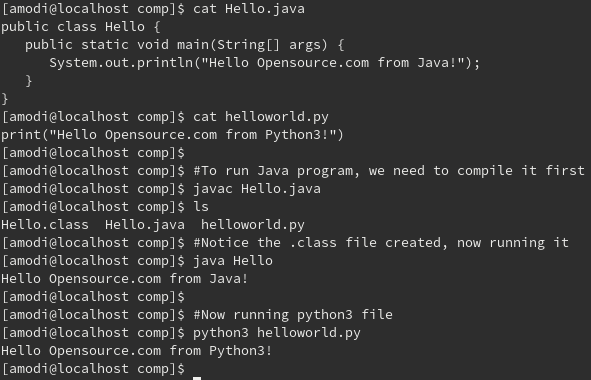
To run the java program «Hello.java» you need to compile it first which creates a «Hello.class» file. To run just the class name, use «java Hello.» For Python, you would just run the file «python3 helloworld.py.»

Why I use Java
There are probably better languages than Java, depending on work requirements. But I haven't seen anything yet to pull me away.