What is diamond problem in case of multiple inheritance in java?
The class which inherits the properties is known as sub class or, child class and the class whose properties are inherited is super class or, parent class.
In inheritance a copy of super class members is created in the sub class object. Therefore, using the sub class object you can access the members of the both classes.
Multiple inheritance
There are various types of inheritance available namely single, multilevel, hierarchical, multiple and, hybrid.
In multiple inheritance one class inherits the properties of multiple classes. In other words, in multiple inheritance we can have one child class and n number of parent classes. Java does not support multiple inheritance (with classes).
The diamond problem
For instance, let us assume that Java does support multiple inheritance. With that assumption consider the following example.
Example
Here, we have an abstract class named Sample with an abstract method as −
Then in the same package/folder, we have two classes extending this class and trying to implement its abstract method, demo().
According to our assumption, since Java supports multiple inheritance, we are trying to inherit both classes Super1 and Super2.
Then, as per the basic rule of inheritance, a copy of both demo() methods should be created in the subclass object which leaves the subclass with two methods with same prototype (name and arguments). Then, if you call the demo() method using the object of the subclass compiler faces an ambiguous situation not knowing which method to call. This issue is known as diamond problem in Java.
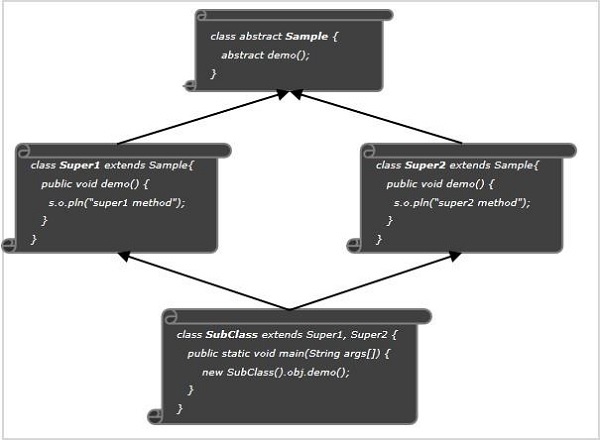
Due to this Java does not support multiple inheritance i.e., you cannot extend more than one other class. Still, if you try to do so, a compile time error is generated.
Compile time error
On compiling, the above program generates the following error −
Solution
You can achieve multiple inheritance in Java, using the default methods (Java8) and interfaces.
From Java8 on wards default methods are introduced in an interface. Unlike other abstract methods these are the methods of an interface with a default implementation. If you have default method in an interface, it is not mandatory to override (provide body) it in the classes that are already implementing this interface.
You can have same default methods (same name and signature) in two different interfaces and, from a class you can implement these two interfaces.
If you do so, you must override the default method from the class explicitly specifying the default method along with its interface name.
Diamond Problem in Java

Java is one of the most popular languages that support object-oriented programming. In object-oriented programming, inheritance is one of the four pillars and it is widely used as it enables the creation of new classes from existing ones. Inheritance provides various advantages to the developer but along with this it also causes some problems one of the problems is the diamond problem in java. While moving further in this article we will learn all about the diamond problem in java, its causes, its solution, etc.
What is the Diamond Problem in Java?
The diamond problem in java is the problem that occurs due to multiple inheritance. It occurs when the child class inherits from more than one parent class and the parent classes have the same name function and the object of the child class calls the function then the compiler does not know as the function is present in both the class. Let’s understand the diamond problem in detail with the help of the example that we have explained above.
Consider a scenario when the parent class is used to create two child classes. The parent class has a method name sum which will be inherited by both the child classes or subclasses. Now suppose we further create grand child class that will inherit from both the child classes and now the user makes an object of the grand child class and the object calls the sum function now the compiler will not be able to identify which sum function they are calling as it is present in both the child classes and because of this ambiguity the java does not support multiple inheritance. And this problem is generally referred to as the diamond problem in java.

Inheritance in Java
The diamond problem in java occurs because of inheritance so before directly moving to understand the diamond problem in java let’s first have a brief discussion about inheritance in java.
Inheritance is basically a concept with the help of which the child class can inherit the features, attributes, and methods of the parent class. This allows the developers to create a hierarchy of classes where the subclasses are inherited from the parent classes.
There are many types of inheritance available in java like
- Single inheritance.
- Multiple inheritance
- Multi-level inheritance
- Hierarchical inheritance
- Hybrid inheritance
To learn about inheritance in detail you can refer to Inheritance in Java.
Why Multiple Inheritance is not allowed in Java?
Multiple inheritance is nothing but when a child inherits the properties of more than one parent class.
Consider a scenario when a base class is used to create two subclasses p1, and p2. So the methods of the base class will be inherited by the subclass. Let’s suppose the base class has a method name sum() now it will be inherited by both p1 and p2. Now if we further use multiple inheritance to create a child class c1 from both p1 and p2. And now the c1 will merit the sum() method from both p1 and p2. Now suppose a case when the user made an object of c1 class and wants to call the sum() method. Now the compiler will be confused as the sum() is present in both the parent class. This is the problem faced during multiple inheritance and because of this multiple inheritance is not allowed in java. Let’s understand this with an example.
Example
Here is an example of multiple inheritance with code implementation.
Explanation of the above example
In the above example we can see the ambiguity with multiple inheritance and because of this reason multiple inheritance is not allowed in java.
Solution of Diamond Problem in Java: Interfaces
You might think that we have said that we cannot implement multiple inheritance in java so there is no solution to the diamond problem in java also as we cannot implement multiple inheritance. The answer is NO, We can implement multiple inheritance in java through default methods using the interface.
This was made possible in Java 8 when classes that implement interfaces were unaffected by methods with implementation. They are the methods that the interface’s definition of the term "default" designates. We are unable to add a method to the interface without using "default" or "static" ways. It is not required to override a default function if it exists in an interface in the classes that implement it. However, ambiguity results when a class implements two distinct interfaces but uses the same default methods for both.
The class can implement more than two interfaces as the interface provides the default implementation of methods. The class that is implementing it should indicate which method is to be used or which of the default methods should be overridden if the implemented interfaces contain default methods with the same method signature.
Example
Let’s solve the above-mentioned example.
Explanation of the above example
In the above example we have implemented multiple inheritance in java with the help of interfaces. We have overridden the sum method in a class that implements the interface to solve the diamond problem. The compiler will know that we have overridden this method when we override the sum method that is present in the implemented interfaces.
Conclusion
The diamond problem in java is a major issue that is occurred when multiple inheritance is allowed in object-oriented programming. Java does not allow multiple inheritance directly but we can implement it by using interfaces. We have seen the diamond problem in java along with the method to solve it. This will allow developers to use multiple inheritance in java without worrying about the diamond problem. And the developers can make the complex codes easy with the help of inheritance. It is advised to avoid multiple inheritance whenever possible due to the diamond problem in java but you can always use interfaces to solve it.
FAQs Related to Diamond Problem in Java
Here are some of the frequently asked questions about the diamond problem in java.
1. What is an interface in Java?
An interface in Java is a collection of abstract methods that define a contract for classes that implement the interface.
2. What is a default method in Java interface?
A default method in Java interface is a method that has a default implementation in the interface itself.
3. What is the super keyword in Java?
The super keyword in Java is used to refer to the superclass of a class or to call a method of the superclass.
4. How does virtual method dispatch work in Java?
Virtual method dispatch in Java works by dynamically dispatching a method based on the type of the object at runtime.
5. Can a class extend multiple interfaces in Java?
Yes, a class can extend multiple interfaces in Java.
Inheritance and Diamond Problem in Java

Hi guys! Today we can discuss one of the concepts we have in OOP in Java. Actually this was asked from me during an interview also. So, I have decided to write the things I know already. But there will be more facts just beyond that explaining Inheritance!! More focus will be on Diamond problem and what are the alternative ways to solve it…
What is Inheritance?
Inheritance is a relation/association between two classes where one class inherits the properties of the other class. This relation is defined using the extends keyword in Java like this.
This is IS-A relationship. Let’s take an example. We can define Vehicle and Car as two related classes where Vehicle is the parent class and Car is the child. Here, Car IS-A Vehicle. Isn’t it?
I won’t be deeply explaining about inheritance. But we can briefly discuss about inheritance types we have.
- Single Inheritance — Extend a class only by 1 class
- Multi Level Inheritance — Extend a class from a derived class, followed by an order of association
- Hierarchical Inheritance — Extend set of classes with the same parent class
Multiple Inheritance
This is the focus of the article. Here 1 class is extended by more than 1 classes.
Hold on! Is this supported by Java? No! Multiple inheritance is not allowed in Java! At any given point in time, a given Java class can extend from only one super class.
Diamond Problem
It’s happening in this scenario. Let’s imagine we have a abstract Parent class called A. Then We have X and Y classes which extend A. Right? Then we have another class Z which extends X and Y both(Tricky part)! All the classes are having a method called methodX which is inherited from A. X and Y both have overridden the method implementation to provide their own logic.
So, how to override methodX inside class Z.
We cannot. It is creating an ambiguity because, we have 2 parent classes which have the same identical method. So, which one to override? Java compiler itself comes to a confusion! This is why Java does not support for multiple inheritance. There we have faced the diamond problem!
So, why it is called as diamond problem?
Let me show you a UML diagram. See the class arrangement…Then you will realize!
You got it right? The diamond shape class setup is the reason for this name!
Множественное наследование в Java. Сравнение композиции и наследования


Для более простого понимания проблемы алмаза допустим, что множественное наследование поддерживается в Java. В этом случае, мы можем получить классы с иерархией показанной на рисунке ниже. Предположим ,что SuperClass — это абстрактный класс, описывающий некоторый метод, а классы ClassA и ClassB — реальные классы. SuperClass.java ClassA.java Теперь, давайте предположим, что класс ClassC наследуется от ClassA и ClassB одновременно, и при этом имеет следующую реализацию: Заметьте, что метод test() вызывает метод doSomething() родительского класса, что приведет к неопределенности, так как компилятор не знает о том, метод какого именно суперкласса должен быть вызван. Благодаря очертаниям диаграммы наследования классов в этой ситуации, напоминающим очертания граненого алмаза проблема получила название «проблема Алмаза». Это и есть основная причина, почему в Java нет поддержки множественного наследования классов. Отметим, что указанная проблема с множественным наследованием классов также может возникнуть с тремя классами, имеющими как минимум один общий метод.
Множественное наследование и интерфейсы
Композиция как спасение
Композиция или наследование?
Предположим, мы имеем следующую связку классов родитель-наследник:
ClassC.java
ClassD.java
Код выше прекрасно компилируется и работает, но что, если ClassC будет реализован иначе:
Отметьте, что метод test() уже существует в классе наследнике, но возвращает результат другого типа. Теперь ClassD , в случае если вы используете IDE, не будет скомпилирован. Вам будет рекомендовано изменить тип возвращаемого результата в классе наследнике или в суперклассе.
Теперь представим себе такую ситуацию, где имеется многоуровневое наследование классов и суперкласс не доступен для наших изменений. Теперь, чтобы избавиться от ошибки компиляции, у нас нет других вариантов, кроме как изменить сигнатуру или имя метода подкласса. Также нам придется внести изменения во все места, где этот метод вызывался. Таким образом, наследование делает наш код хрупким.
Проблема, описанная выше, никогда не встречается в случае композиции, и поэтому делает последнюю более предпочтительной перед наследованием.
Следующая проблема с наследованием заключается в том, что мы демонстрируем все методы родителя клиенту. И если суперкласс разработан не очень корректно и содержит дыры в «безопасности». Тогда, несмотря на то, что мы полностью позаботимся о безопасности при реализации нашего подкласса, мы все равно будем зависеть от ущербной реализации класса-родителя.
Композиция помогает нам в обеспечении контролируемого доступа к методам суперкласса, тогда как наследование не поддерживает никакого контроля над его методами. Это — также одно из главных преимуществ композиции над наследованием.
Еще одно преимущество композиции то, что оно добавляет гибкости при вызове методов. Реализация класса ClassC , описанная выше, не оптимальна и использует раннее связывание с вызываемым методом. Минимальные изменения позволят нам сделать вызов методов гибким и обеспечить позднее связывание (связывание во время выполнения).
ClassC.java
Программа выше выведет на экран:
Эта гибкости при вызове метода, не наблюдается при наследовании, что заставляет использовать композицию в качестве наилучшего подхода.
Модульное тестирование проще в случае композиции, потому что мы знаем, что для всех методов, которые используются в суперклассе, мы можем поставить заглушку для тестов, в то время как в наследовании мы сильно зависим от суперкласса и не знаем, как методы класса-родителя будут использованы. Таким образом, из-за наследования, нам придется тестировать все методы суперкласса, что является излишней работой.
В идеале, наследование следует использовать только тогда, когда отношение ”is-a” справедливо для классов родителя и наследника, иначе стоит предпочесть композицию.