Nikon или Canon в 2021 году?
Вечные противостояния: мерседес или бмв, найк или адидас, «Барселона» или «Реал»… «Никон» или «Кэнон» — то, с чего многие когда-то начинали. Мы с вами уже говорили на эту тему в 2017 году, ролик есть на канале. Но с тех пор много воды утекло. Что же всё-таки выбрать сегодня, Canon или Nikon? Давайте поговорим.
Nikon и Canon — два старейших производителя фототехники. Они соперничают уже больше 70-ти лет. Ещё недавно Canon и Nikon боролись в сегменте зеркальных фотоаппаратов. Но сегодня мы видим, что на смену зеркалкам приходят беззеркалки. В будущем противостояние двух гигантов индустрии продолжится. Но уже на рынке беззеркальных систем.
Зеркалки Canon и Nikon — стоит ли покупать?
Но начнем мы наш разговор всё-таки с зеркалок. Canon и Nikon продолжают поддерживать несколько своих зеркальных линеек. В 2019 году вышел Canon 90D, в 2020 — Canon 1Dx Mark III. У Nikon в 2020 вышла модель D780. Лично я считаю, что сегодня покупать зеркалки новыми в магазине имеет смысл только в одном случае. Если вы — профессионал.
Если вы зарабатываете фотографией на хлеб, если у вас скопился парк оптики, ваша старенькая зеркалка совсем устала… Тогда имеет смысл рассмотреть именно зеркальные камеры. Здесь по-прежнему есть отличный Nikon D850 и свеженький D780. Кэнонисты могут купить Canon 5D Mark IV. Он справится с большинством задач. А там, где его будет недостаточно, всегда выручит 1Dx последней версии.
Итак, вы поняли. Сегодня я рекомендую смотреть на новые зеркалки только профессионалам. В крайнем случае их могут рассмотреть к покупке ностальгирующие любители. Поэтому говорить о противостоянии Canon и Nikon в этом сегменте нет никакого смысла. Те, кто остается в зазеркалье, уже давно сделали выбор между этими брендами. А дальше… У Никониста и у Кэнониста нет цели, только путь.
Эпоха беззеркальных камер. Кроп-камеры Canon и Nikon
С беззеркалками всё значительно интереснее. Они развиваются, их выпускают очень много. Сегодня нас интересуют только два бренда. Но и они к 2021-му году умудрились выпустить 20 камер на двоих. В этой статистике, конечно, солидную часть заняли камеры системы Canon EOS M.
Предлагаю с кроп-камер и начать. Беззеркальные камеры с APS-C сенсором являются самыми доступными. К таким камерам относится и линейка Canon EOS M. В сегменте кроп-камер Canon выносит Nikon в одну калитку. Система EOS M развивается с 2012 года. А кропнутые беззеркалка Nikon появилась только в 2019 году. Представляет их сейчас одна единственная камера — Nikon Z50. Такой поздний старт привел к тому, что в системе Nikon Z сейчас очень мало доступной оптики. Большая часть объектиов — дорогие решения для полнокадровых камер. Да, можно подключать старые объективы через переходник. Но, как говорится, ощущения не те.
Canon здесь побеждает Nikon. Но не всё так просто и однозначно, как может показаться на первый взгляд. Умный человек должен думать наперед, согласны? Проблема в том, что по слухам Canon собирается свернуть систему EOS M. Почему эти слухи могут быть правдой? Потому что на фоне очевидного спада спроса на фотокамеры, у Canon сейчас имеется рекордное количество разнообразных линеек камер.
У них две зеркальные системы — EF и EF-S. У них две беззеркальные системы — EOS M и EOS R. Есть ещё отдельные компактные камеры, вроде Canon G7x. В общем, камер и систем слишком много. Сейчас основные силы брошены на развитие самой новой системы — EOS R. Ожидается, что скоро в новой системе выйдет кроп-камера, что и поставит под сомнение существование линейки EOS M.
Из всего вышесказанного можно сделать такой вывод. Сегодня беззеркальные кропы Canon превосходят камеры Nikon как минимум количественно. Но рассчитывать на систему Canon EOS M всё равно нельзя — она не выглядит как “будущее компании Canon”. Сегодня я бы не выбирал ни Canon, ни Никон в данном сегменте. Конечно, если речь идет о покупке первой камеры.
Системы Nikon Z и Canon EOS R — главное противостояние сегодня
Полнокадровые системы Canon EOS R и Nikon Z. То, ради чего мы, собственно, здесь и собрались. Ведь это главное противостояние компаний Nikon и Canon сегодня. Canon EOS RP или Nikon Z5, Canon EOS R или Nikon Z6? А также Canon R6, R5 и Nikon Z7 Mark II. Давайте всё это обсудим.
Когда Nikon и Canon ещё не выпустили свои полнокадровые беззеркалки, мы говорили о том, что Nikon — это больше про фото, а Canon — скорее мультимедийный инструмент. Но с приходом беззеркалок всё смешалось.
Nikon Z6 или Canon EOS R
Если смотреть на Canon EOS R и Nikon Z6, то нельзя однозначно сказать, какая из них подходит больше для фото, а какая для видео. Обе эти камеры — мультимедийные инструменты, которые стоят друг друга. Но если нужно выбирать, то какую? Я бы мог сказать классическое “да, выбирайте ту, которая больше нравится”. Устроит ли вас такой ответ? Если вы прямо сейчас выбираете фотоаппарат, то вряд ли. Так что будем более категоричными.
Разберитесь, для чего вам фотоаппарат. Для фото или для видео. Если для фото, то для какого именно. Если для видео, то что вы будете снимать. Вот вам несколько подсказок.
Если вам фотоаппарат нужен для фотосъемки пейзажей, то Nikon со своей детализацией и динамическим диапазоном, как и во времена зеркалок, кажется лучшим выбором.
Если вы хотите снимать портреты, то я бы взял Canon. Не из-за цветопередачи, как многие подумали. Nikon научила камеры неплохо передавать цвет кожи в этом поколении камер. Основная причина — автофокус. DualPixel Кэнона работает лучше по моим субъективным ощущениям.
Для видеосъемки семейных торжеств, дней рождений, выездов на природу и вообще для видеосъемки семьи я бы, скорее всего, выбрал Nikon. За то, что он вам позволит снимать 4k с полной матрицы и запечатлеть всё, что происходит, в максимальном качестве. Да, Canon тоже умеет снимать в 4k, но работа с ним кажется сложнее — 4k там с кропом 1.8. Это означает, что вам будет не очень комфортно снимать на китовую оптику. На том же объективе 24-105mm вы лишитесь широкого угла. Нужен будет какой-то другой объектив. В общем, видео на Canon можно снимать не хуже, но на Nikon проще.
Поехали дальше. Предположим вы снимаете блог. Если вы не хотите докупать внешний монитор, то ваш выбор — Canon. У него есть полностью поворотный экран и отличный автофокус по лицу.
Если вы хотите снимать видео с плоским профилем, чтобы это видео писалось в камеру и вам достаточно 8 бит 4:2:0 — то ваш выбор Canon. Clog он пишет на карту памяти в таком качестве без проблем. Nikon плоский профиль может писать только на внешний рекордер. Да, это будут 10 бит 4:2:2, но в этом режиме на внешний рекордер умеет писать и Canon. А вот чего Canon не умеет — снимать видео в RAW. И это уже для настоящих маньяков — придется не только рекордер к Никону купить, но и платную прошивку установить. В общем, дорого, но профессионально. Если нужно такое, то к Nikon.
Ну, вы поняли, эта тема бесконечна. Для одних задач лучше подходит Canon EOS R, для других — Nikon Z6. Но в целом обе эти камеры высокого уровня и едва ли вы ошибетесь, выбрав одну из них.
Nikon Z5 против Canon EOS RP
Canon EOS RP или Nikon Z5. Честно говоря, тут я не планирую разглагольствовать, как в случае с предыдущими камерами. Лично мне намного больше нравится Nikon Z5. Если мы абстрагируемся от систем, а говорим только о самих камерах, то у Canon есть только одно преимущество — цена. Он продается давно. Официальная цена между камерами около 10 тысяч рублей. Однако. Разница в цене между новыми камерами без официальной гарантии — почти 30 тысяч рублей. А это уже очень серьезно. Все цены я беру с я.маркета, ссылки на модели из сегодняшнего видео будут в описании и прикрепленном комментарии к ролику. Если вы смотрите это видео намного позже, чем оно вышло — цены могли измениться. Актуальные лучше уточнять по ссылкам.
И вот если мы говорим о разнице в 30 тысяч рублей, то тут уже всё становится не так однозначно. Сразу можно поразмышлять на тему: а нужно ли вам 4к видео, матричная стабилизация. А надо ли вам, чтобы у камеры был двойной слот для карт памяти. И так далее. Nikon Z5 выглядит лучше, но возможно вам эти улучшения ни к чему.
Но чем мне особенно нравится Nikon Z5, так это тем, что её можно использовать для профессиональных задач. У неё есть двойной слот для карт памяти и защита от пыли и влаги. По сути, эта младшая полнокадровая беззеркалка от Nikon позволяет вам заниматься коммерческой фотосъемкой. Снимать без проблем на такую камеру можно: свадьбы, корпоративы, предметку, интерьеры. Так что, если ваш приоритет не сэкономить на камере, а купить инструмент для дальнейшего зарабатывания денег — Nikon Z5 ваш кандидат.
Canon EOS R6 или Nikon Z6 Mark II
Обе камеры вышли в 2020 году, обе примерно в один бюджет. Можно сказать, что это следующий уровень после первой Nikon Z6 и EOS R.
Про Nikon Z6 первого поколения мы уже много чего сказали. Так вот. Камера второго поколения точно такая же. Изменений в ней немного. Во-первых, появился второй слот для карт памяти. И этот слот — под карты формата SD. Конечно, после выхода первой камеры с дорогущими картами XQD было очевидно, что такой формат долго не продержится. Теперь появилась альтернатива.
Другие улучшения — появилась возможность видеосъемки 4k 60 кадров в секунду. Двойной процессор. Немного выросла скорость серийной съемки, но что более важно — существенно увеличился буфер памяти. Камера не ощущается новым инструментом, но она явно стала лучше.
Canon EOS R6 по сравнению с EOS R как раз ощущается чем-то новым и переосмысленным. Многое изменилось. В том числе в камеру установили матрицу от флагмана 1dx mark III. Автофокус улучшился — теперь в камере используется DualPixel второго поколения. Изменилась эргономика и внешний вид. Производитель убрал из камеры лишние элементы, добавил недостающие. В Canon пожадничали и не добавили верхний экран. Основной дисплей стал хуже, чем был в EOS R. Но в остальном получился очень классный инструмент для фото. Да и для видео тоже. Кроп из видео ушел, 4k 30p камера снимает без проблем. 4k 60p тоже снимает, но с известными проблемами с перегревом.
Камеры идут ноздря в ноздрю. Конечно, canon выглядит поинтереснее за счет матрицы и системы автофокуса, у него есть поворотный экран и двойной слот под SD-карты. Но Nikon не будет сильно хуже, да и стоит он меньше. Эти камеры, как правило, выбирают при переходе с зеркальных систем, с камер уровня Nikon D750 или Canon 5D Mark III.
Когда вышло первое поколение, я говорил, что профессионалам стоит подождать второго. Что уйдут основные косяки, появятся двойные слоты для карт, подтянется автофокус. Так и получилось. Теперь это две достойные камеры. Одна для кэнонистов, другая для никонистов. Никто не должен быть расстроен.
Nikon Z7 и Z7 Mark II
Эти камеры стоят особняком, потому что их не с чем сравнить у Canon. Первую версию Nikon Z7 на 2021 год никому не могу рекомендовать к покупке. Она хороша, но слишком дорога для любителя и слишком несовершенна для профессионала. Z6 Mark II сегодня выглядит более полноценным инструментом за меньшие деньги.
Что же касается Z7 Mark II, то конкурента у Canon ей нет. R6 заметно дешевле и явно направлена на другие задачи. Z7 Mark II — это многопиксельная камера, которую сегодня можно назвать полноценной беззеркальной заменой Nikon D850. В некоторых аспектах, например в видео, она даже лучше. Думаю, подобный инструмент лучше подходит для портретной или пейзажной съемки: её матрица позволяет хорошо передавать детали и печатать снимки в больших форматах: плакаты, баннеры и прочее.
Canon R5
Это обратная ситуация Nikon Z7. Тут уже у Nikon нет конкурента. Да, по каким-то моментам, например по разрешению матрицы эту камеру можно сравнить с Nikon Z7 второй версии. Но по очень многим параметрам EOS R5 выглядит лучше. Отличный автофокус, заявленный ресурс затвора 500 тысяч кадров, скорость серийной съемки 12 кадров в секунду, большой буфер памяти, возможность съемки видео в 8k, видоискатель на 5.5 миллионов пикселей. В общем, это немного другой уровень, чем у Z7. Ну и по цене соответственно R5 существенно дороже.
Я вам в краткой форме сегодня рассказал о самых значимых камерах Canon и Nikon. Это две равноценные системы. Нельзя сказать, что одна из них лучше. Всё зависит от вашего бюджета и задач. Хотите самую недорогую камеру для проф. съемки — это к Nikon. Хотите камеру для ведения блога — тут у Canon есть интересные варианты. И так далее.
Когда вы выбираете систему или камеру, очень важно, в какой точке вы находитесь сейчас. Что вы умеете, есть ли у вас уже какая-то камера. Профессиональные фотографы могут со спокойной душой оставаться в рамках своей системы, переходить от зеркалок к беззеркалкам. Nikon и Canon достойно осваивают новое для себя беззеркальное направление. Перескакивать с одной системы на другую — пустая трата денег.
Что касается новичков, которые оптимистично смотрят на своё будущее в фотографии. То есть, они прям четко уверены, что сейчас ворвутся в мир фото и будут тут долго. Что им можно посоветовать? Если смотреть на перспективы развития систем, то Canon, конечно, крепче стоит на ногах. Эту систему активнее покупают, её шансы в будущем сохранить позиции я оцениваю несколько выше. Так что, если вы настолько далеко хотите заглянуть, то Canon может быть лучшим выбором. Из этих двух, а не вообще. Думаю, если вам понравится это видео и вы его поддержите своими лайками и комментариями, то мы обсудим и другие системы. А сегодня на этом всё. Спасибо за внимание! С вами был канал “Полный кадр”, подписывайтесь на нас в инстаграмме и телеграме. Делайте правильный выбор!
Canon R vs Nikon Z5
The Canon EOS R and the Nikon Z5 are two digital cameras that were revealed to the public, respectively, in September 2018 and July 2020. Both the Canon R and the Z5 are mirrorless interchangeable lens cameras that are equipped with a full frame sensor. The Canon has a resolution of 30.1 megapixels, whereas the Nikon provides 24.2 MP.
Below is an overview of the main specs of the two cameras as a starting point for the comparison.
Going beyond this snapshot of core features and characteristics, what are the differences between the Canon EOS R and the Nikon Z5? Which one should you buy? Read on to find out how these two cameras compare with respect to their body size, their imaging sensors, their shooting features, their input-output connections, and their reception by expert reviewers.
Body comparison
The side-by-side display below illustrates the physical size and weight of the Canon R and the Nikon Z5. The two cameras are presented according to their relative size. Three consecutive perspectives from the front, the top, and the back are available. All width, height and depth dimensions are rounded to the nearest millimeter.

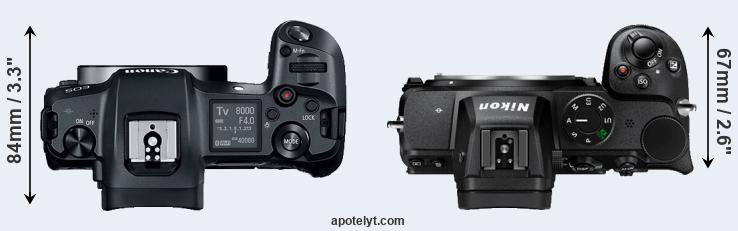
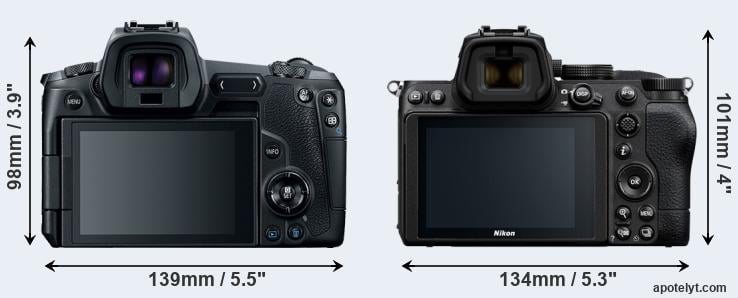
If the front view area (width x height) of the cameras is taken as an aggregate measure of their size, the Canon R and the Nikon Z5 are of equal size. However, the Z5 is slightly heavier (2 percent) than the Canon R. In this context, it is worth noting that both cameras are splash and dust-proof and can, hence, be used in inclement weather conditions or harsh environments.
The above size and weight comparisons are to some extent incomplete since they do not consider the interchangeable lenses that both of these cameras require. Hence, you might want to study and compare the specifications of available lenses in order to get the full picture of the size and weight of the two camera systems.
Concerning battery life, the Canon R gets 370 shots out of its LP-E6N battery, while the Z5 can take 470 images on a single charge of its EN-EL15c power pack. The battery packs of both cameras can be charged via USB, which can be very convenient when travelling.
The adjacent table lists the principal physical characteristics of the two cameras alongside a wider set of alternatives. In case you want to display and compare another camera duo, you can use the CAM-parator app to select your camera combination among a large number of options.
Any camera decision will naturally be influenced heavily by the price. The listed launch prices provide an indication of the market segment that the manufacturer of the cameras have been targeting. The Z5 was launched at a markedly lower price (by 39 percent) than the Canon R, which puts it into a different market segment. Usually, retail prices stay at first close to the launch price, but after several months, discounts become available. Later in the product cycle and, in particular, when the replacement model is about to appear, further discounting and stock clearance sales often push the camera price considerably down. Then, after the new model is out, very good deals can frequently be found on the pre-owned market.
Sensor comparison
The imaging sensor is at the core of digital cameras and its size is one of the main determining factors of image quality. All other things equal, a large sensor will have larger individual pixel-units that offer better low-light sensitivity, wider dynamic range, and richer color-depth than smaller pixels in a sensor of the same technological generation. Furthermore, a large sensor camera will give the photographer more possibilities to use shallow depth-of-field in order to isolate a subject from the background. On the downside, larger sensors are more costly to manufacture and tend to lead to bigger and heavier cameras and lenses.
Both cameras under consideration feature a full frame sensor, but their sensors differ slightly in size. The sensor area in the Z5 is 1 percent smaller. They nevertheless have the same format factor of 1.0. Both cameras have a native aspect ratio (sensor width to sensor height) of 3:2.
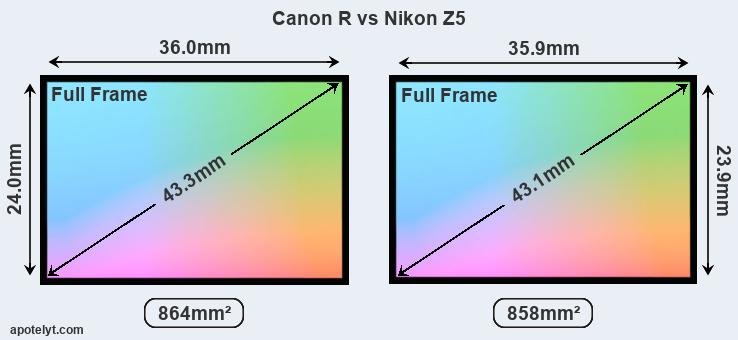
With 30.1MP, the Canon R offers a higher resolution than the Z5 (24.2MP), but the Canon R has smaller individual pixels (pixel pitch of 5.36μm versus 5.95μm for the Z5). Moreover, the Z5 is a somewhat more recent model (by 1 year and 10 months) than the Canon R, and its sensor might have benefitted from technological advances during this time that further enhance the light gathering capacity of its pixels.
The resolution advantage of the Canon R implies greater flexibility for cropping images or the possibility to print larger pictures. The maximum print size of the Canon R for good quality output (200 dots per inch) amounts to 33.6 x 22.4 inches or 85.3 x 56.9 cm, for very good quality (250 dpi) 26.9 x 17.9 inches or 68.3 x 45.5 cm, and for excellent quality (300 dpi) 22.4 x 14.9 inches or 56.9 x 37.9 cm. The corresponding values for the Nikon Z5 are 30.1 x 20.1 inches or 76.4 x 51 cm for good quality, 24.1 x 16.1 inches or 61.1 x 40.8 cm for very good quality, and 20.1 x 13.4 inches or 50.9 x 34 cm for excellent quality prints.
The Canon EOS R has a native sensitivity range from ISO 100 to ISO 40000, which can be extended to ISO 50-102400. The corresponding ISO settings for the Nikon Z5 are ISO 100 to ISO 51200, with the possibility to increase the ISO range to 50-102400.
Technology-wise, both cameras are equipped with CMOS (Complementary Metal–Oxide–Semiconductor) sensors. Both cameras use a Bayer filter for capturing RGB colors on a square grid of photosensors. This arrangement is found in most digital cameras.

Consistent information on actual sensor performance is available from DXO Mark for many cameras. This service assesses and scores the color depth («DXO Portrait»), dynamic range («DXO Landscape»), and low-light sensitivity («DXO Sports») of camera sensors, and also publishes an overall camera score. The table below summarizes the physical sensor characteristics and sensor quality findings and compares them across a set of similar cameras.
Many modern cameras are not only capable of taking still images, but also of capturing video footage. Both cameras under consideration have a sensor with sufficiently fast read-out times for moving pictures, and both provide the same movie specifications (4K/30p).
Feature comparison
Apart from body and sensor, cameras can and do differ across a range of features. The Canon R and the Z5 are similar in the sense that both feature an electronic viewfinder, which is helpful when framing images in bright sunlight. Moreover, their viewfinders offer an identical resolution of 3690k dots. The following table reports on some other key feature differences and similarities of the Canon R, the Nikon Z5, and comparable cameras.
One feature that is present on the Canon R, but is missing on the Z5 is a top-level LCD. While being, of course, smaller than the rear screen, the control panel conveys some of the essential shooting information and can be convenient for quick and easy settings verification.
The Canon R has an articulated LCD that can be turned to be front-facing. This characteristic will be appreciated by vloggers and photographers who are interested in snapping selfies. In contrast, the Z5 does not have a selfie-screen.
The reported shutter speed information refers to the use of the mechanical shutter. Yet, some cameras only have an electronic shutter, while others have an electronic shutter in addition to a mechanical one. In fact, both cameras under consideration feature an electronic shutter, which makes completely silent shooting possible. However, this mode is less suitable for photographing moving objects (risk of rolling shutter) or shooting under artificial light sources (risk of flickering).
The Nikon Z5 has an intervalometer built-in. This enables the photographer to capture time lapse sequences, such as flower blooming, a sunset or moon rise, without purchasing an external camera trigger and related software.
Concerning the storage of imaging data, both the Canon R and the Z5 write their files to SDXC cards. The Z5 features dual card slots, which can be very useful in case a memory card fails. In contrast, the Canon R only has one slot. Moreover, both cameras support UHS-II cards (Ultra High Speed data transfer of up to 312 MB/s).
Connectivity comparison
For some imaging applications, the extent to which a camera can communicate with its environment can be an important aspect in the camera decision process. The table below provides an overview of the connectivity of the Canon EOS R and Nikon Z5 and, in particular, the interfaces the cameras (and selected comparators) provide for accessory control and data transfer.
Both the Canon R and the Z5 are recent models that are part of the current product line-up. Neither of the two has a direct predecessor, so perhaps they will constitute the origins of new camera lines for Canon and Nikon. Further information on the features and operation of the Canon R and Z5 can be found, respectively, in the Canon R Manual (free pdf) or the online Nikon Z5 Manual.
Review summary
So what is the bottom line? Is there a clear favorite between the Canon R and the Nikon Z5? Which camera is better? The listing below highlights the relative strengths of the two models.
Arguments in favor of the Canon EOS R:
- More detail: Offers more megapixels (30.1 vs 24.2MP) with a 12% higher linear resolution.
- Easier setting verification: Features an LCD display on top to control shooting parameters.
- More detailed LCD: Has a higher resolution rear screen (2100k vs 1040k dots).
- More flexible LCD: Has a swivel screen for odd-angle shots in portrait or landscape orientation.
- More selfie-friendly: Has an articulated screen that can be turned to be front-facing.
- Faster burst: Shoots at higher frequency (8 vs 4.5 flaps/sec) to capture the decisive moment.
- More heavily discounted: Has been on the market for longer (launched in September 2018).
Reasons to prefer the Nikon Z5:
- Larger viewfinder image: Features a viewfinder with a higher magnification (0.80x vs 0.76x).
- Easier time-lapse photography: Has an intervalometer built-in for low frequency shooting.
- Longer lasting: Gets more shots (470 versus 370) out of a single battery charge.
- Sharper images: Has stabilization technology built-in to reduce the impact of hand-shake.
- Faster data transfer: Supports a more advanced USB protocol (3.2 vs 3.1).
- Greater peace of mind: Features a second card slot as a backup in case of memory card failure.
- More affordable: Was introduced into a lower priced category (39 percent cheaper at launch).
- More modern: Was introduced somewhat (1 year and 10 months) more recently.
If the count of individual advantages (bullet points above) is taken as a guide, the Z5 comes out slightly ahead of the Canon R (8 : 7 points). However, the relevance of individual strengths will vary across photographers, so that you might want to apply your own weighing scheme to the summary points when reflecting and deciding on a new camera. A professional wildlife photographer will view the differences between cameras in a way that diverges from the perspective of a family photog, and a person interested in architecture has distinct needs from a sports shooter. Hence, the decision which camera is best and worth buying is often a very personal one.
How about other alternatives? Do the specifications of the Canon R and the Nikon Z5 place the cameras among the top in their class? Find out in the latest Best Mirrorless Interchangeable Lens Camera listing whether the two cameras rank among the cream of the crop.
In any case, while the comparison of technical specifications can provide a useful overview of the capabilities of different cameras, it remains partial and cannot reveal, for example, the shooting experience and imaging performance when actually working with the Canon R or the Z5. User reviews, such as those found at amazon, can sometimes inform about these issues, but such feedback is often incomplete, inconsistent, and biased.
Expert reviews
This is where reviews by experts come in. The table below provides a synthesis of the camera assessments of some of the best known photo-gear review sites (amateurphotographer [AP], cameralabs [CL], digitalcameraworld [DCW], dpreview [DPR], ephotozine [EPZ], photographyblog [PB]). As can be seen, the professional reviewers agree in many cases on the quality of different cameras, but sometimes their assessments diverge, reinforcing the earlier point that a camera decision is often a very personal choice.
The review scores listed above should be treated with care, though. The ratings are only valid when referring to cameras in the same category and of the same age. Thus, a score needs to be put into the context of the launch date and the launch price of the camera, and rating-comparisons among cameras that span long time periods or concern very differently equipped models make little sense. Also, kindly note that some of the listed sites have over time developped their review approaches and their reporting style.
Other camera comparisons
Did this review help to inform your camera decision process? In case you are interested in seeing how other cameras pair up, just make a corresponding selection in the search boxes below. There is also a set of direct links to comparison reviews that other users of the CAM-parator app explored.
Specifications: Canon R vs Nikon Z5
Below is a side-by-side comparison of the specs of the two cameras to facilitate a quick review of their differences and common features.
| Camera Model | Canon R | Nikon Z5 |
| Camera Type | Mirrorless system camera | Mirrorless system camera |
| Camera Lens | Canon RF mount lenses | Nikon Z mount lenses |
| Launch Date | September 2018 | July 2020 |
| Launch Price | USD 2,299 | USD 1,399 |
| Sensor Specs | Canon R | Nikon Z5 |
|---|---|---|
| Sensor Technology | CMOS | CMOS |
| Sensor Format | Full Frame Sensor | Full Frame Sensor |
| Sensor Size | 36.0 x 24.0 mm | 35.9 x 23.9 mm |
| Sensor Area | 864 mm 2 | 858.01 mm 2 |
| Sensor Diagonal | 43.3 mm | 43.1 mm |
| Crop Factor | 1.0x | 1.0x |
| Sensor Resolution | 30.1 Megapixels | 24.2 Megapixels |
| Image Resolution | 6720 x 4480 pixels | 6016 x 4016 pixels |
| Pixel Pitch | 5.36 μm | 5.95 μm |
| Pixel Density | 3.48 MP/cm 2 | 2.82 MP/cm 2 |
| Moiré control | Anti-Alias filter | Anti-Alias filter |
| Movie Capability | 4K/30p Video | 4K/30p Video |
| ISO Setting | 100 — 40,000 ISO | 100 — 51,200 ISO |
| ISO Boost | 50 — 102,400 ISO | 50 — 102,400 ISO |
| Image Processor | DIGIC 8 | EXPEED 6 |
| DXO Sensor Quality (score) | 89 | .. |
| DXO Color Depth (bits) | 24.5 | .. |
| DXO Dynamic Range (EV) | 13.5 | .. |
| DXO Low Light (ISO) | 2742 | .. |
| Screen Specs | Canon R | Nikon Z5 |
| Viewfinder Type | Electronic viewfinder | Electronic viewfinder |
| Viewfinder Field of View | 100% | 100% |
| Viewfinder Magnification | 0.76x | 0.80x |
| Viewfinder Resolution | 3690k dots | 3690k dots |
| Top-Level Screen | Control Panel | no Top Display |
| LCD Framing | Live View | Live View |
| Rear LCD Size | 3.2inch | 3.2inch |
| LCD Resolution | 2100k dots | 1040k dots |
| LCD Attachment | Swivel screen | Tilting screen |
| Touch Input | Touchscreen | Touchscreen |
| Shooting Specs | Canon R | Nikon Z5 |
| Focus System | On-Sensor Phase-detect | On-Sensor Phase-detect |
| Manual Focusing Aid | Focus Peaking | Focus Peaking |
| Max Shutter Speed (mechanical) | 1/8000s | 1/8000s |
| Continuous Shooting | 8 shutter flaps/s | 4.5 shutter flaps/s |
| Shutter Life Expectancy | 200 000 actuations | 200 000 actuations |
| Electronic Shutter | YES | up to 1/8000s |
| Time-Lapse Photography | no Intervalometer | Intervalometer built-in |
| Image Stabilization | Lens stabilization only | In-body stabilization |
| Fill Flash | no On-Board Flash | no On-Board Flash |
| Storage Medium | SDXC cards | SDXC cards |
| Single or Dual Card Slots | Single card slot | Dual card slots |
| UHS card support | UHS-II | Dual UHS-II |
| Connectivity Specs | Canon R | Nikon Z5 |
| External Flash | Hotshoe | Hotshoe |
| USB Connector | USB 3.1 | USB 3.2 |
| HDMI Port | mini HDMI | micro HDMI |
| Microphone Port | External MIC port | External MIC port |
| Headphone Socket | Headphone port | Headphone port |
| Wifi Support | Wifi built-in | Wifi built-in |
| Bluetooth Support | Bluetooth built-in | Bluetooth built-in |
| Body Specs | Canon R | Nikon Z5 |
| Environmental Sealing | Weathersealed body | Weathersealed body |
| Battery Type | LP-E6N | EN-EL15c |
| Battery Life (CIPA) | 370 shots per charge | 470 shots per charge |
| In-Camera Charging | USB charging | USB charging |
| Body Dimensions | 139 x 98 x 84 mm (5.5 x 3.9 x 3.3 in) |
134 x 101 x 67 mm (5.3 x 4.0 x 2.6 in) |
| Camera Weight | 660 g (23.3 oz) | 675 g (23.8 oz) |
Did you notice an error on this page? If so, please get in touch, so that we can correct the information.
Nikon Z5 vs Canon EOS RP vs Sony a7 II: how do they compare?
The Nikon Z5 is the second camera to be launched explicitly as an entry-level step into the world of full-frame mirrorless. Its launch price isn’t quite as low as that of the Canon EOS RP, but it’s clearly got a similar audience in its sights.
And, because Sony seems determined to leave all its previous models on the market, it’s also likely to sell at a price that’s roughly comparable with the a7 II. The Sony was originally aimed at a higher price point (and audience) but is available at entry-level prices now that nearly six years have elapsed.
Gear in this story
 89%
89%
 82%
82%
83%
Comments
Oh. Just convinced my little brother to get the Sony A7II with 28-75mm kit lens plus a 50mm f/1.8..
Looking at the current lowest price for the Nikon Z5, he didn't do anything wrong, though. The Z5 body only would've been more expensive than what he got.
You buy the Sony Alpha 7 mk II because of the Sony 55mm 1.8 and the 24-105 f4. Simples.
Happy to see how well my OLD A7II hangs in there with the much newer cameras. Too bad Sony can't do a little better job of price matching with the A7III which I would think would be a clear winner in this trio with the better focusing system and larger battery.
You get the 200$ cashback now, and the body is usually 1.8k, still above 1.5k but not too far.
The A7 II has a very good sensor however it has some big drawbacks (AF, one UHS I slot, slow burst) that being why Sony dropped the price.
The A7 III comes with a better sensor (BSI) and fixing the A7 II problems, it's just too good to be cheaper, it stacks well against the mid league (
Wanted to wait for A7 IV to buy the A7 III, but I don't think Sony will drop the price too much. The A7 III still crushes at DR and low light and it's not a big problem to tolerate lower res on viewfinder and screen.
If I could only get one, probably the Nikon Z5. But if I couldn't afford $1300, then I'd choose the Sony A7 II, still a good camera. I don't know if I'd buy the RP. I think that for the price, you're losing out on some stuff that the A7 II offers for $100 less.
I feel that the RP has too many compromises in order to bring the price down, and pretty much it's the same price as the Z5 is today (I do expect the Z5's price might drop $100 or so over the next year or so as it ages). If the RP and Z5 had been released at the same time, I'd still go with the Z5 because it does offer the IBIS and dual card slots, not to mention USB power. But with now a $400 price difference one has to weigh that out.
Fro ma lens standpoint, Nikon and Canon are pretty close in terms of total native lenses for the R and Z mount. And even if we factor in adapted lenses, they're both still close too.
But I'd still take an A7 II over an RP if I had to choose between just those two.
Not that IBIS is a necessity, I have found it to be quite helpful and one of the reasons it would be hard for me to go back to a DSLR. I've been able to get shots in low light that would have proven to be rather difficult with my D750. Either get a sharp, but noisy shot, or simply a soft image, but with the IBIS in the Nikon's I can shoot down to around 1/10 or so in some cases, whereas with my DSLRs that would be nearly impossible.
(Of course I don't use IBIS as a crutch and will try to keep the shutter speeds at 1/60 or faster, but it's nice to have for those times when you're already "maxed out" on your ISO (for me that's usually 1600 or 3200 depending on which body I'm shooting with) and I have to start slowing down the shutter to get the shot I want.
I'm not in the market for a budget MILC, but if I was, it would be the Nikon that I'd choose.
It's got the best EVF, the best ergonomics, the longest battery life, dual card slots, IBIS and a screen that tilts on axis with the lens, so IMO it's by far the best body.
That just leaves the lenses as the deciding factor. Sony has more choices, but there are enough native Z and RF lenses for most people, and while we are waiting a few months for the Nikon and Canon ranges to fill out, their F and EF lenses can be used via adaptors with full compatibility and virtually identical performance.
Yeah it interesting, any of them will take great photos.
Anyone considering spending 1500 on the Z5 surely has to consider the Z6 which is just a bit more expensive and they would have to consider the A7Rii as it is bargain at around 1400. The Z5 will likely drop in price but it is still 1599 euro where I live, the Z6 is 1799euro and the A7Rii is 1499.
The D750 at 1349euro it's still a great camera with a lot of used glass available and the AF is more than good enough.
The A7Rii will get you more detail and AF was an improvement over A7ii.
In reality if you shoot any kind of landscapes or scenics or shoot portraits the 42mp of the A7Rii is going to be of some benefit.
Anyone paying $1500 for a Z5 has to figure out why they’re paying $300 over MSRP.
In Europe there is a VAT which adds to the price.
1500 Euro where I live.
Body only to body only $500 more for the Z5 than the Sony a7 II. I rest my case.
I'll choose RP. Because
It support two amazing lenses
i) 35mm f/1.8 macro prime
2) 85mm f/2 macro prime.
And also it's lightweight.
Only downside is Dynamic range. I hope Canon will release another lightweight cheaper model replacing RP. with good dynamic range and autofocus in coming time
It's all about compromises and what matters more to you.
Canon is lighter, but it also has a weaker battery and no IBIS. So with the other cameras you will be able to use cheaper and lighter lenses (well, at least in theory).
Also, the lenses you mentioned don't seem that unique?
those lenses are extremely unique to me. I love 35mm and 85mm. But most lenses are heavy. Some are lightweight but don't focus closer. These are light and focus closer. Currently i use fuji with XF 23 and XF 56. but I wish they focus closer than currently they do. Specially i miss taking pictures of derails of food when traveling.
You want a camera for taking food photos from your travels? Have you tried your smartphone? I am sincerely curious and asking.
My smartphone camera is ok but not really good. They are great for posting picture online but they are not worth for selling (if any one interested).
I use my smartphone only to record geolocation and also it hel
p visualize the scene before taking out the camera.
My phone is not expensive. It's a basic android phone which i use for social media.
My travel photography is not about food mostly but some time in India foods are not only delicious but also photo worthy.
I also have a fairly midrange Android phone from a couple years ago. It does at least have a nice screen tho. But yeah, real camera for the win.
The Fujinon 23mm f1.4 focuses to 11" close, I would think that's enough to shoot food and such.
It's close enough for full plate but not close enough for desserts, details. Also not having Image stabilaisation affect close up as we will be stopping down allot.
I get that the A7II is Sony's current "entry level" model, but the A7RII can still be had new for the price of the Z5. That should have been added or considered because, even at $1k the A7II might not be the best value, but anyone stepping up to $1.4k, who's brand agnostic, really should consider the A7RII. compared to the A7RII the Z5 looks like a much worse value.
One similarity between these cameras is that I cant afford any of them.
Interesting comparison, a few comments as an RP user since the camera's launch:
— The battery is a non-issue for photography, I get 300+ pictures per battery and the smaller form factor contributes to the camera's compact size and light weight, which I consider to be an advantage. I have two spare batteries but practically never get to use both.
— The price when I bought a second RP body with the 24-240 lens was $1,500 including an EF adapter. Applying the discount to the lens (MSRP $899) and body (at the time $999) equally gave me the RP for $799! This was in December 2019 and BH still have that pricing. With the new 24-105 f:4-7.1 IS it is $1,299.
— Granted the RP's sensor is the 6D mk2 2016 vintage, but it is harsh to state that it cannot perform beyond jpg dynamics (8 bit). It does a decent job in low light using RAW up to ISO 6,400, considering the price point of the camera it is quite acceptable.
I don't know about your first point, I used the RP and the A7rii, which have a rather low battery rating (between 250 and 350), and I used them for photography only, and the battery life was a huge pain, because I was always thinking about preserving the battery as much as possible, instead of not thinking at all, and focusing on the shoots. I also had to carry 3 batteries in total.
To me, having a much better battery (500+ cipa rating) is a huge advantage.
This is a joke right? lets compare a 2020 & 2019 cameras to a 2014 camera
this is why no-one takes DPR seriously anymore
Only shows what a head start Sony has (or had, depending on one's POV) in the mirrorless camera market.
That's btw. exactly why I switched from Canon FF years ago and won't go back anytime soon. Not unless Canon invents some radically new kind of equipment, rather than a "me-too". They had their chance to keep me on-board, they missed it in waiting far too long to enter the FF mirrorless world. So be it.
The Sony is still available new, its release date makes no difference as its specs are still in line with the others. Sounds like a Sony fan is mad because Richard chose the Nikon. 😉 I found the comparison useful.
There are mistakes in the comparison table. Flash sync speeds for the Sony A7ii, A7iii should be 1/250
Sony is so outdated now.
Just for this month. New models are coming, then other brands are outdated for some months.
Wait a moment! The Sony A7ii costs only 800 US Dollars (body only) at Amazon.com.
In no way is this a fair comparison to the 1400 USD Nikon. That's a 43% price gap and a temporal distance of whopping 6 years, which is almost an eternity in the high-tech imaging technology world.
That being said,I fully understand the rationale behind it: let's compare the cheapest FF MILCs. That's fine with me, but for almost double the price we can expect an entirely different level of performance, can't we?
Sony likes to have old tech in the market. It's their strategy and thus their problem.
Comparison with other brands totally warranted.
"Sony likes to have old tech in the market."
I thought Sony likes to drop products on whim and move to something different. This is what I read many times in these forums.
@ bluevellet: Good for customers that reasonable priced models are available, especially when performance is on par with newer, higher priced cameras from other makers. Or what?
"The Nikon Z5 uses an 24MP FSI CMOS sensor: possibly the one used in the Sony a7 Mark II, though possibly a newer variant like the one in the D750."
Wow!
. haven't seen that one coming! ����
Wait! The D750 was launched SEP 2014 and the A7ii was launched DEC 2014.
Meant to be older I guess.
The Point is:
Saying „could be this sensor. could be that sensor. or could be another sensor“ is a complete zero content statement — just a gap filling redundancy.
Just taken with a sense of irony. ��
you meant a "with a sensor irony"?
Wonder what the total unit run of the A7ii is? Sony must be making money hand over fist; having long ago fully amortized the R&D costs of that model. Reminds me of the old Pentax K1000 film SLR that was produced from 1976-1997.
At this price, it can be compared to the A7R II. That's only £1199 brand new. 42mp, 4K and IBIS for an absolute steal of a price.
Don't think so..
It's a camera with much worse AF both for stills and video, battery life, EVF, no touch screen, weak IBIS, much worse high ISO and maaany maaaany more..
In fact besides the extra resolution it's worse in everything else (and for many, including myself, 42mp it's a problem, especially in a camera like A7rii that doesn't offer losseless compressed raw)
AF is ok i and I believe that it may be better than a7ii, battery life is still ok, IBIS is still a sony IBIS, same as in a7ii, and is better than no IBIS at all, ISO 12k is still very usable(it's the same sensor as a7riii), 64gb card can hold up more than 500 jpegs+uncompressed raw, video is better than a7ii, screen and evf are same as a7ii.
I think NIkon needs to offer a bundle with the Z5 and the 24-70 f/4 for $1999.
No doubt the Z5 will be around $999 by the holidays,
I'd like to see an IBIS test. I want to know if like the Z6 it has better IBIS than all the Sonys. The little guy does have a better VF than the A7iii as well as a better touchscreen and other features. It will be a great deal.
$100 drop a month? Ouch.
I bought an A7R3 for $600 off six months after its release. Sales happen,
Speaking of IBIS, I was wondering if having the larger mount diameter allowed for more freedom of movement in the sensor, and more effective IBIS?
That's an answer only the brands can give you.
@dmanthree Regarding your mount question, yes, it helps. But what is the most important is the actual optical circle of the lens. If the lens is already full of vignetting when all is centered, moving the sensor to the edge or to a corner to take the picture will sure darken some of it. Ron
All very promising and while 4.5 FPS will not work for me, it is good for most purposes. However, the elephant in the room is lenses. A Nikkor F 50MM f 1.8 is $197, 2 inches long and 58MM filter. The Z Mount version is $597 and about the size of a minivan with a filter the size of a dinner plate. The "kit" Z lens has such as small minimum aperture that it is unusable in all but the best light and can not deliver strong subject separation.
Kit zoom and (wanted) strong subject separation? Seriously?
The Z 50 is a Distagon design and worth every penny of that 600. That lens alone is worth getting into the Z system. And have you seen the samples from the new kit lens/ Welcome to 2020.
You cannot compare an "antique" cheap double Gauss design of a 200$ 50 mm lens, which is barelly usable wide open, with the Z 50 mm S which has special glass, aspherical surfaces, N coating and more .
Sony A7 III still has EVF with 2.36 Million Dots (2011) compared to 3.69 Million Dots of Z5. Given A7 S III will have the world's best EVF with 9.44 million dot resolution shows how far behind the basic A7 has fallen.
You should try the cameras in real world situations, then you would find that they are all capable of doing serious work. Also, they will not perform worse when new cameras with higher specs are released. Truly amazing, or what?
My optical viewfinder is still better than that of a A7 S III. And it doesn't drain the battery. Man is a stupid animal that can be tricked into beleiving that anything new is, without a doubt, better and that anything new makes the previous iteration of a product obsolete.
@ Tourlou: There are a lot of strengts with electronic viewfinders, and I would never go back to OVF.
Lack of mirror vibration, more exact focusing and no lenses that need to be focus adjusted are other factors you don't have to worry about when there is no mirror box.
Mirror vivration has been a problem for me only above 500mm of focal length with unstabilised manual lenses. Quiet shutter release mode fixed the problem. But it's true though that focus peeking would be nice to have with old manual lenses. One of my friend has a Z7. We were planning to go out and do some astro photos using my 1000mm lens (MTO-11 CA) but we've both been all over the place in the last 6 months. Maybe this summer.
@ Tourlou: Mirror vibrations can be a problem with shorter focal lengts too, especially in the 1/30-1/125 sec shutter speed range. I have owned very expensive cameras where mirror vibration was a real world problem, since there was no mirror lock-up feature, before live view was an option.
magnat, maybe you have no mirror vibration but you have shutter shock, this has been experienced in many mirorrless cameras.
@ dansclic: Mirror vibrations is way worse than shutter vibrations, and all cameras with electronic first shutter curtain or full electronic shutter have no shutter vibrations at all (all mirrorless from many years back).
Note that most DSLR cameras have both mirror and shutter vibrations.
@Magnar W I owned film cameras with mirror lockup 30+ years ago. I also have owned at least one DSLR that had mirror lockup before Live View was introduced in later models. Where did you get the notion that mirror lockup did not exist before Live View?
I don't agree with this comparison. EOS RP (even A7II) is not (for me) a direct competitor of the Z5 ! The price isn't the same, specifications are higher on Z5, and customers are not the same (or may be different) due to these differences.
Th RP is a real entry level camera (poor specs) and Z5 (at this target price) leaves a place under for a true entry level Z (Z3?) around $1000 or just below, with more simplificated interface (buttons, one SD slot) and lowered performances.
In fact, this Nikon should be compared with the Canon R, not the RP
Yes and no, the EOS R is between 2 levels also. and is still Canon's mirrorless prototype !! 😀
Its price today is a combination of the need to decrease it because it's old and not powerful enough (and now R6 and R5 have been launched), and the need to maintain a not so low price because of the quite high definition of its sensor and the user interface with top screen. Not so easy.
The RP was targeted more for the Z6/A7 III crowd (at the time) and the R was targeted towards the Z7/A7R III crowd (again, at the time). They are partially going by specs and price. The RP was $1300 when released and the A7 III was $1999, so I think in this comparison, they are about right to compare it to an A7 III and RP as they are likely the closest competitors in terms of price and basic features (resolution, etc).
I don't think so . The RP has very low specs compared to a Z6 or A7III, I really can't imagine Canon wanted to place the RP as a competitor of these ones. They just wanted to propose the cheapest fullframe mirroless of the market, where there was only the old A7. that's the real competitor !
Nikon released the Z6 and Z7 quite the same way Canon proposes R6 and R5 today : 2 strong mirrorless cameras for sports and highres. That was not the case for the R, a mid-level camera, somewhere between 6D's and 5D's (not very clear !), close to 6D's because of low "motor" performances and rear interface, close to 5D's because of the Mpix count and top interface.
Today, R6 is in front A7III and Z6, R5 is in front of Z7 and A7R3/4.
Well, the R's closest competitors at the time (from Sony and NIkon) were the Z6 and A7III even though price is quite different for both (the Sony and Nikon were close in price). Sony released the A7R IV (earlier) and announced the A7S III, Canon has the R5 and R6 now, Nikon will be announcing their second round of mid/high end FF ML bodies probably before year's end, and the cycle will repeat.
Nobody noticed that I trolled for the three different brands. I was attacked for being a Sony, Canon and Nikon shill in the same comment thread.
Interesting experiment, thanks guys.
And your conclusion is.
I'm pretty sure trolling will get you banned. Or at least shadow banned or partially banned (can post in the forums but not front page posts) as dpr loves.
Here's the posts for Melindra's "interesting experiment".
> The Canon Is the best. It's all that sweet, sweet printer ink money that makes them the compnay to beat.
> The Z5 is clearly the winner
> A7R2 still available new in at least a dozen countries, because it's awesome.
> The Nikon is the better camera? Not only did I not say anything like that
@kandid. His conclusion could be that the comments section on every announcement is a poisonous cess pit full of undesirables (you know who you are) massively spoiling a excellent free source of information for most.
It would also be easy to say just bypass those that bother but with most of the undesirables (Yes you really know who you are) posting many many times it becomes impossible to have any meaningful exchange.
That is just my interpretation of what his conclusion could be. I may of course be totally wrong, he could just think the comments section is full of w@nkers! You know who you are ��
Or maybe his conclusion could be that trolling would cause people calling you names.
Name calling, yes he may well come to that conclusion. I guess one might say he would be entitled to that opinion, it is like a school playground afterall!?
Too much free time. Perhaps unemployed. Hope you enjoyed it.
Perhaps should have mentioned the weight? Also saying the Z5 will be good if/when it's price comes down, and some new lenses appear, isn't really advice on what to buy, but not to bother for now. Who knows what else will be available by then?
Also too many expensive lenses are getting mentioned, there really is a limit to how much most people will spend on their at-purchase-time lens if they are buying a cheap body, and lenses available in kits will be the #1 choice. (Plus will low-end purchasers really want a FF lens that tops out at 50mm, vs the 55×1.5 mm that used to be the cheap option?)
As to what's best, perhaps ergonomics (including for beginners, and the more advanced) should also be a major consideration. Although curiously you can get the RP with the RF 24-105 L (yes, the whizzy one) in a kit for $1899 (BH) which I think would be my choice for a $1899 kit if the body has to be low-end FF, as that's a lot of lens for the money quality-wise (see the R6 DPReview TV samples).
You can find A7III on gray market for $1400/€1400. It's the best choice.
With what lens? (Genuine question, at say $1899 budget.)
Also do newbies want grey products? Older and braver photographers maybe.
Even if you don't want grey market, you can get the A7III for 1600€. Or with a 28-70 for the same price as the Z5 kit that only has a 24-50. And the possibilities of extra lenses are much bigger with the sony kit.
Jon555 — 28-75 tamron
Normally means no warranty or you rely on the (possibly) shaddy vendor for support.
I'm not sure how that is the "best choice" for most people, especially given sony's track record.
Why you would prefer outdated Sony cameras? Even menus are not touch-based?
Newbie4Life, I got a sony grey market with 3 years warranty. The normal UK warranty is 1year.
Had a problem with the shutter on the second year. The grey market store paid the repair. If I had bought the UK version I would've had to pay the £300 shutter replacement.
StoneJack, because an "outdated" sony camera is better than the current Nikon or canon offers at the same price.
I bought my first "real camera" A7R III on the grey market. Had no issues with it for over a year.
Sold it and bought A7R IV when it was released. Also on the grey market. No issues so far.
I even buy my lenses there.
https://www.e-infin.com/
Those guys are good. Relatively quick delivery.
I also sometimes use Ebay, but most of those cheap ones are also grey market.
jon555
if you are on budget, go apsc
So let's go with the OP and an A7III at $1400, BH has the Tamron 28-70 (which is the one you want) at $879, so that isn't it. The Sony lens, which isn't great just creeps in. However you can have an RP with the 24-105 L at that money, which is off on a different planet for IQ (err, unless you want to raise the shadows 4-5 stops).
It depends what you want and whose brand and ergonomics rocks your boat, but for $1899 I'd still say get the RP and the 24-105 L (and see the Dpreview TV image gallery for the R6 with that lens).
But on that RP you don't have things like IBIS.
The 24-105 has excellent IS and are most purchasers going to buy a lot more lenses? Plus if you upgrade the camera at a later date you have a lens you don't need to upgrade.
I'm not a huge RP fan, but the 24-105 L looks amazing in the available samples and it's a lens for life for the same money as a camera with more buzzers and bells and a lot less good lens. Back when I was shooting a crop body getting a really good lens made a huge difference to the image quality (24-105 L BTW).
As some hack U.K. Tog said on T.V. way back in the day "it's the lens, innit. " or something like that.
https://www.youtube.com/watch?v=lryK6w5kP1M
You can buy an A7III with the 24-105 G for £2349.00 or the RP with the 24-105 L for £2,149.00
So for £200 more you're getting a better body with better af, better sensor, FF 4k video, ibis, and all the lens you need.
For £2349 you could have a Z6 (not the Z5) and the 24-200 (£1459+£849 = £2308) and some change. but someone on a limited budget probably lost interest several hundred pounds ago.
A7 III + 24-105mm G costs about £2175 or €2400 on the link I provided above.
I'd be loath to recommend most grey sites to beginners, plus if you are going that way you need to re-price the other cameras/lenses too, which will generally move in the same direction. Plus consider used. My £1999 was retail from official distributors.
BTW their U.K. address looks like a house.
Even if the you can get the RP for £2000 and the A7III for £2350, the A7III is much more camera for not much more. You're talking about a camera that is R6 level for RP price.
Or you can even buy a A7R II with a 28-75 f2.8 cheaper than the RP kit — £1,898.00.
And I sold my 24-105L for the 24-70 2.8, so I would prefer the 2.8 option. With the RP, to go with a 2.8 you'd pay £3478.00 :\
I don't think beginners are willing to spend €1500 on a camera body. Unless rich. And in that case, they won't order from grey sites.
It's mostly for us who know what we're doing.
P.S. I have ordered A7R IV, 70-200mm GM, 135mm GM, 1.4x teleconverter from E-Infin and never had any issues from their EU site.
EOS RP costs €999 on there, which is nearly €500 cheaper than A7 III.
But, you buy what you want, where you want. I'm not trying to convince anyone, just saying there are way cheaper options if you're willing to go down that road.
Also great glass will be better than whatever the body gives you around 80% of the time, or more.
With modern glass, even a generic entry level lens will give you great images most of the time.
@PAntunes Even a phone will give great images some of the time. It's those other times, when phones or entry level lenses will not give great images, when gear begins to matter.
MGradyC Could you post an couple of images where the glass made any difference?
I use a lot of old glass and the difference between good glass and bad glass is clear. I use a lot of new glass, and the difference just isn’t there. The saying that glass is the most important part was true when the cheap glass was really bad and all cameras were a simple box. Today we’re not in the same place.
How old is old? Pre-autofocus? (Hey, I bought a 1979 Canon 200mm last December, it's fun but has too much CA for backlit subjects. Manual focus is okay-ish on mirrorless, focus tracking not so much.)
My Oly 45/1.2 (m43) is clearly better than older m43 (and adapted) lenses around that focal length, for sharpness, contrast, CA, blur quality and mechanically. Ultra-wides usually have the biggest advantages.
(BTW you can't post images in comments.)
Jon555 Most lenses made in the last 10 years won’t make a big difference. Some will be a little sharper, but a much bigger difference will be seen in AF performance, iso, resolution, etc. You’ll see a much bigger difference going from a 10yo aps camera to a new FF one. Going from a $200 50 1.8 to a $2000 50 1.4 won’t have the same impact.
Ps: you can put links to images 🙂
Z5 is 675g! Instant turn off.
It turns of the screen at least.
Compare the weight with kit lenses
Really. Do they still sell that noisy by all means retarded Sony a7ii ? I remember it had a really loud shutter with no electronic option (only first curtain ), poor low light and battery performance , no minimum SS in auto ISO (keeps around 1/60 all the time instead to go wide open ) , no auto brightness of the screen , and overly sensitive eye sensor without an option to turn off the screen completely. The colour rendition is quite unnatural comparing to CaNikons .I was sure it was discontinued after the a7iii launch. we’ll.. you don’t even get what you pay for.
Α7ii is a good camera if you shoot static objects at base ISO and only in B/W. Don't be unfair..
I've shot with canon for years, switched to the A7II and I shoot mostly people. I'm sure that you couldn't tell what camera shot what if I showed you the images.
@PA
Not much point in that change then. ��
Huge change from a photographer's point of view. Just not on the final images.
Just like a book. If you use a computer instead of a typewriter, there is a massive difference for the writer, not the reader.
@PAntunes
Well — the analogy is interesting but you are in fact comparing using one computer with using a different computer (unless the Canon you replaced was an AE-1) to produce the same result. This is a much more subjective nuanced decision.
I shoot portraits for a living. For anyone shooting portraits the addition of eye-af was like going from a typewriter to a computer.
Instead of having to spend the day moving the camera around pointing the center AF to the eye and recomposing, getting out of focus images, I could just tell the camera to find the eye and the camera would know exactly where to focus. Right now, with a better camera, I can shoot e-com all day without having to move the camera on the tripod. I don't even need to look at the camera. I can be shooting looking at the model and I know the camera will find the eye. If you're shooting for 6-8h a day, it's a massive difference.
But colour wasn't.
@PA
Fair enough. good thing that Canon are catching up (have caught up) in this area.
Kandid, yes, for anyone shooting fashion/portraits with canon, it's amazing news.
I'm sure many are a little ashamed of the "why would anyone need eye-af? I can do it just fine on my DSLR" comments now.
So this Z5 would score at least 93 DxO Mark Points (D750) but maybe 1-2 Points perhaps better. well, the D750 is 93, the Z6 is 95. does someone really care about 1-2 DxO Mark Points Difference?
I paid 1500 bucks for my original A7 back into it's heyday, and the Sensor is still good enough for my Needs.
It's more important, which Lens you do mount on, less the Body. And what matters for some people more: The Z5 "Entry Level" Nikon does feature 1/8000s, whileas the D750 as Enthusiast, or "Semi-Pro" DSLR Body featured only 1/4000s. and still it is a fine DSLR, even the D780 is something better, albeit newer.
For the "Non-BSI" Sensor Moaners, again, the Canon EOS R6 doesn't feature a BSI Sensor, anyway, it's ordinary FSI Tech, too. Canon Fans should think about this, i've seen some bashing Nikon for not using BSI.
On FF bodies BSI makes a teeny difference (1/4 stop or so). IMHO the most useful new sensor tech is dual-gain. Also the R6 has basically the 1DxIII sensor for small money, that should sell a bunch of them.
Jon555, I'm sure you'll be the one to explain that to me. Why is the 1DxIII sensor better? It's better than anything else from canon, but when you look at the competition, it's just a normal sensor with less resolution.
The advantages of cameras like the 1Dx was never the quality of the sensor.
Pantunes, are you sure? 1D always boast more DR than regular 5d counterpart, traditionally
1DX IIi even have better dr than a9II in low iso
1DXIII may seems have lower pixel on paper but it uses new low pass filters, sharper image without compromising the moire effect reduction, I read somewhere the image is comparable with 24 or 26 mpx something forgot
This is the same core they put on their top of the line DSLR, their pride, the same sensor they put on their flagship, i honestly think buying R6 especially after price cut is a steal, basically you buy 1DX the kind of camera that professional uses and put it in mirrorless body with almost half the price
Guys, the 1DX III Sensor is not 100% the one, which is inside the R6. At least the OLPF is being different, it's made of 16-Layers, from what i've read so far. Too bad, it's not without an AA Filter. Yes, Canon wants to reduce Moire, but basically, with 24 MP@FF, this is, if ever, very subtle, and only for Fashion Photographers mostly being interesting.
Websites reporting "similar" but not 100% the same 1DX III Sensor, at least not from the OPLF, which makes a fine, but way subtle difference.
I'm pretty sure the silicon is the same, but the AA filter and Microlenses are probably different.
I'm still on the fence between a used A7R2 and the Z5. The Z5 is more suitable for my need but the price of Z mount lens is just absurd. I want an 85mm f1.8 lens. The Nikon Z is $796 compared to Sony E which is only $600. I'm probably going to wait until the Z5 is about $1000 to make my choice easier.
You can adapt an older lens, if it's the same manufacturer (F->Z, EF->RF) performance should be good.
The A7RII is 42MP and it's a huge difference to 24 MP. Can't be compared. So if you really want/need 42 MP the A7RII is the way to go.
D_Gunman, Go for the A7III then. Similar to the Z5 and with sony lineup.
Suddenly, all culprits of A7R Mk2 are gone ? Same goes for A7 Mk2 ?
We can drool how cheap they are with nice feature list, but in the end, you get cameras with almost zero support from its own manufacturer, slow/sluggish interface, and some other culprits.
So, maybe cheap, but not more "futur" proof than Canikon counterparts. So why not compare to A7+A7r MkIII versions ?
Expensive equipment and lenses (compared to competition) means they (Nikon) urgently need the money. That's why they are next in line to go JIP (joining Olympus camera division).
Btw, this will make for some nice brand names, like: The Nikon Zuiko, The Nikon OM-D, etc. 😉
Nikon have (just over) $3B in cash, they're fine.
Time will tell. I say Canon and Sony will battle for first place in FF mirrorless camera market share. Nikon and Panasonic are both candidates for third place. Anyone after third place will be gone or sold in a couple of years, because of the rather small camera market (compared to earlier years).
Fuji has it's own niche with APS-C, but who knows, if they survive? Maybe some manufacturer will bring some "revolutionary" tech, like a true RGB sensor, or big IQ improvements in the form of more AI (not just AI-AF). I would like see the Bayer layout be finally put to rest. Or cameras with handheld night shooting modes, like many smartphones are already capable of.
Nikon are selling c. 5x the number of ILCs Panasonic are, Fuji are currently in 4th Place. (selling quite expensive cameras with cheaper sensors is a great business to be in though, if you can keep it going. )
The A7ii doesn’t have a silent electronic shutter. It’s the biggest drawback of this camera. The Z5 looks fantastic, at the end of the day it’s all about price and handling, The RP’s sensor doesn’t not really compete in this group
@FujLiver
Yes I see — more MP In the RP takes it up to the next league — got it ��
you've never shot with the RP have you 🙁 unfortunately it is not an IQ competitor for the Z5 or A7ii
@Fuj
You forgot the magic words — in YOUR opinion — many will/ do disagree. I do not see the IQ advantage that you suggest — but there may be low light/ flexibility advantages particularly with the Z5.
There is nothing to dispute. The DR of the RP is not usable in 2020
@FujLiver
Sorry — I forgot you were God. ����������
Um, a7m2 6 yrld camera. Funny it can't even compare to the A7m3 3yrld camera. Way to go Nikon. First they give you a pro style camera with 1 card slot.. Now they give you a 2card slot week camera .
Conclusion aside, Sony a7ii, a veteran mirrorless camera, should feel very proud of itself, as it is compared against two of the youngest ones. As a user of Sony a7ii exclusively with vintage manual focus glass, I feel it provides the best value for my use. Z5 looks like a very good candidate as well. Looking forward to reviews of Z5.
That is the advantage of vintage glass with mirrorless bodies. You have already decided which lenses you like, and can move them from system to system at minimal cost.
Z5 is weather sealed, RP and Sony are not. Z5 has two card slots, RP and Sony have a single slot. Z5 looks like Z6/7 and has the same great ergonomics, RP and Sony are far worse. And so on, and so on.
Oh yes the Sony A7II is weather sealed.
The a7ii, a 6 year old camera is far worse, you don't say!
Also, the a7ii is weather resistant.
Z5 is clearly better but it's new and its going to cost quite a bit more than the other 2 cameras.
An easy win for the Nikon Z5!
Although they said that's provided you wait maybe 9 months for the price to come down, which was weird advice for someone that wants a camera now.
Even without the price drop, the Nikon Z5 is still the better camera, unless you want to go ahead and spend even more on say an a7mk4 etc
If you want the FF "look" and you don't care about video and the extra resolution these cameras are way overpriced if you buy them new.
For 200 bucks you can get a 5dmark1 that will give you the same photo for probably 90% of the time.
And besides the less money, you will also get the best SOOC colors ever produced by a digital camera (compared to probably the worst SOOC colors ever produced by a digital camera. You can guess who that is. ).
True, but the old DSLRs are too big and heavy. If you want a FF look in more modern way for cheap you may consider the first Sony A7. Yes, it's a slow camera, but very compact and have all modern technologies like wifi, nfc to connect with your phone. And it has a good DR.
So it's a nice camera for landscape, portraits and street photography, where you don't need super fast AF, but will get quality and sharp photos.
What could go wrong with a 15 year old camera?
"but the old DSLRs are too big and heavy"
Compared to RP yes but compared to this new Nikon it's only 140g more..
Oh and I forget to mention the most enjoyable noisy mirror-shutter sound in any digital camera..it's a pure joy to hear it bomb.
I moved up from the a6500 last year because it was becoming clear that Sony enthusiast APS-C was becoming a dead end (with the release of a6600), especially with regard to ergonomics. All I wanted was good IQ, good ergonomics and a good mix of features like IBIS. At the time, it was between the a7iii and the Z6, which was going for slightly more than the a7iii. I chose the a7iii in the end because it had better autofocus (at least at that point in time) and some nice to have features like dual SD card slots.
Today, I'm finding the a7iii to be a little too big of a jump and a bit too unwieldy with the 24-105. Had the Z5 been released back then, I think it would have been the ideal camera for me. I would save on money, and have the option to bring around a really compact camera if I needed to, all the while allowing me better lens options should I want to upscale. But it's a little too late now.
Z5 isn't smaller than a A7III is it? Not sure what you mean. Sony has a lot of pretty compact lens options.
Trade your 24-105 for the tamron 28-75/2.8.
The Z5 is actually slightly larger and heavier than the A7 III. After that, it really depends on what lens you put on it.
Nikon is doing something Canon really should do: focus on one mount. As much as I'd hate to see it go, the M mount seems to be a dead end. Yes, I know, I'll catch hell for saying that, but it's what I believe.
EM mount offerings are great but I have to wonder if it is a placeholder for eventual RF technologies. I hope they continue it though as many of those options are very portable.
Idk, i don't think M mount is a dead end, RF mount is too big for walk around lenses, M lenses even almost can pass the hole opening of RF mount
Canon can simply remove evf for coming m mount camera and let it focus on walk around camera, like GSX series with interchangeable lens
I had an EM6 II for a bit, but sold it. The lenses, for the most part, were average, at best. The lack of a high-quality standard zoom was a complete deal breaker for me. I tried two different versions and both were simply horrid. I passed. I'll hope for some compact lenses for the RF line. But I'm not going back to the EM mount.
Maybe you can give Nikon credit for this when they have more than 2 APS-C lenses and 1 DX body in Z mount.
I think they will keep making EOS M until the entry market is all dried up. The general market it targets doesn't really care about upgrades or lens selection (will probably never buy much beyond the kit lenses).
@tlkslc: yes, they only have a couple of dedicated DX Z-mount lenses. But you can also use all the other Z mount lenses on their crop body, something you can't do with Canon's two mount solution. So the philosophy is to make DX lenses where it makes sense, IE the shorter zooms, and then rely on FF lenses for teles. I guess. I still believe you're much better off with a single mount. For the record, I'm an R shooter, not a Z shooter.
I heard 7D mII update will be mirrorless
> EM mount offerings are great
For canon EF-m primes you can choose between 22/28/32mm.
Kinda crazy to have a whole mount system with primes spanning only 10mm and no common focal lengths such as 50/85 or 100mm.
I know you can use FF lenses on a Z50, but who wants a huge $900 35mm f1.8 "nifty fifty" for a crop camera? Could stick with DX DSLR and get a tiny and light one for $200.
Understood, but maybe Nikon will offer some "Zx" lenses. Or you can adapt some smaller F-mount glass. It's early. I guess we'll see what happens over the next couple of years.
Can adapt smaller EF lenses to M mount, too!
I am not saying I think it's great that Canon made RF incompatible with EF-M. But I'd be really unlikely to recommend a Z50 to anyone right now given the lens options. Canon EF-M you have several body options and could build a reasonably full kit without adapting glass. Even have some welcome additions from Sigma like the 56mm f1.4. Unless we see some real dedication to build out a solid DX kit for Z mount, it's going to be a tough sell. And I honestly don't see that happening anytime soon.
This is a great strategy from Nikon. They don't have older cameras that they can sell for nice prices, so they build one just like if it was old for the low end market. At the same time they'll push the price of the Z6.1 up to make it a more profitable item for them. And they stop having a camera that doesn't sell enough to justify the lower price point that is the Z6.
"They don't have older cameras that they can sell for nice prices"
What about all those Gold Award winners? D610, D800, D850, D750.
All arguably better than any camera mentioned here. All used by more professional photographers. All with a better selection of lenses.
They have better "older" cameras than anyone else.
The real difference is the D750 from 2014 sells for $500 more than the A7ii, scored the gold ward and was rated a 90%.
Hmm not sure you noticed, but those are DSLRs. A very different type of camera.
PAntunes, you said "They don't have older cameras. "
Did you know DSLRs are cameras or not?
No Sony 24MP camera has ever scored 90% here. Maybe you meant Nikon doesn't have old mediocre low scoring cameras to sell?
Willow, the context of his comment was obviously mirrorless.
Willow w, you're right, and I'm wrong. Specially because Nikon has much older mirrorless cameras than sony. How could I not specify that they also had to be digital? I'm sure many looked at my ignorant comment and asked how could I forget the Nikon 35TI? An epic mirrorless camera from nikon that is much older than anything else on this list and cheaper.
But you're also wrong. A9 has 24mp and has a 90% score.
I agree that Nikon's Z strategy is good. They have to carefully manage two mounts (F and Z) and two markets (DLSR and mirrorless). They first released the flagships Z6 and Z7, then Z50 and Z5. In business, it is called product differentiation, so they can sell more price-tuned cameras to price-sensitive buyers and sell more flagships to customers, who can afford flagships. At same time, they released D6 and D780 to cater to DSLR people, with substantial LiveView improvements (D780). In that sense, all buyers are covered and no buyer has a buyer remorse. For example, I am buyer of Z6 and while Z5 is cheaper, I have no remorse because Z6's video is brilliant and unlimited. But for those who are not in video, Z5's perfect entry into FF Z cameras and you still get the great AF and can utilize your old SDcards. Thats the reason, Nikon managed to return their market share.
Check your facts.. 3 cameras scored 90%+
A9 = 90%
A7RIII = 91%
A7RIV = 92%
And yes, Nikon do have some great DSLRs especially the D850
You guys are hurting my feelings with the A7ii. It has served me well for 4 years. I paid $1300 for the body back then. I guess it's still relevant if its getting compared to the Z5 and RP.
There is more choice now. I would probably recommend the RP since you can get refurbs for $800 bucks. It has touch screen for beginners. The A7ii would suit more advanced users as it operates more like a DSLR.
I don't know if the RP with the 24-105 kit lens is still $999, but that is best choice if we must use a $1000 limit in the comparison. It has the touchscreen, good focusing and tracking, a more useful lens, and and much easier to understand interface. Images SOOC look a lot better too despite the sensor.
That deal is gone. but you can get the RP and L kit for $1500.
I nearly pulled the trigger, but it be more of a side step versus upgrade.
Not sure if touch screens are better or worse for beginners or pros. Some are horrible because they operate slowly or with poor feel- you’d have to be a pro to operate them!
There are literally hundreds of millions of amateurs waking around with touchscreen devices in their pockets. There is nothing amateur or pro about a camera with a touchscreen, what defines that is total capability of the camera, not how well the touchscreen is integrated in the camera's interface.
We should start a petition to ban the A7ii because it makes Sony look bad in review comparisons.
I don't think it makes Sony look bad at all.
Then why are we not allowed to use it in comparisons? This is the camera Sony is selling to customers looking for FF cameras in this price range. Sony, not DPR.
When someone complains that it is an unfair comparison it seems pretty sleezy to me. They are not being honest.
Frankly, the A7ii sells for 898 at BH. The A7iii for 1798. Z5 for 1399. So the price of the Z5 is actually closer to the A7iii than the A7ii. The choice seems to be somewhat arbitrary.
Actually that’s the thing that’s upsetting so many Nikon and Canon folks. Their beloved cameras are being compared to a dinosaur, and the dinosaur is holding up pretty well.
Reviewers today seem to act a bit like car reviewers that only compare engine horsepower and 0-100 acceleration. What about usability and unique features?
I just switched from an old 5D2 to the RP and was astounded this supposedly limited camera body features spot metering, something that used to be reserved for semi-pro and pro models, and a ton of customization features. Does not seem "entry level" to me at all. Yes, the screens are relatively low-res and the shutter unit is a less advanced one, though I cannot remember having used 1/8000s on the DSLR on purpose, ever.
Is the "good enough" factor is so huge these days that reviewers have to play camera top trumps with the specs?
Speaking of cars, if you bought a new Corvette last year you really just bought a 2014 C7.
Most car designs last several years.
How do you measure usability? What weight do you give to unique features that are likely only relevant to a small subset of users, otherwise they wouldn't be unique?
It's understandable that reviews focus on measurable and relevant features.
You have a point, but mine is that the focus on "headline" features like sensor DR is a bit excessive nowadays, especially since the standards are so high. I tried the A7R2 years ago and found it responded very slowly, then dismissed mirrorless for the time being. No amount of sensor DR or low noise could've changed that.
A review of a single camera is probably more likely to discuss these individual properties than a comparison that has to find a common set of properties that can be compared.
It was pointed out the Sony A6600 is mostly a camera from 2014. I don't think there is a part in it newer than what Sony produced in 2014.
Sony sells the A6600 and A7ii as "new" options for buyers today. That's Sony, not anybody else.
I think we are seeing children upset their brand lost even though none would bu the camera Sony is selling today.
I love what Sony is doing here. Selling these cameras for cheap and occupying the market.
This is why Sony is doing good in this market.
Yes. The A6600 has the most advanced AF system on the market for a crop sensor camera. Not sure really why you think there’s nothing new in the A6600.
@Canon
You don't understood this, right? "Sony sells the A6600 and A7ii as "new" options for buyers today. That's Sony, not anybody else."
Sony sells all older iterations, there _are_ brand new, even being introduced years ago, but still into production, and/or into Sales — there's nothing wrong with that ! Instead of Canikon, phasing out older Models, and just selling the latest Model — it's great, to have Choices ! So people can buy exactly the right Camera, for their Price Range — what's wrong with that?
People like you don't understand. and bashing against it. Not being a Sony Fan, but it's completely fine, to have older DSLMs into the Market, for a reduced Price. and of course, they are new, but not from a technical Point.
@marcpetzold, I don't disagree but I'm still curious why Sony is still producing these cameras. I don't think there can be a big difference in production costs between A7 and A7iii. It seems to me that market share and customer value would be even bigger if Sony sells the A7iii at a lower price instead.
Sony doesn't have a FF camera in this price range. So they sell this.
It is extremely unfair and frankly sleezy to say no one can compare it even though it is the camera SONY is selling to customers looking for cameras in this price range.
Willow w, no one is saying you can't compare the A7II. You can, but you can also compare it to a A7III that costs the same as the Z6.
The A7II with kit lens in the UK costs £1200. The Z5 kit costs £1720 and the A7III kit costs £1700.
The problem is that Nikon doesn't have a camera to compete in the £1000 price point.
They are still producing them because people are still buying them.
I think some of the “it’s unfair” commentary is coming from Europe where the A7III is the comparable camera price wise, and others in the USA saying this should be compared to the A7RII which was a much better camera, not only because of the resolution. In the US the A7RII is the same price as the Z5.
If falls in the price range this site defined. It is a valid price rage too. I don't know why everyone gets so nasty about it. It is a camera not your child. Or do some think of it that way?
Depending on where you are located, Sony has 2-3, actually more cameras at or below the price of the Z5. I think people are questioning why DPR chose to compare it to the camera $500 less than the Z5 instead of one that was more comparable cost wise.
If we are going to impose a $1000 or $900 limit, then for any beginner someone looking a camera in this price range the RP wins hands down. It comes with a more useful kit lens, it has a better user interface and touchscreen, despite its sensor images look a lot better SOOC, and it has very good eye tracking and focus. It also works with more lenses on the planet (EF lenses are everywhere)
Sure. If we are going to impose a $1000 limit the Z5 doesn’t make the list and then there is no article.
If we are going to impose a $1400US limit, why not use the A7RII?
If we are assuming Europe prices why not use the A7III?
These are valid questions. (Richard responded to both but still they are valid questions)
The A7Rii is not for sale new on Amazon (this is an Amazon site) and is not listed as a camera in production on Sony's site. Blame Sony.
I can still buy it new in a normal camera store. When was it decided that you can only buy a camera if it's on amazon?
And it's still on sony's website as well, so it's not discontinued.
And it's still on amazon uk.
I think you can pick up the mic and go home.
Willow. Your problem is you read Happy Dad’s comment and trusted it to be complete. A7RII is available as new.
This is a look at entry-level cameras. The a7 II has been repositioned as Sony’s entry-level offering. It’s clumsy enough to have to compare an aging enthusiast model to a camera actually designed as an entry-level option (the EOS RP). Bringing an aging higher-end model into the mix becomes ridiculous.
Essentially it quickly comes down to: would you rather have a modern camera with modest ambitions or are you willing to put up with an older camera’s lack of refinement, AF and battery life to get better image quality? That’s such a high-level decision that it’s not necessarily worth delving around in specifics of specs to resolve.
I’ve added the a7 III to the spec table, because so many people have pointed out how cheap it’s got in Europe (and it might get re-positioned when a new model is released, so may well continue to be a relevant comparison once the Z5 has settled to a sensible street price).
Thank you Richard.
Some people are never happy. But that's the Internet for you.
Isn't A7RII also $1400 now?
Actually, not everywhere. I was checking UK prices..
A7II £999.00
A7RII £1,199.00
RP £1,219.00
Z5 £1,719.00 (kit — they don't have body only price for UK yet)
It's cheaper to get a 42mp IBIS camera from sony than an entry level canon. Add third party lenses and for someone buying a entry level kit, sony offers are just way better.
I would consider this almost perfect if it wasn't for the brutal 1.7K crop on 4k video
Also consider the Fujifilm X-T3/X-T4. In many ways the Fuji is the more appealing camera. You don't need full frame.
Said the guy that doesn't shoot FF.
I totally agree that the X-T3 and X-T4 are appealing cameras. In many ways they’re a better fit for my own needs than any of the cameras listed here. But this is an article comparing entry-level full-frame cameras, not a roundup or buying guide that looks at everything on the market.
@NexLupus I don't shoot FF because I don't need full frame. 🙂
@Richard Butler Fair enough but buyers looking to spend this kind of money might not yet be 100% sure they need full frame and want to explore all options. Hence my comment.
I think a very significant thing often overlooked in these kinds of comparisons . Where features rule supreme is the very important ergonomics aspect. The Sony A7rII was the slowest mirrorless body I have ever used with very poor ergonomics for me . The A7rIII was a bit faster in use with the same god awful ergonomics . From actual ownership the IBIS in the Nikon cameras is also superior
For a FF sensor the A7II lags behind at high ISO compared to the D750 which I think shares the same base sensor as the Z5.
I have only held the Z6 briefly but the ergonomics and build are far better than the A7RIII I used to have. The EOS R feels great in hand too.
I don't want to sound too negative here, but I don't really think this was a very necessary article, or at least it didn't need to be titled a comparison between cameras. You could do a "preview" or first look and just show the comparison chart on the summary section. Everyone can easily use the Camera comparison feature on your site to extrapolate some of the other things you mention. But it's already published and it is what it is. For what's it worth, prior to reading this article, I already surmised that Z5 is better than the R6 or A7II and falls nicely between them and things like the R6, A7III, Z6, S1, especially for people who want a nice FF camera but can't afford something more expensive. The Joystick, Dual SD slots, IBIS, decent battery life, silent shooting, etc will all be appealing to someone looking to spend around $1500-$2000 for a very good camera and 1 lens.
Not R6 but RP most probably you wanted to write?
Yes, thank you for the correction.
I thought the Canon RP had headphone jack, did they took it off?
No, I got it right in the text but wrong in the table.
The table shows the A7II without headphone jack too, but it has one.
Argh, I hate making tables. Essentially a 17 x 4 table like this is just 68 opportunities to make a mistake. And then everyone just looks at the table and argues about the things you tried to explain in the text.
"Likewise the Nikon matches the Sony in offering both mic and headphone sockets"
The text also seems to point out that only the Nikon and the Sony have both sockets.
So this (somewhat odd) positioning of products is only valid for as long as there's no A7IV in the market. As soon as that happens, the Z5 (and EOS RP) will have to compete with the A7III since it will be discounted (likely at or below the Nikon's current $1400 MSRP), and that's not a favorable position seeing as the A7III has a better video spec, continuous fps, native lens selection, etc.
I get that DPReview has to make comparisons with the products that are available, but that doesn't mean readers shouldn't be analytical when drawing their own conclusions. The fact that the A7II is still even marginally relevant in the current conversation just speaks to Sony's advantage at present: They've essentially baited Nikon (and perhaps Canon as well, depending on how well the R5 does in practice) into releasing a camera that will fail to compete on price vs. features in 6 months, which means that for 3/4 of its 2-year lifespan (i.e. the remaining 18 months) it will play second fiddle.
That's a lot of ifs and maybes working under the assumption that Sony will release the A7 IV pretty soon. It's apparently not coming out this summer with the A7S III tho, who knows if it's coming out this year at all. Tack the current world issues atop that, and it's anyone's guess. They could release it at the end of year or start of next year and catch an upswing in various economies, or it could be even farther out. Rumors seem pretty vague still.
I don't disagree, but people looking to buy at any point between now and the next few months aren't gonna sit around to chase rumors. Those that value the variety of E mount lineup might wait, those that don't will be less inclined to put it off. In the meantime, product cycles might very likely get stretched beyond 2 years given that the world has gone to heck and this market is still shrinking.
Nikon z5 canon r что выбрать
Лучшая полнокадровая беззеркальная камера начального уровня прямо сейчас, но не по цене.
Вердикт
Nikon Z5 — лучшая полнокадровая беззеркальная камера начального уровня, которую вы можете купить прямо сейчас. Она не идеальна, но благодаря сочетанию отличного качества изображения, надежной автофокусировки, легкого управления, водонепроницаемого и прочного корпуса, у Z5 есть много чего. Единственное, что сдерживает, — это стоимость этой камеры, поскольку она ненамного дешевле, чем даже лучший Z6.
Плюсы
- Удобный захват и прочная конструкция
- Логичная схема управления.
- Электронный видоискатель высокого разрешения
- 5-осевая система автофокусировки
- Очень мощная система автофокусировки
Минусы
- Слабая скорость серийной съемки
- Неутешительные характеристики видео, включая обрезанное 4K
- Дисплей наклоняется только вверх и вниз, но не в сторону.
Краткая спецификация.
| Тип камеры: | полнокадровая (FX) беззеркальная |
| Крепление объектива: | Nikon Z |
| Сенсор: | полнокадровый CMOS 24,3 МП |
| Система автофокусировки: | 273-точечная гибридная (совмещает определение фазы и контраста) с автофокусом по глазам для людей и животных |
| Стабилизация: | 5-осевая в корпусе |
| Видоискатель: | электронный 0,39-дюймовый OLED-экран с разрешением 3690000 точек |
| Экран: | 3,2-дюймовый наклонный сенсорный экран с разрешением 1040 000 точек |
| Максимальное разрешение видео: | 4K (с кадрированием 1,7x) |
| Максимальная скорость непрерывной съемки: | 4,5 кадра в секунду |
| Карты памяти: | Dual SD / SDHC / SDXC UHS-II |
| Возможности подключения: | Wi-Fi, Bluetooth, SnapBridge |
| Размеры (Ш x В x Г): | 134 x 100,5 x 69,5 мм |
| Вес: | только корпус 590 г, 675 г с аккумулятором и картой памяти, но без защитной крышки |
Двухминутный обзор
Nikon Z5 — это новая полнокадровая беззеркальная камера начального уровня, внешне идентичная Nikon Z6, но которая находится ниже в линейке беззеркальных камер компании. Она может может быть дороже, чем у конкурентов, таких как Canon EOS RP и Sony Alpha A7 II, но Nikon Z5 на данный момент является лучшей полнокадровой беззеркальной камерой начального уровня.
Что касается характеристик, Nikon Z5 предлагает множество вариантов. В основе камеры лежит большой полнокадровый сенсор на 24 МП, который, как мы обнаружили, вознаградит вас великолепными изображениями в различных сценариях съемки. Если вы, регулярно снимаете в плохих условиях освещения, то вам лучше рассмотреть Nikon Z6 — его новый датчик с задней подсветкой лучше работает при более высоких значениях ISO, хотя вам действительно придется внимательно посмотреть на файлы, чтобы определить разницу.
Электронный видоискатель (EVF) с разрешением 3,69 миллиона точек на Nikon Z5 превосходен — он большой и яркий, он делает компоновку снимков удовольствием — и есть очень хороший 3,0-дюймовый сенсорный экран с наклоняемым углом. Существует также очень мощная система автофокусировки с 273 точками, которая хорошо работает как для статических, так и для движущихся объектов, и даже достаточно умна, чтобы распознавать и фокусироваться на глазах вашего объекта (включая глаз вашего питомца).

Скорость серийной съемки всего 4,5 кадра в секунду разочаровывает, в то время как ограниченные возможности съемки 4K означают, что это не идеальный выбор для гибридной работы по фото и видео. Помимо этих разочарований, Nikon Z5 — действительно хорошая камера для фото съемки. Рукоятка большая и удобная, а элементы управления хорошо продуманы и удобны. Даже тем, кто хочет перейти прямо со смартфона, переход будет довольно простым.
По сравнению со своими ближайшими конкурентами (Canon EOS RP и Sony A7 II) Nikon Z5, безусловно, лучший вариант на данный момент — он предлагает более сложные функции, чем EOS RP, и является гораздо более доступной камерой, чем устаревшая A7 II.
На самом деле, самая большая проблема для Z5 исходит не от конкурентов, а от Nikon Z6. Поскольку более старая модель упала в цене с момента ее запуска два года назад, Z6 не намного дороже (по крайней мере, при покупке только корпуса), чем Z5, а Z6 предлагает ряд тонких преимуществ, которые делают её более функциональной. Z6, по крайней мере, на данный момент, стоит гораздо лучше. Когда после запуска цены на Z5 упадут, тогда цены на эту камеру, станут более убедительными.
Дата релиза и цена на Nikon Z5
- Nikon Z5 начал выпускатсья с 21 июля 2020 г.
- Камера с китовым объективом с объективом 24-50 мм стоит 1699 долларов.
- Вы также можете купить Nikon Z5 только тушку.
В зависимости от того, где вы находитесь, Nikon Z5 можно купить прямо сейчас у Nikon и крупных розничных продавцов, либо она появится очень скоро и в других магазинах.
Хотя Nikon Z5 можно купить только в корпусе, большинство захотят приобрести комплект, в который входит новый стандартный зум-объектив Nikon 24-50 мм f / 4-6,3. Стартовая цена этого комплекта составляет 1699 долларов, что делает Z5 самой доступной полнокадровой беззеркальной камерой Nikon, и она примерно на 750 долларов дороже, чем Nikon Z6 (хотя эта камера лучше) с 24-70 мм f / 4 стандартным зум.
Nikon Z5, вероятно, будут сравнивать с двумя другими полнокадровыми беззеркальными камерами, Canon RP и Sony Alpha A7 II. Поскольку RP более двух лет, а Alpha A7 II почти семь лет, их можно найти за значительно меньшие деньги, чем Z5, при этом Canon RP стоит в районе 1300 долларов (с более универсальным зум-объективом 24-105 мм f / 4-7,1), а Alpha A7 II — примерно до 1000 долларов (с малозаметным зум-объективом 28-70 мм f / 3,5-5,6).
Дизайн и удобство
- Такой же размер и вес, как у Nikon Z6
- Диск режима экспозиции находится справа от электронного видоискателя.
- Пластик, используемый на задней части и основании камеры.
Обычно вы ожидаете, что камера начального уровня будет меньше и легче, чем более дорогие модели в этом диапазоне, но Nikon Z5 имеет тот же размер и вес, что и Z6. Её вес с аккумулятором составляет 675 г, но в конструкции и эргономике Z5 произошли некоторые изменения по сравнению с Z6.
Начиная с конструкции, есть некоторые тонкие различия. Обе камеры используют панели из магниевого сплава для верхней и передней части, но Z6 имеет преимущество в задней части с другой панелью из магниевого сплава; Вместо этого Z5 использует пластиковую панель на задней панели, но все же приятно видеть приличное количество магниевого сплава на камере начального уровня. Z5 также защищен от атмосферных воздействий, как и Z6, при этом у неё такая же большая и удобная ручка.
Основное эргономическое различие между Z5 и Z6 — отсутствие ЖК-дисплея на верхней панели Z5. Этот дисплей может быть удобным для проверки и настройки параметров экспозиции, но это не является важным элементом и это не то, что есть в большинстве беззеркальных камер.
При отсутствии дисплея на верхней панели Nikon изменил положение диска выбора режимов, переместив его с левой стороны видоискателя как на Z6, вправо. В остальном компоновка элементов управления практически идентична Z6, и это хорошо. Четко обозначенные элементы управления расположены в верхней и задней части камеры, а джойстик и D-панель суб-селектора позволяют легко управлять выбором области автофокусировки и навигацией по меню. Вы также можете управлять многими настройками Z5 через 3,0-дюймовый сенсорный ЖК-экран, в то время как система меню Nikon — один из лучших интерфейсов, с которыми можно разобраться.

ЖК-дисплей торчащий, что неудивительно, ведь в Z5 используется тот же механизм наклона, что и в Z6. Видео операторы и видеоблогеры могут быть разочарованы тем, что не увидят полностью разворачиваемый дисплей с переменным углом наклона, но фотографы должны найти это полезным инструментом, который поможет им создавать кадры под низким и высоким углом.
Однако следует помнить о том, что Nikon выбрал дисплей с более низким разрешением на Z5, чем на Z6, снизившись с разрешения 2,1 миллиона точек до 1,1 миллиона точек. Такого снижения затрат следовало ожидать, и конкурирующие камеры, такие как Canon EOS RP, имеют аналогичное разрешение (хотя его дисплей имеет шарнир с переменным углом наклона).
Про Z6 (и Z7, если на то пошло) было много различных мнений, когда обе эти камеры прибыли с одним слотом для карт XQD, но для Z5 Nikon, похоже, играл безопаснее и выбрал два слота UHS-II SD. Пользователи оценят дополнительную гибкость, которую может обеспечить два слота для карт, и это то, чего не хватает как в EOS RP, так и в EOS R.
Технические характеристики и особенности
- Полнокадровая CMOS-матрица 24 МП
- Электронный видоискатель с разрешением 3,69 миллиона точек
- Запись видео 4K с кропом 1,7x
Поскольку у Z5 и Z6 одинаковое разрешение 24MP, можно допустить мысль, что Nikon решил использовать в Z5 тот же датчик, что и в Z6. Однако это не так, поскольку Z5 не получил более дорогостоящую сенсорную технологию с задней подсветкой, которая есть в Z6, что, вероятно, означает, что этот сенсор является одним из сенсоров последнего поколения, которые можно найти в подобных Nikon D750.
Не позволяйте этому вас слишком сильно оттолкнуть, поскольку вы, вероятно, увидите разницу в производительности только при более высоких значениях ISO, когда Z6 должен обеспечивать более чистые изображения.

Хотя компания Nikon, возможно, сэкономила на матрице, приятно видеть, что она решила использовать тот же электронный видоискатель с разрешением 3,69 миллиона точек (EVF), что и в Nikon Z6, что впечатляет для камеры начального уровня. Z5 также получил ту же 5-ступенчатую систему стабилизации изображения (IBIS), что и Z6, а также ту же 273-точечную гибридную систему автофокусировки.
Покрытие по-прежнему составляет 90% по вертикали и горизонтали, но система была настроена с тех пор, как мы впервые увидели ее на Z6 (пользователи этой камеры могут пользоваться этими настройками через обновление прошивки). Это позволяет системе автофокусировки обнаруживать глаза человека и животных, а также есть более продвинутый режим слежения.
Nikon Z5 немного затруднен, когда дело доходит до видео, что, наряду с отсутствием дисплея с переменным углом наклона, может отпугнуть тех, кто ищет гибридную камеру, которая проста для дома и которая подходит для съемки видео в неподвижном виде. Хотя хорошей новостью является то, что она может снимать в 4K при 30p, плохая новость заключается в том, что для этого нужно обрезать сенсор в 1,7 раза.
Это означает, например, что объектив 24-50 мм, поставляемый с Z5, фактически становится 40,8-85 мм при съемке фильмов 4K, что снижает вероятность того, что вы сможете получить в кадре все, что хотите. Однако вы можете снимать в Full HD без каких-либо ограничений кадрирования с разрешением до 60p, хотя нет режимов замедленной съемки 120p.
Производительность
- Консервативная серийная съемка со скоростью 4,5 кадра в секунду
- Надежная работа автофокуса
- Достойное время автономной работы
В то время как Nikon Z5 позаимствовал многие функции Z6, одна область, в которой новая камера заметно отстает, — это скорость серийной съемки. В то время как Z6 может выдавать впечатляющие 12 кадров в секунду, Nikon, похоже, ограничил Z5 довольно пешеходными 4,5 кадрами в секунду, и хотя это сопоставимо с подобными EOS RP и Sony Alpha A7 II, это любопытное решение Nikon ограничить Z5 на такую скорость съемки.
Поскольку в камере используется тот же процессор обработки изображений EXPEED 6, что и в Z6, вполне разумно ожидать, что Z5 теоретически сможет снимать так же быстро, но в нынешних условиях это означает, что Z5 слабоват для тех, кто хочет снимать в движении.
Система автофокусировки с 273 точками, используемая в Z5, дает очень хорошие результаты, превосходя системы конкурентов, таких как EOS RP и Alpha A7 II. Независимо от того, снимаете ли вы в режимах покадровой или непрерывной автофокусировки, есть приличный выбор режимов фокусировки, хотя мы обнаружили, что в большинстве случаев фокусировка выполняется быстро и тихо. Отслеживание фокуса работало хорошо, быстро и надежно отслеживая объекты вокруг кадра — просто позор, что ограниченная скорость серийной съемки Z5 ограничивает возможности съемки в движении.

Если вы хотите снимать портреты (людей или домашних животных), функция обнаружения глаз Z5 работает очень хорошо. Z5 автоматически распознает лицо до того, как рамка автофокусировки сожмется, чтобы закрыть глаз и удерживать фокус, пока объект находится в кадре. Вероятно, у него не такой уровень сложности, как у более дорогого Sony Alpha A7 III, но тем не менее он очень хорош.
Встроенная в Z5 стабилизация изображения также обеспечивает стабильную работу, позволяя получать резкие снимки при низкой выдержке, что в противном случае привело бы к некоторой форме дрожания камеры.
Наконец, Z5 получает новую батарею EN-EL15c, которая предлагает большую емкость по сравнению со старыми вариантами (хотя она взаимозаменяема со старыми вариантами). Вы можете рассчитывать получить 470 снимков при использовании одного только заднего экрана или 390 снимков при использовании электронного видоискателя — что примерно на 80 снимков лучше, чем у Z6.
Качество изображения и видео
- ISO 100-51 200 с возможностью расширения до 50-102 400
- Отличная резкость и детализация
- Производительность при высоких ISO не такая сильная, как у Z6
Как я уже сказал, в то время как Z5 имеет то же разрешение, что и Z6, она использует другой полнокадровый сенсор. Итак, учитывая отсутствие у Z5 конструкции сенсора с задней подсветкой, которым пользуется Z6, что это означает для качества изображения?
Короткий ответ заключается в том, что вам нужно очень внимательно посмотреть на изображения с двух камер, чтобы увидеть разницу. При низких значениях ISO вы будете вознаграждены четкими и чистыми изображениями, сравнимыми с изображениями из Z6, и только по мере продвижения к верхнему пределу диапазона ISO вы заметите разницу, когда начнете увеличивать снимки. Только тогда появится намек на шум.
Тем не менее, даже здесь Z5 по-прежнему хорошо справляется с шумом изображения. При ISO 6400 детализация сохраняется, при 100% виден лишь небольшой цветовой шум. Как и следовало ожидать, динамический диапазон и уровни детализации снижаются при настройке чувствительности расширения, поэтому ISO 102 400 следует использовать только в крайнем случае.


Система замера Nikon Z5 — очень хорошо работает. Вы обнаружите, что есть предвзятое отношение к светлым участкам, но это гарантирует, что детали в ярких областях не будут размыты. Небольшая постобработка, для слегка недоэкспонированных снимков, позволит получить хорошо сбалансированное изображение.
Китовый объектив 24–50 мм вполне подойдет, но вам стоит сдерживать свои ожидания. Максимальная диафрагма f / 6,3 при 50 мм является ограничением, и мы, безусловно, рекомендуем обратить внимание на приобретение превосходной серии Z 24-70 мм f / 4, если ваш бюджет будет растягиваться так далеко (или даже если посмотреть на пару Z)
Впрочем, 4K-видео немного разочаровывает. Кроп-фактор 1,7x может быть ограничивающим, в то время как узкий диапазон размеров кадра также разочарует тех, кто хочет время от времени снимать больше нескольких минут.
Стоит ли покупать Nikon Z5?

Купите, если…
Вам нужна функциональная и доступная беззеркальная камера с полнокадровой матрицей
Независимо от того, переходите ли вы со смартфона или обновляете существующую камеру, Nikon Z5 станет убедительным аргументом, если вам нужна функциональная и доступная полнокадровая камера. Сенсор дает очень приятные результаты, а элементы управления и управление делают Z5 отличной камерой, с которой можно начать съемку.
Вы ищете легкую камеру для путешествий
Nikon Z5 с полнокадровой матрицей и довольно компактными размерами — хороший выбор для тех, кто ищет аккуратного спутника в путешествии, который обеспечит высококачественные изображения. Совместите его с новым суперзумом 24-200 мм f / 4-6,3 VR, и вы получите очень универсальную многофункциональную установку для фотосъемки, которая идеально подходит для отпуска и других приключений.
Вы хотите, чтобы второй корпус дополнял вашу полнокадровую зеркальную камеру Nikon
Если у вас есть набор объективов с байонетом F и полнокадровая цифровая зеркальная фотокамера Nikon, Nikon Z5 станет отличным дополнением к вашему набору. Соедините его с адаптером крепления FTZ, и вы получите компактный корпус, который позволит вам использовать существующие объективы в тех случаях, когда вы хотите путешествовать налегке — это относительно безопасный способ погрузиться в беззеркальную систему Nikon.
Не покупайте, если…
Вы хотите снимать действие
Хотя скорость серийной съемки сравнима с конкурентами, Nikon Z5 сдерживает его скромная скорость серийной съемки. Фокусировка выполняется быстро, но возможность снимать со скоростью всего 4,5 кадра в секунду означает, что она не подходит для многих съемок в движении. Не поймите меня неправильно — вы сможете делать такие снимки с Z5, но вам придется работать больше, чем с некоторыми другими камерами.
Вы хотите регулярно снимать видео
Если видео будет важной частью того, что вы хотите запечатлеть, то Nikon Z5 вам не подойдет. Хотя она может снимать 4K, ваши возможности довольно ограничены, и вам лучше поискать другую камеру, например, Panasonic Lumix GH5 — один из лучших вариантов для съемки видео прямо сейчас, в то время как Fujifilm X-T4 предлагает отличное сочетание фото и видео.
Вы ищете камеру с лучшими характеристиками по цене
Z5 можно похвалить, но вы платите больше за полнокадровый сенсор. У датчиков такого размера, безусловно, есть свои преимущества, но не стоит упускать из виду камеры формата APS-C по аналогичной цене. Они часто будут иметь более продвинутые функции, чем Z5, в то время как качество изображения не будет так сильно отставать от Z5.