Collections Framework Overview
The primary advantages of a collections framework are that it:
- Reduces programming effort by providing data structures and algorithms so you don’t have to write them yourself.
- Increases performance by providing high-performance implementations of data structures and algorithms. Because the various implementations of each interface are interchangeable, programs can be tuned by switching implementations.
- Provides interoperability between unrelated APIs by establishing a common language to pass collections back and forth.
- Reduces the effort required to learn APIs by requiring you to learn multiple ad hoc collection APIs.
- Reduces the effort required to design and implement APIs by not requiring you to produce ad hoc collections APIs.
- Fosters software reuse by providing a standard interface for collections and algorithms with which to manipulate them.
The collections framework consists of:
- Collection interfaces. Represent different types of collections, such as sets, lists, and maps. These interfaces form the basis of the framework.
- General-purpose implementations. Primary implementations of the collection interfaces.
- Legacy implementations. The collection classes from earlier releases, Vector and Hashtable , were retrofitted to implement the collection interfaces.
- Special-purpose implementations. Implementations designed for use in special situations. These implementations display nonstandard performance characteristics, usage restrictions, or behavior.
- Concurrent implementations. Implementations designed for highly concurrent use.
- Wrapper implementations. Add functionality, such as synchronization, to other implementations.
- Convenience implementations. High-performance «mini-implementations» of the collection interfaces.
- Abstract implementations. Partial implementations of the collection interfaces to facilitate custom implementations.
- Algorithms. Static methods that perform useful functions on collections, such as sorting a list.
- Infrastructure. Interfaces that provide essential support for the collection interfaces.
- Array Utilities. Utility functions for arrays of primitive types and reference objects. Not, strictly speaking, a part of the collections framework, this feature was added to the Java platform at the same time as the collections framework and relies on some of the same infrastructure.
Collection Interfaces
The collection interfaces are divided into two groups. The most basic interface, java.util.Collection , has the following descendants:
- java.util.Set
- java.util.SortedSet
- java.util.NavigableSet
- java.util.List
- java.util.Queue
- java.util.concurrent.BlockingQueue
- java.util.concurrent.TransferQueue
- java.util.Deque
- java.util.concurrent.BlockingDeque
The other collection interfaces are based on java.util.Map and are not true collections. However, these interfaces contain collection-view operations, which enable them to be manipulated as collections. Map has the following offspring:
- java.util.SortedMap
- java.util.NavigableMap
- java.util.concurrent.ConcurrentMap
- java.util.concurrent.ConcurrentNavigableMap
Many of the modification methods in the collection interfaces are labeled optional. Implementations are permitted to not perform one or more of these operations, throwing a runtime exception ( UnsupportedOperationException ) if they are attempted. The documentation for each implementation must specify which optional operations are supported. Several terms are introduced to aid in this specification:
- Collections that do not support modification operations (such as add , remove and clear ) are referred to as unmodifiable. Collections that are not unmodifiable are modifiable.
- Collections that additionally guarantee that no change in the Collection object will be visible are referred to as immutable. Collections that are not immutable are mutable.
- Lists that guarantee that their size remains constant even though the elements can change are referred to as fixed-size. Lists that are not fixed-size are referred to as variable-size.
- Lists that support fast (generally constant time) indexed element access are known as random access lists. Lists that do not support fast indexed element access are known as sequential access lists. The RandomAccess marker interface enables lists to advertise the fact that they support random access. This enables generic algorithms to change their behavior to provide good performance when applied to either random or sequential access lists.
Some implementations restrict what elements (or in the case of Maps , keys and values) can be stored. Possible restrictions include requiring elements to:
- Be of a particular type.
- Be not null.
- Obey some arbitrary predicate.
Attempting to add an element that violates an implementation’s restrictions results in a runtime exception, typically a ClassCastException , an IllegalArgumentException , or a NullPointerException . Attempting to remove or test for the presence of an element that violates an implementation’s restrictions can result in an exception. Some restricted collections permit this usage.
Collection Implementations
Classes that implement the collection interfaces typically have names in the form of <Implementation-style><Interface>. The general purpose implementations are summarized in the following table:
| Interface | Hash Table | Resizable Array | Balanced Tree | Linked List | Hash Table + Linked List |
|---|---|---|---|---|---|
| Set | HashSet | TreeSet | LinkedHashSet | ||
| List | ArrayList | LinkedList | |||
| Queue, Deque | ArrayDeque | LinkedList | |||
| Map | HashMap | TreeMap | LinkedHashMap |
The general-purpose implementations support all of the optional operations in the collection interfaces and have no restrictions on the elements they may contain. They are unsynchronized, but the Collections class contains static factories called synchronization wrappers that can be used to add synchronization to many unsynchronized collections. All of the new implementations have fail-fast iterators, which detect invalid concurrent modification, and fail quickly and cleanly (rather than behaving erratically).
The AbstractCollection , AbstractSet , AbstractList , AbstractSequentialList and AbstractMap classes provide basic implementations of the core collection interfaces, to minimize the effort required to implement them. The API documentation for these classes describes precisely how each method is implemented so the implementer knows which methods must be overridden, given the performance of the basic operations of a specific implementation.
Concurrent Collections
Applications that use collections from more than one thread must be carefully programmed. In general, this is known as concurrent programming. The Java platform includes extensive support for concurrent programming. See Java Concurrency Utilities for details.
Collections are so frequently used that various concurrent friendly interfaces and implementations of collections are included in the APIs. These types go beyond the synchronization wrappers discussed previously to provide features that are frequently needed in concurrent programming.
These concurrent-aware interfaces are available:
- BlockingQueue
- TransferQueue
- BlockingDeque
- ConcurrentMap
- ConcurrentNavigableMap
The following concurrent-aware implementation classes are available. See the API documentation for the correct usage of these implementations.
- LinkedBlockingQueue
- ArrayBlockingQueue
- PriorityBlockingQueue
- DelayQueue
- SynchronousQueue
- CopyOnWriteArrayList
- CopyOnWriteArraySet
- ConcurrentSkipListSet
- ConcurrentHashMap
- ConcurrentSkipListMap
Design Goals
The main design goal was to produce an API that was small in size and, more importantly, in "conceptual weight." It was critical that the new functionality not seem too different to current Java programmers; it had to augment current facilities, rather than replace them. At the same time, the new API had to be powerful enough to provide all the advantages described previously.
To keep the number of core interfaces small, the interfaces do not attempt to capture such subtle distinctions as mutability, modifiability, and resizability. Instead, certain calls in the core interfaces are optional, enabling implementations to throw an UnsupportedOperationException to indicate that they do not support a specified optional operation. Collection implementers must clearly document which optional operations are supported by an implementation.
To keep the number of methods in each core interface small, an interface contains a method only if either:
- It is a truly fundamental operation: a basic operations in terms of which others could be reasonably defined,
- There is a compelling performance reason why an important implementation would want to override it.
It was critical that all reasonable representations of collections interoperate well. This included arrays, which cannot be made to implement the Collection interface directly without changing the language. Thus, the framework includes methods to enable collections to be moved into arrays, arrays to be viewed as collections, and maps to be viewed as collections.
Copyright © 1998, 2021, Oracle and/or its affiliates. 500 Oracle Parkway
Redwood Shores, CA 94065 USA. All rights reserved.
Report a bug or suggest an enhancement
For further API reference and developer documentation see the Java SE Documentation, which contains more detailed, developer-targeted descriptions with conceptual overviews, definitions of terms, workarounds, and working code examples. Other versions.
Java is a trademark or registered trademark of Oracle and/or its affiliates in the US and other countries.
Copyright © 1993, 2023, Oracle and/or its affiliates, 500 Oracle Parkway, Redwood Shores, CA 94065 USA.
All rights reserved. Use is subject to license terms and the documentation redistribution policy.
Java Collections Framework — Collections in Java With Examples

In my previous articles, you have learned about OOP concepts and Java Strings. Now, let us move towards the slightly advance concept, i.e Java collections. Java collections refer to a single unit of objects. You can perform all operations on data such as searching, sorting, insertion, manipulation, deletion, etc. by Java collections.
Now, let us move ahead in this blog, where we will understand each aspect of it in the following sequence:
- What is a Java collection framework?
- Java collection framework Hierarchy
- Interface
- List
- Queue
- Sets
Let’s get started with the first topic in the Java collections blog.
What is a Java Collection Framework?
A Java collection framework provides an architecture to store and manipulate a group of objects. A Java collection framework includes the following:
- Interfaces
- Classes
- Algorithm
Let’s learn about them in detail:
Interfaces:
Interface in Java refers to the abstract data types. They allow Java collections to be manipulated independently from the details of their representation. Also, they form a hierarchy in object-oriented programming languages.
Classes:
Classes in Java are the implementation of the collection interface. It basically refers to the data structures that are used again and again.
Algorithm:
Algorithm refers to the methods which are used to perform operations such as searching and sorting, on objects that implement collection interfaces. Algorithms are polymorphic in nature as the same method can be used to take many forms or you can say perform different implementations of the Java collection interface.
The Java collection framework provides the developers to access prepackaged data structures as well as algorithms to manipulate data. Next, let us move to the Java collections framework hierarchy and see where these interfaces and classes reside.
Java Collection Framework Hierarchy
As we have learned Java collection framework includes interfaces and classes. Now, let us see the Java collections framework hierarchy.
In the above image, the blue part refers to the different interfaces and the yellow part defines the class. Now, let us understand these components in detail.
Interface
Iterator interface :
An iterator is an interface that iterates the elements. It is used to traverse the list and modify the elements. Iterator interface has three methods which are mentioned below:
- public boolean hasNext() — This method returns true if the iterator has more elements.
- public object next() — It returns the element and moves the cursor pointer to the next element.
- public void remove() — This method removes the last elements returned by the iterator.
There are three components that extend the collection interface i.e List, Queue and Sets. Let’s learn about them in detail:
A List is an ordered Collection of elements which may contain duplicates. It is an interface that extends the Collection interface. Lists are further classified into the following:
- ArrayList
- LinkedList
- Vectors
Let’s go into detail on each one of them:
Array list:
ArrayList is the implementation of List Interface where the elements can be dynamically added or removed from the list. Also, the size of the list is increased dynamically if the elements are added more than the initial size.
Syntax:
ArrayList object = new ArrayList ();
Some of the methods in array list are listed below:
Let us understand Array list with a programmatic example:
In the above code, it will return the names that we have added using add() method i.e:
Linked List:
Linked List is a sequence of links which contains items. Each link contains a connection to another link.
Syntax: Linkedlist object = new Linkedlist();
Java Linked List class uses two types of Linked list to store the elements:
- Singly Linked List
- Doubly Linked List
Singly Linked List:
In a singly Linked list, each node in this list stores the data of the node and a pointer or reference to the next node in the list. Refer to the below image to get a better understanding of single Linked list.
Doubly Linked List:
In a doubly Linked list, it has two references, one to the next node and another to the previous node. You can refer to the below image to get a better understanding of doubly linked list.
Some of the methods in the linked list are listed below:
Let us understand linked list with a programmatic example:
The output of the above program would be:
Vectors :
Vectors are similar to arrays, where the elements of the vector object can be accessed via an index into the vector. Vector implements a dynamic array. Also, the vector is not limited to a specific size, it can shrink or grow automatically whenever required. It is similar to ArrayList, but with two differences :
- Vector is synchronized.
- Vector contains many legacy methods that are not part of the collections framework.
Vector object = new Vector(size,increment);
Below are some of the methods of the Vector class:
Now, let us move to the next subtype of the Java Collections interface i.e Queue.
Queue
Queue in Java follows a FIFO approach i.e. it orders the elements in First In First Out manner. In a queue, the first element is removed first and last element is removed in the end. Each basic method exists in two forms: one throws an exception if the operation fails, the other returns a special value.
Also, priority queue implements Queue interface. The elements of the priority queue are ordered according to their natural ordering, or by a Comparator provided at the queue construction time. The head of this queue is the least element with respect to the specified ordering.
Below are some of the methods of Java Queue interface:
Let us understand these priority queues with a programmatic example:
In the above code, the output would be :
Next, let us move forward to our next topic, i.e. Sets.
A Set refers to a collection that cannot contain duplicate elements. It is mainly used to model the mathematical set abstraction. Set has its implementation in various classes such as HashSet, TreeSet and LinkedHashSet.
Let’s go into detail on each one of them:
HashSet:
Java HashSet class creates a collection that uses a hash table for storage. HashSet only contains unique elements and it inherits the AbstractSet class and implements Set interface. Also, it uses a mechanism hashing to store the elements.
Below are some of the methods of Java HashSet class:
Let us understand these HashSet with a programmatic example:
The output of the above code would be:
Linked HashSet :
Java LinkedHashSet class is a Hashtable and Linked list implementation of the set interface. It contains only unique elements like HashSet. Linked HashSet also provides all optional set operations and maintains insertion order. Let us understand these linked HashSet with a programmatic example:
The output of the above code would be:
TreeSet :
TreeSet class implements the Set interface that uses a tree for storage. The objects of this class are stored in the ascending order. Also, it inherits AbstractSet class and implements the NavigableSet interface. It contains only unique elements like HashSet. In TreeSet class, access and retrieval time are faster.
Below are some of the methods of Java TreeSet class:
Let us understand these TreeSet with a programmatic example:
The output of the above program would be:
Now you must be wondering what is the difference between all these sets?
HashSet stores elements in random order whereas LinkedHashSet stores elements according to insertion order and TreeHashSet stores according to natural ordering.
This is the end of the “Java Collections” article. I hope you guys are clear with Java collections framework, it’s hierarchy, interface, list, queue and sets that I have discussed above.
If you wish to check out more articles on the market’s most trending technologies like Artificial Intelligence, DevOps, Ethical Hacking, then you can refer to Edureka’s official site.
Do look out for other articles in this series which will explain the various other aspects of Java.
Справочник по Java Collections Framework
Данная публикация не является полным разбором или анализом (не покрывает пакет java.util.concurrent ). Это, скорее, справочник, который поможет начинающим разработчикам понять ключевые отличия одних коллекций от других, а более опытным разработчикам просто освежить материал в памяти.
Что такое Java Collections Framework?
Java Collection Framework — иерархия интерфейсов и их реализаций, которая является частью JDK и позволяет разработчику пользоваться большим количесвом структур данных из «коробки».
Базовые понятия
На вершине иерархии в Java Collection Framework располагаются 2 интерфейса: Collection и Map . Эти интерфейсы разделяют все коллекции, входящие во фреймворк на две части по типу хранения данных: простые последовательные наборы элементов и наборы пар «ключ — значение» (словари).
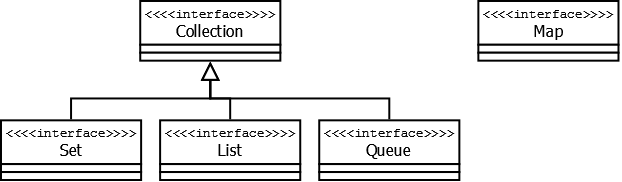
Collection — этот интерфейс находится в составе JDK c версии 1.2 и определяет основные методы работы с простыми наборами элементов, которые будут общими для всех его реализаций (например size() , isEmpty() , add(E e) и др.). Интерфейс был слегка доработан с приходом дженериков в Java 1.5. Также, в версии Java 8, было добавлено несколько новых методов для работы с лямбдами (такие как stream() , parallelStream() , removeIf(Predicate<? super E> filter) и др.).
Важно также отметить, что эти методы были реализованы непосредственно в интерфейсе как default -методы.
Map. Данный интерфейс также находится в составе JDK c версии 1.2 и предоставляет разработчику базовые методы для работы с данными вида «ключ — значение».Также как и Collection , он был дополнен дженериками в версии Java 1.5 и в версии Java 8 появились дополнительные методы для работы с лямбдами, а также методы, которые зачастую реализовались в логике приложения ( getOrDefault(Object key, V defaultValue) , putIfAbsent(K key, V value) ).
Интерфейс Map [doc]

Hashtable — реализация такой структуры данных, как хэш-таблица. Она не позволяет использовать null в качестве значения или ключа. Эта коллекция была реализована раньше, чем Java Collection Framework, но в последствии была включена в его состав. Как и другие коллекции из Java 1.0, Hashtable является синхронизированной (почти все методы помечены как synchronized ). Из-за этой особенности у неё имеются существенные проблемы с производительностью и, начиная с Java 1.2, в большинстве случаев рекомендуется использовать другие реализации интерфейса Map ввиду отсутствия у них синхронизации.
HashMap — коллекция является альтернативой Hashtable . Двумя основными отличиями от Hashtable являются то, что HashMap не синхронизирована и HashMap позволяет использовать null как в качестве ключа, так и значения. Так же как и Hashtable , данная коллекция не является упорядоченной: порядок хранения элементов зависит от хэш-функции. Добавление элемента выполняется за константное время O(1), но время удаления, получения зависит от распределения хэш-функции. В идеале является константным, но может быть и линейным O(n). Более подробную информацию о HashMap можно почитать здесь (актуально для Java < 8).
LinkedHashMap — это упорядоченная реализация хэш-таблицы. Здесь, в отличии от HashMap , порядок итерирования равен порядку добавления элементов. Данная особенность достигается благодаря двунаправленным связям между элементами (аналогично LinkedList ). Но это преимущество имеет также и недостаток — увеличение памяти, которое занимет коллекция. Более подробная информация изложена в этой статье.
TreeMap — реализация Map основанная на красно-чёрных деревьях. Как и LinkedHashMap является упорядоченной. По-умолчанию, коллекция сортируется по ключам с использованием принципа «natural ordering», но это поведение может быть настроено под конкретную задачу при помощи объекта Comparator , который указывается в качестве параметра при создании объекта TreeMap .
WeakHashMap — реализация хэш-таблицы, которая организована с использованием weak references. Другими словами, Garbage Collector автоматически удалит элемент из коллекции при следующей сборке мусора, если на ключ этого элеметна нет жёстких ссылок.
Интерфейс List [doc]
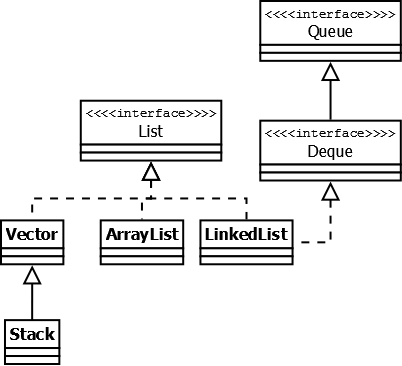
Реализации этого интерфейса представляют собой упорядоченные коллекции. Кроме того, разработчику предоставляется возможность доступа к элементам коллекции по индексу и по значению (так как реализации позволяют хранить дубликаты, результатом поиска по значению будет первое найденное вхождение).
Vector — реализация динамического массива объектов. Позволяет хранить любые данные, включая null в качестве элемента. Vector появился в JDK версии Java 1.0, но как и Hashtable , эту коллекцию не рекомендуется использовать, если не требуется достижения потокобезопасности. Потому как в Vector , в отличии от других реализаций List , все операции с данными являются синхронизированными. В качестве альтернативы часто применяется аналог — ArrayList .
Stack — данная коллекция является расширением коллекции Vector . Была добавлена в Java 1.0 как реализация стека LIFO (last-in-first-out). Является частично синхронизированной коллекцией (кроме метода добавления push() ). После добавления в Java 1.6 интерфейса Deque , рекомендуется использовать именно реализации этого интерфейса, например ArrayDeque .
ArrayList — как и Vector является реализацией динамического массива объектов. Позволяет хранить любые данные, включая null в качестве элемента. Как можно догадаться из названия, его реализация основана на обычном массиве. Данную реализацию следует применять, если в процессе работы с коллекцией предплагается частое обращение к элементам по индексу. Из-за особенностей реализации поиндексное обращение к элементам выполняется за константное время O(1). Но данную коллекцию рекомендуется избегать, если требуется частое удаление/добавление элементов в середину коллекции. Подробный анализ и описание можно почитать в этом хабратопике.
LinkedList — ещё одна реализация List . Позволяет хранить любые данные, включая null . Особенностью реализации данной коллекции является то, что в её основе лежит двунаправленный связный список (каждый элемент имеет ссылку на предыдущий и следующий). Благодаря этому, добавление и удаление из середины, доступ по индексу, значению происходит за линейное время O(n), а из начала и конца за константное O(1). Так же, ввиду реализации, данную коллекцию можно использовать как стек или очередь. Для этого в ней реализованы соответствующие методы. На Хабре также есть статья с подробным анализом и описанием этой коллекции.
Интерфейс Set [doc]
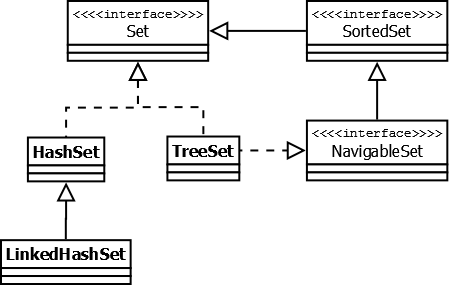
Представляет собой неупорядоченную коллекцию, которая не может содержать дублирующиеся данные. Является программной моделью математического понятия «множество».
HashSet — реализация интерфейса Set , базирующаяся на HashMap . Внутри использует объект HashMap для хранения данных. В качестве ключа используется добавляемый элемент, а в качестве значения — объект-пустышка (new Object()). Из-за особенностей реализации порядок элементов не гарантируется при добавлении.
LinkedHashSet — отличается от HashSet только тем, что в основе лежит LinkedHashMap вместо HashMap . Благодаря этому отличию порядок элементов при обходе коллекции является идентичным порядку добавления элементов.
TreeSet — аналогично другим классам-реализациям интерфейса Set содержит в себе объект NavigableMap , что и обуславливает его поведение. Предоставляет возможность управлять порядком элементов в коллекции при помощи объекта Comparator , либо сохраняет элементы с использованием «natural ordering».
Интерфейс Queue [doc]
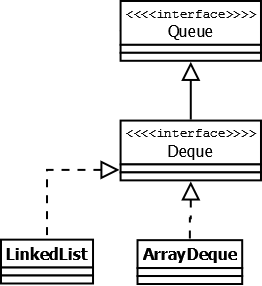
Этот интерфейс описывает коллекции с предопределённым способом вставки и извлечения элементов, а именно — очереди FIFO (first-in-first-out). Помимо методов, определённых в интерфейсе Collection, определяет дополнительные методы для извлечения и добавления элементов в очередь. Большинство реализаций данного интерфейса находится в пакете java.util.concurrent и подробно рассматриваются в данном обзоре.
PriorityQueue — является единственной прямой реализацией интерфейса Queue (была добавлена, как и интерфейс Queue, в Java 1.5), не считая класса LinkedList , который так же реализует этот интерфейс, но был реализован намного раньше. Особенностью данной очереди является возможность управления порядком элементов. По-умолчанию, элементы сортируются с использованием «natural ordering», но это поведение может быть переопределено при помощи объекта Comparator , который задаётся при создании очереди. Данная коллекция не поддерживает null в качестве элементов.
ArrayDeque — реализация интерфейса Deque, который расширяет интерфейс Queue методами, позволяющими реализовать конструкцию вида LIFO (last-in-first-out). Интерфейс Deque и реализация ArrayDeque были добавлены в Java 1.6. Эта коллекция представляет собой реализацию с использованием массивов, подобно ArrayList , но не позволяет обращаться к элементам по индексу и хранение null . Как заявлено в документации, коллекция работает быстрее чем Stack , если используется как LIFO коллекция, а также быстрее чем LinkedList, если используется как FIFO.
Заключение
Java Collections Framework содержит большое количество различных структур данных, доступных в JDK «из коробки», которые в большинстве случаев покрывают все потребности при реализации логики приложения. Сравнение временных характеристик основных коллекций, которые зачастую используются в разработке приложений приведено в таблице:
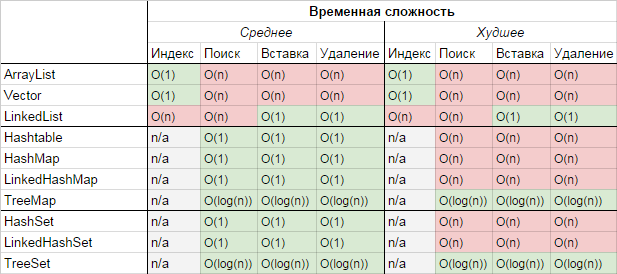
При необходимости, разработчик может создать собственную реализацию, расширив или переопределив существующую логику, либо создав свою собственную реализацию подходящего интерфейса с нуля. Также существует некоторое количество готовых решений, которые являются альтернативой или дополнением к Java Collections Framework. Наиболее популярными являются Google Guava и Commons Collections.
Для чего нужны коллекции в java
Let us see the hierarchy of Collection framework. The java.util package contains all the classes and interfaces for the Collection framework.
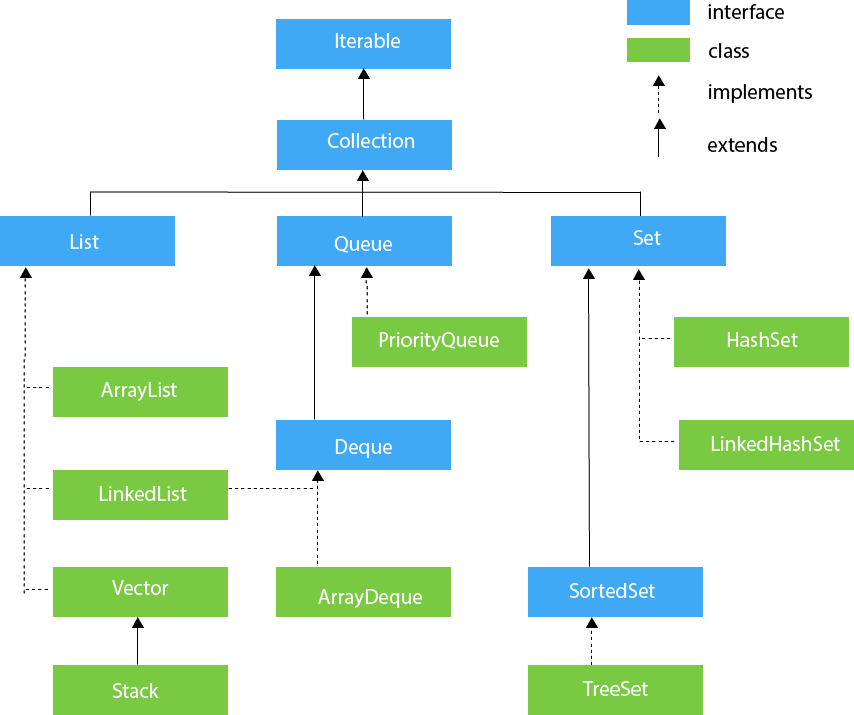
Methods of Collection interface
There are many methods declared in the Collection interface. They are as follows:
| No. | Method | Description |
|---|---|---|
| 1 | public boolean add(E e) | It is used to insert an element in this collection. |
| 2 | public boolean addAll(Collection<? extends E> c) | It is used to insert the specified collection elements in the invoking collection. |
| 3 | public boolean remove(Object element) | It is used to delete an element from the collection. |
| 4 | public boolean removeAll(Collection<?> c) | It is used to delete all the elements of the specified collection from the invoking collection. |
| 5 | default boolean removeIf(Predicate<? super E> filter) | It is used to delete all the elements of the collection that satisfy the specified predicate. |
| 6 | public boolean retainAll(Collection<?> c) | It is used to delete all the elements of invoking collection except the specified collection. |
| 7 | public int size() | It returns the total number of elements in the collection. |
| 8 | public void clear() | It removes the total number of elements from the collection. |
| 9 | public boolean contains(Object element) | It is used to search an element. |
| 10 | public boolean containsAll(Collection<?> c) | It is used to search the specified collection in the collection. |
| 11 | public Iterator iterator() | It returns an iterator. |
| 12 | public Object[] toArray() | It converts collection into array. |
| 13 | public <T> T[] toArray(T[] a) | It converts collection into array. Here, the runtime type of the returned array is that of the specified array. |
| 14 | public boolean isEmpty() | It checks if collection is empty. |
| 15 | default Stream<E> parallelStream() | It returns a possibly parallel Stream with the collection as its source. |
| 16 | default Stream<E> stream() | It returns a sequential Stream with the collection as its source. |
| 17 | default Spliterator<E> spliterator() | It generates a Spliterator over the specified elements in the collection. |
| 18 | public boolean equals(Object element) | It matches two collections. |
| 19 | public int hashCode() | It returns the hash code number of the collection. |
Iterator interface
| Iterator interface provides the facility of iterating the elements in a forward direction only. |
Methods of Iterator interface
There are only three methods in the Iterator interface. They are:
| No. | Method | Description |
|---|---|---|
| 1 | public boolean hasNext() | It returns true if the iterator has more elements otherwise it returns false. |
| 2 | public Object next() | It returns the element and moves the cursor pointer to the next element. |
| 3 | public void remove() | It removes the last elements returned by the iterator. It is less used. |
Iterable Interface
The Iterable interface is the root interface for all the collection classes. The Collection interface extends the Iterable interface and therefore all the subclasses of Collection interface also implement the Iterable interface.
It contains only one abstract method. i.e.,
It returns the iterator over the elements of type T.
Collection Interface
The Collection interface is the interface which is implemented by all the classes in the collection framework. It declares the methods that every collection will have. In other words, we can say that the Collection interface builds the foundation on which the collection framework depends.
Some of the methods of Collection interface are Boolean add ( Object obj), Boolean addAll ( Collection c), void clear(), etc. which are implemented by all the subclasses of Collection interface.
List Interface
List interface is the child interface of Collection interface. It inhibits a list type data structure in which we can store the ordered collection of objects. It can have duplicate values.
List interface is implemented by the classes ArrayList, LinkedList, Vector, and Stack.
To instantiate the List interface, we must use :
There are various methods in List interface that can be used to insert, delete, and access the elements from the list.
The classes that implement the List interface are given below.
ArrayList
The ArrayList class implements the List interface. It uses a dynamic array to store the duplicate element of different data types. The ArrayList class maintains the insertion order and is non-synchronized. The elements stored in the ArrayList class can be randomly accessed. Consider the following example.
LinkedList
LinkedList implements the Collection interface. It uses a doubly linked list internally to store the elements. It can store the duplicate elements. It maintains the insertion order and is not synchronized. In LinkedList, the manipulation is fast because no shifting is required.
Consider the following example.
Vector
Vector uses a dynamic array to store the data elements. It is similar to ArrayList. However, It is synchronized and contains many methods that are not the part of Collection framework.
Consider the following example.
Stack
The stack is the subclass of Vector. It implements the last-in-first-out data structure, i.e., Stack. The stack contains all of the methods of Vector class and also provides its methods like boolean push(), boolean peek(), boolean push(object o), which defines its properties.
Consider the following example.
Queue Interface
Queue interface maintains the first-in-first-out order. It can be defined as an ordered list that is used to hold the elements which are about to be processed. There are various classes like PriorityQueue, Deque, and ArrayDeque which implements the Queue interface.
Queue interface can be instantiated as:
There are various classes that implement the Queue interface, some of them are given below.
PriorityQueue
The PriorityQueue class implements the Queue interface. It holds the elements or objects which are to be processed by their priorities. PriorityQueue doesn't allow null values to be stored in the queue.
Consider the following example.
Deque Interface
Deque interface extends the Queue interface. In Deque, we can remove and add the elements from both the side. Deque stands for a double-ended queue which enables us to perform the operations at both the ends.
Deque can be instantiated as:
ArrayDeque
ArrayDeque class implements the Deque interface. It facilitates us to use the Deque. Unlike queue, we can add or delete the elements from both the ends.
ArrayDeque is faster than ArrayList and Stack and has no capacity restrictions.
Consider the following example.
Set Interface
Set Interface in Java is present in java.util package. It extends the Collection interface. It represents the unordered set of elements which doesn't allow us to store the duplicate items. We can store at most one null value in Set. Set is implemented by HashSet, LinkedHashSet, and TreeSet.
Set can be instantiated as:
HashSet
HashSet class implements Set Interface. It represents the collection that uses a hash table for storage. Hashing is used to store the elements in the HashSet. It contains unique items.
Consider the following example.
LinkedHashSet
LinkedHashSet class represents the LinkedList implementation of Set Interface. It extends the HashSet class and implements Set interface. Like HashSet, It also contains unique elements. It maintains the insertion order and permits null elements.
Consider the following example.
SortedSet Interface
SortedSet is the alternate of Set interface that provides a total ordering on its elements. The elements of the SortedSet are arranged in the increasing (ascending) order. The SortedSet provides the additional methods that inhibit the natural ordering of the elements.
The SortedSet can be instantiated as:
TreeSet
Java TreeSet class implements the Set interface that uses a tree for storage. Like HashSet, TreeSet also contains unique elements. However, the access and retrieval time of TreeSet is quite fast. The elements in TreeSet stored in ascending order.